New Orleans Gutter Installation
6-Inch K-Style + Hurricane-Rated Hangers for Tropical-System Rain
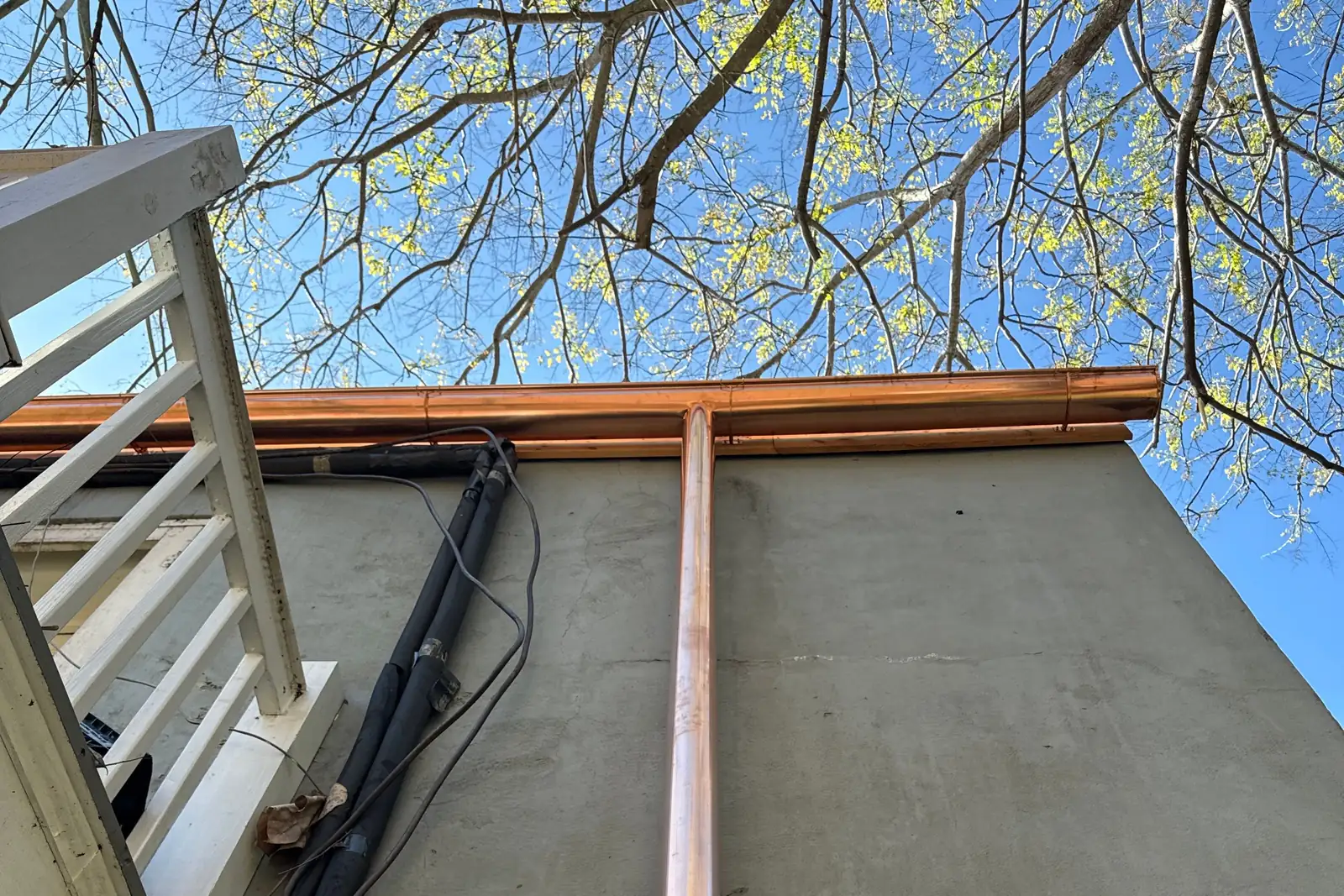
NOLA rainfall and hurricane wind both push gutter spec. We default to 6-inch K-style aluminum with 3x4 downspouts, hidden hangers at hurricane-zone spacing (24-inch maximum), and salt-aware fastener selection. Copper half-round is a worthwhile upgrade for historic Garden District and Uptown homes.
Prefer to book online? Schedule your free New Orleans estimate
Schedule Your FREE
Roof Inspection & Estimate
Request a written estimate
Where is your property?
We serve Texas, Louisiana & Missouri
What do you need?
Almost done!
How can we reach you?
By submitting, you consent to follow-up messages. Reply STOP to opt out.
Sources we use
Check the scope against current guidance
Official sources reviewed September 7, 2026, plus a planning tool for comparing the decisions in your estimate.
NOLA Ready
Hurricane property preparation
Reviewed September 7, 2026. Clear private gutters and downspouts; report clogged public catch basins to 311.
Read the official guidance →New Orleans HDLC
Historic exterior-work application process
Reviewed September 7, 2026. Identify the district and itemize existing and proposed exterior materials with photos before work.
Read the official guidance →What gutters are best for New Orleans?
For most NOLA homes we recommend 6-inch K-style aluminum with 3x4 downspouts and hidden hangers at hurricane-zone spacing (24-inch maximum). NOLA tropical-system rainfall events routinely deliver intense bursts that overwhelm undersized 5-inch systems. For historic homes in Garden District and Uptown, half-round copper is a strong upgrade — salt-resistant, 50+ year service life, and aesthetically appropriate for the architecture.
- 6-inch K-style standard for NOLA homes
- 3x4 downspouts handle tropical-system events
- Hurricane-rated hidden hangers (24-inch max spacing)
- Stainless or hot-dip galvanized fasteners coastal-adjacent
- Copper half-round for historic homes
How NOLA Conditions Drive Gutter Specs
Hurricane Wind, Tropical Rainfall, Salt, Termite, Live Oak
NOLA combines hurricane wind events, frequent tropical rainfall, salt-air exposure, year-round termite pressure, and significant live oak debris in older neighborhoods.
Tropical-System Rainfall Intensity
Impact: NOLA frequently sees tropical-system rainfall events that drop 4-6+ inches in short periods. Undersized gutters overflow and dump water at the foundation; insufficient downspout capacity causes back-up and overflow.
Our Solution: 6-inch K-style with 3x4 downspouts standard. Multiple intermediate downspouts on long runs. Sizing per actual NOLA rainfall data, not the 4 in/hr SMACNA reference.
Hurricane Wind Tearing Off Gutters
Impact: Hurricane Ida (2021) and Hurricane Katrina (2005) both demonstrated extensive gutter loss patterns when hidden hangers were spaced too widely or face-screwed only.
Our Solution: Hidden hangers at 24-inch maximum spacing (vs typical 24-32 in non-hurricane areas). Screw fastening through fascia into rafter tail or sub-fascia. Closer spacing on corners and long runs.
Salt Air Corrosion (Lake-Adjacent and Downriver)
Impact: Lake Pontchartrain-adjacent and downriver homes see real salt corrosion on standard galvanized fasteners and aluminum gutters within years rather than decades.
Our Solution: Stainless steel or hot-dip galvanized fasteners on coastal-adjacent installs. Copper gutters as a premium upgrade — copper develops a verdigris patina but does not corrode like aluminum in chronic salt exposure.
Live Oak and Cypress Debris
Impact: Garden District, Uptown, and other older neighborhoods have mature live oak and cypress canopy that drops fine debris year-round. Spanish moss adds to the mix on some trees.
Our Solution: Micromesh gutter guards (200-275 micron stainless steel) handle the local debris pattern best. Reverse-curve guards struggle with seed pods, Spanish moss, and very fine debris.
Fascia Termite Damage
Impact: NOLA termites attack wood fascia behind gutters. Tear-off frequently reveals fascia damage that needs repair before new gutters can be hung.
Our Solution: Fascia inspection during the bid walk. Replacement scope included where damage is found. Composite or Hardie trim alternatives for termite-resistant fascia replacement.
NOLA Gutter Considerations by Area
Live oak canopy, salt exposure, and historic district status vary significantly:
Garden District + Uptown
Mature live oak canopy, historic homes with copper or original aluminum gutters, Spanish moss in older trees.
6-inch K-style copper half-round preferred for historic homes; aluminum acceptable. Micromesh guards essential for live oak and Spanish moss debris.
French Quarter + Faubourg Marigny
Historic-protected. Some homes have integrated drainage or scupper systems rather than conventional gutters.
District approval may apply for visible gutter installations. Copper is the appropriate material aesthetically.
Lakeview + Lakefront
Post-Katrina rebuilds. Less canopy than older neighborhoods. Significant lake-adjacent salt exposure.
6-inch K-style aluminum with stainless fasteners. Hurricane-rated hangers. Foundation drainage important on post-Katrina rebuild homes built to current elevation requirements.
Mid-City + Bywater
Mix of older homes with mature canopy and newer infill construction.
6-inch K-style aluminum with 3x4 downspouts. Micromesh guards under heavy canopy. Termite-aware fascia replacement common.
New Orleans Gutter Installation Cost Ranges
NOLA gutter pricing reflects 6-inch K-style as standard plus hurricane-rated install detail and salt-aware spec for lake-adjacent homes:
6" K-style aluminum, .032 gauge, 3x4 downspouts
Standard tier per LF
Default NOLA residential spec.
6" half-round copper
Premium tier per LF
3-5x aluminum cost. Salt-resistant, ideal for historic and lake-adjacent.
Hurricane-rated hanger spacing add
Modest add per LF
Tighter 24" max spacing.
Coarse-mesh or screen guards
Modest add per LF
Budget-tier debris management.
Micromesh guards (LeafFilter, MasterShield)
Significant add per LF
Filters live oak and Spanish moss debris. Lifetime transferable warranty.
Stainless fastener upgrade
Modest add per LF
Required for chronic lake-adjacent or downriver salt exposure.
Fascia replacement (termite damage)
Variable per LF
Common scope add when termite damage discovered at tear-off.
Factors Affecting Price
- 1Total linear footage and downspout count
- 2Material (aluminum standard, copper premium)
- 3Salt-air exposure (drives fastener and material spec)
- 4Live oak canopy density (drives guard selection)
- 5Historic district status
- 6Termite damage scope at fascia
Ranges represent typical NOLA contractor pricing for residential gutters as of mid-2026. Historic homes and homes with significant termite-damaged fascia run higher than baseline.
Our New Orleans Gutter Installation Process
NOLA install priorities: 6-inch capacity for tropical rainfall, hurricane-rated hanger spacing, salt-aware fasteners, termite-aware fascia repair.
Site Walk and Sizing
Drainage area calculation per elevation, downspout discharge planning, fascia condition check (termite damage frequently discovered).
Existing Gutter Removal
Old gutters and hangers removed without further damaging fascia. Termite damage assessed and repair scope confirmed.
Fascia Repair (If Needed)
Termite-damaged or rotted fascia replaced before new gutters go up. Hardie or composite trim for termite-resistant replacement.
On-Site Seamless Forming
Color-matched .032 aluminum coil fed through portable forming machine. Continuous gutter formed to exact length per run.
Hurricane-Rated Hanger Layout
Hidden hangers at 24-inch maximum spacing. Screw fastening through fascia into rafter tail or sub-fascia.
Local Note: For lake-adjacent and downriver homes, stainless or hot-dip galvanized fasteners only.
End Caps, Miters, Outlets
Inside and outside corners formed and sealed. 3x4 downspout outlets cut and crimped.
Downspouts and Discharge
Downspouts hung plumb, secured every 6-8 feet. Discharge configured 4-6 feet from foundation minimum.
Gutter Guard Install (If Selected)
Micromesh, reverse-curve, or screen guards per manufacturer instructions.
Water Test and Walk
Hose test at multiple points. Photo documentation. Manufacturer warranty registration.
Recommended Gutter Specs for New Orleans
NOLA standard: 6-inch K-style aluminum with 3x4 downspouts. Material upgrades for historic and lake-adjacent applications:
6" K-Style Aluminum, .032 Gauge, 3x4 Downspouts
Why for New Orleans
Sized for tropical-system rainfall. .032 gauge resists hail dents and hurricane wind uplift. Standard NOLA residential spec.
Best For
Mid-City, Bywater, post-Katrina rebuilds outside lake-adjacent salt zones.
Considerations
Visual scale larger than 5-inch. Standard galvanized fasteners adequate for inner-NOLA away from chronic salt.
6" Half-Round Copper
Why for New Orleans
Salt-resistant for lake-adjacent and downriver installs. Develops verdigris patina; ages well alongside historic architecture. 50+ year service life.
Best For
Garden District, Uptown, historic-protected homes, lake-adjacent and downriver homes with chronic salt exposure.
Considerations
3-5x aluminum cost. Patina develops over years; some homeowners prefer rapid-patina pre-treatment options.
Micromesh Gutter Guards
Why for New Orleans
Live oak, cypress, and Spanish moss debris common in older NOLA neighborhoods. Micromesh handles all three; reverse-curve struggles with Spanish moss and seed pods.
Best For
Garden District, Uptown, Mid-City, and other live-oak-heavy neighborhoods.
Considerations
Higher install cost than coarse-mesh or screen guards. Lifetime transferable warranties offset upfront cost over time.
Why Hire Lapeyre for New Orleans Gutters
NOLA gutters need hurricane-rated install detail, salt-aware fastener spec, termite-aware fascia repair, and coordination with broader exterior projects.
Hurricane-Rated Install Detail
Hidden hangers at 24-inch max spacing, screw fastening into rafter tail. Tropical-system wind events tear off poorly-installed gutters consistently.
Sized to Actual NOLA Rainfall
NOAA Atlas 14 and SMACNA tables applied. 6-inch K-style with 3x4 downspouts as the residential default.
Salt-Aware Fastener Spec
Stainless or hot-dip galvanized for lake-adjacent and downriver homes. Standard galvanized fails fast in chronic salt exposure.
Termite-Aware Fascia Repair
Fascia inspection during bid walk; termite-resistant trim replacement (Hardie or composite) where damage found.
Historic District Coordination
For protected and significant homes, copper and matched-profile installations coordinated with appropriate approval bodies.
Keep the roof-edge system connected to a workable discharge plan
Begin with roof geometry and existing water behavior. Identify which sections feed each gutter, where valleys concentrate runoff, where water currently overtops, and whether fascia or attachment points need repair. Ask for a drawing or marked photos showing downspout locations. A quotation based only on gutter length leaves the outlets and downstream route unresolved, even though those details determine where the collected water goes.
NOLA Ready recommends clearing gutters and downspouts and reporting clogged catch basins to 311. Treat private roof drainage and street drainage as different systems: a gutter contractor should identify the proposed discharge path, while a public catch-basin problem follows the City's reporting route. Do not assume new gutters will solve water backing up elsewhere or that directing water toward a neighboring building is acceptable. Check the site's restrictions before changing visible or connected drainage components.
Compare profile, material, corners, outlets, hangers, downspouts, fascia repairs, removal, and disposal in each bid. For a historic property, confirm review of visible changes before ordering. If guards are proposed, ask how they are cleaned and how the outlets can be accessed. At completion, review runoff routing and any remaining limitations. If financing the work, compare the actual amount, APR, and term; the payment calculator supplies arithmetic, not a gutter price estimate.
Compare your options before signing
Compare roof financing payments
Enter the actual financed amount, APR, and term to compare monthly payments and total repayment.
Read more about this roofing decision
Gutter Sizing Guide: SMACNA Examples
Most residential gutter overflow problems are sizing problems, not material problems. Here is how SMACNA actually sizes K-style gutters and downspouts — with worked examples for the four metros we work in.
Gutter Guards Compared: LeafFilter vs LeafGuard
Four major gutter guard categories (micromesh, reverse-curve, screen, foam) handle four different debris patterns. Here is which guard actually works for your trees and climate.
FAQ
Frequently Asked Questions
Will larger gutters fix every overflow problem?
No. Ask whether the cause is debris, an outlet, pitch, concentrated runoff, or the discharge path. The proposed size should follow that diagnosis rather than replace it.
What should I do about a clogged street catch basin?
NOLA Ready directs residents to report clogged catch basins to 311. Keep that public drainage issue separate from the inspection and maintenance of private gutters and downspouts.
Why 6-inch gutters in New Orleans?
NOLA tropical-system rainfall events routinely deliver intense bursts that overwhelm undersized 5-inch systems. 6-inch K-style with 3x4 downspouts increases capacity by roughly 67% per linear foot of gutter and approximately 75% more downspout cross-sectional area. For most NOLA homes, this is the right capacity for actual local rainfall.
Do my NOLA gutters need hurricane-rated install?
Yes — hidden hangers at 24-inch maximum spacing and screw fastening through the fascia into the rafter tail or sub-fascia. Hurricane Ida and Hurricane Katrina both demonstrated extensive gutter loss patterns when hangers were spaced too widely. Tighter hanger spacing is one of the cheapest upgrades providing the largest hurricane-resistance benefit.
When do I need stainless steel fasteners?
For Lake Pontchartrain-adjacent and downriver homes with chronic salt exposure, yes. Standard galvanized fasteners corrode within years in salt air. Hot-dip galvanized is acceptable for moderate exposure; stainless steel for severe exposure. Inner-NOLA homes away from the lake have moderate exposure and hot-dip galvanized is typically adequate.
Are copper gutters worth it for Garden District homes?
Often yes. Copper has a 50+ year service life, develops a green verdigris patina that ages alongside historic architecture, and resists salt corrosion. The cost premium is significant — typically 3 to 5 times equivalent aluminum K-style. For homes in protected districts and architecturally significant properties, copper is often the appropriate material aesthetically.
Which gutter guards work best in NOLA?
For homes under live oak, cypress, or with Spanish moss-bearing trees — common in Garden District, Uptown, and Mid-City — micromesh guards with 200-275 micron stainless steel mesh work best. Spanish moss, live oak debris, and seed pods all defeat reverse-curve guards. Micromesh handles the local debris pattern better than any other guard type.
How long does NOLA gutter installation take?
Most installs complete in 1-2 working days. Seamless forming happens on-site. Fascia repair (when needed for termite or rot damage) is the main schedule variable. Hurricane-season weather windows add scheduling unpredictability — we plan around tropical-system tracks.
What about the LDI Fortify Homes Program?
The Louisiana Fortify Homes Program (LFHP), administered by the Louisiana Department of Insurance, offers grants of up to $10,000 toward FORTIFIED Roof installations on a lottery basis. The grant focuses on the roof, not gutters directly. However, properly-installed gutters integrate with the FORTIFIED Roof drip edge and ice/water shield, and we coordinate the gutter scope with FORTIFIED Roof projects when both are part of the same job.
Will hurricane gutter damage be covered by insurance?
Yes — wind, hurricane wind, and hail damage to gutters are typically covered perils on Louisiana homeowners policies. We document gutter damage with the same photo-by-elevation approach we use for roofs and include it in the storm scope. Pulled-off gutters, creased downspouts, and hail-dent damage are consistently covered when the storm event is documented for the broader claim.
How does termite damage affect gutter installation?
NOLA termites attack wood fascia behind gutters. Tear-off frequently reveals termite damage that needs repair before new gutters can be hung. We inspect fascia condition during the bid walk and budget for replacement scope when damage is likely. Hardie or composite trim alternatives provide termite-resistant fascia replacement.
Do I need heat tape on NOLA gutters?
No. NOLA does not have a chronic ice damming problem. Heat tape is a real consideration in St. Louis where freeze-thaw and ice dams are routine, but it is not standard spec for NOLA homes.
Contact information
Thank you for considering us for roofing needs. We will get back to you during normal business hours.


Send us a message