Materials Guide
Gutter Guards Compared: LeafFilter vs LeafGuard
Four major gutter guard categories (micromesh, reverse-curve, screen, foam) handle four different debris patterns. Here is which guard actually works for your trees and climate.
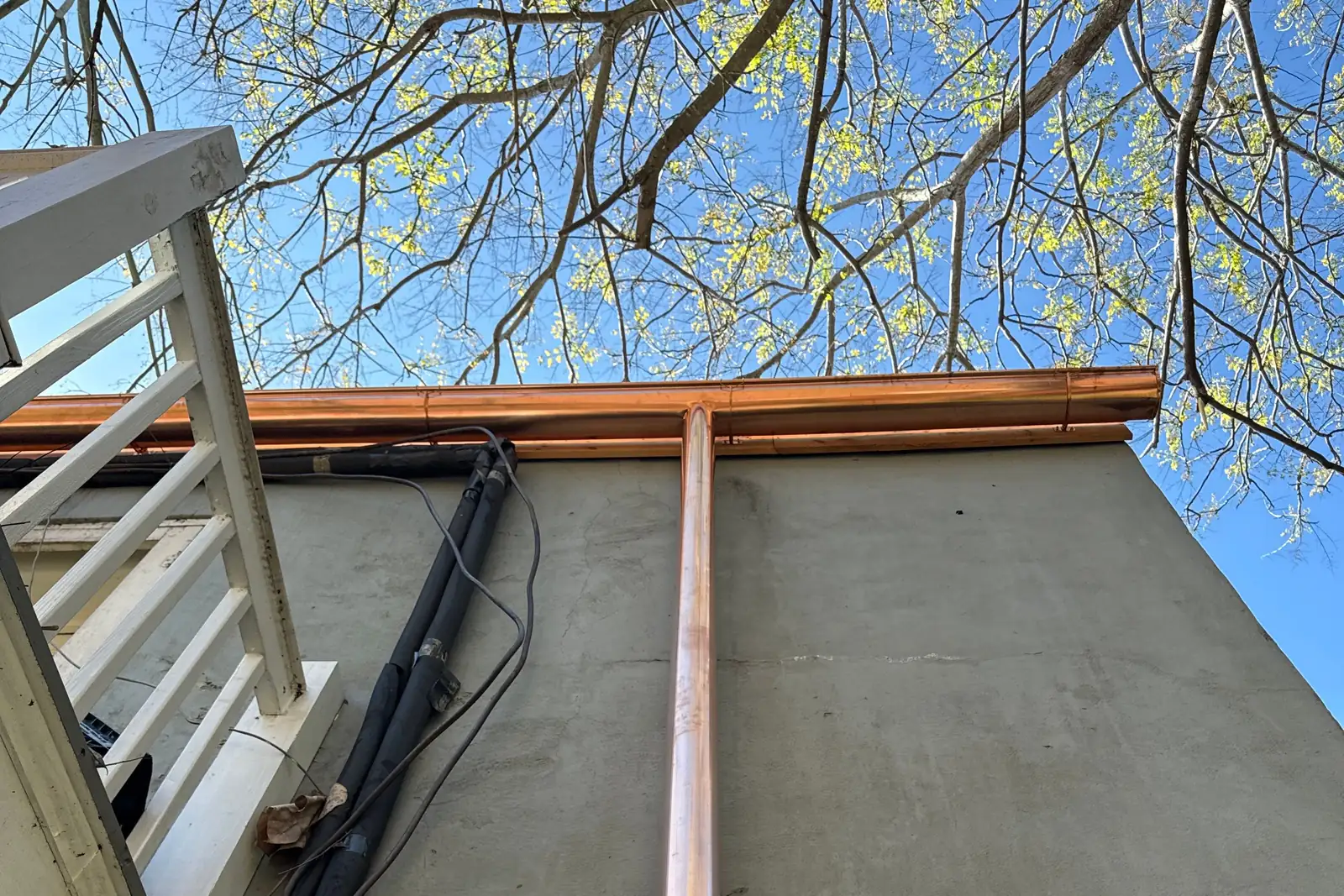
A gutter that overflows once a season was sized wrong. We sit down with the roof plan, the local rainfall numbers, and the slope, then install seamless aluminum or copper to the right capacity.
We partner with multiple lenders to offer financing for all credit levels. A soft credit pull checks your options without affecting your score.
Pay off your project within 18 months with zero interest.
Spread your project cost over up to 20 years for the lowest monthly payment.
Our multi-lender platform finds options where single-bank programs turn people away.
Subject to credit approval. Terms and conditions apply. Contact us for details.
Get answers to common questions about our gutter installation services.
It comes down to drainage area and rainfall intensity. SMACNA tables show a 5" K-style gutter handles roughly 5,520 sq ft of drainage area at 4 in/hr rainfall, while a 6" K-style handles about 7,960 sq ft. In Houston and New Orleans, where short-duration rainfall intensity routinely exceeds that benchmark, we usually recommend 6" with 3x4 downspouts. In Austin and St. Louis, 5" is fine for most homes. We size to your specific roof.
Seamless gutters are formed on-site from a continuous coil to match your roof length. Fewer joints means fewer failure points. Sectional gutters have a seam every 10 feet, and most leaks develop at those seams over time. Seamless also offers a cleaner appearance and typically lasts longer with less maintenance.
If you have oaks, pines, maples, or any leaf-shedding tree within fall distance of the roof, yes. Guards keep the system flowing and reduce cleanouts to roughly once a year. The right guard depends on debris type. Micromesh handles fine debris like pine needles and shingle granules well. Reverse-curve guards handle larger leaves but can struggle with conifers. We pick based on what is actually landing in your gutter.
Without guards, twice a year as a minimum: late spring after pollen and seed drop, and late fall after leaves come down. After any major storm, do a quick visual check for clogs at downspouts. With quality guards, you can usually drop to one annual inspection plus spot checks after storms.
Find location-specific gutter installation information, pricing, and project details for your city.
Materials Guide
Four major gutter guard categories (micromesh, reverse-curve, screen, foam) handle four different debris patterns. Here is which guard actually works for your trees and climate.
Materials Guide
Most residential gutter overflow problems are sizing problems, not material problems. Here is how SMACNA actually sizes K-style gutters and downspouts — with worked examples for the four metros we work in.
Contact us today for a free inspection and estimate for your gutter installation project.