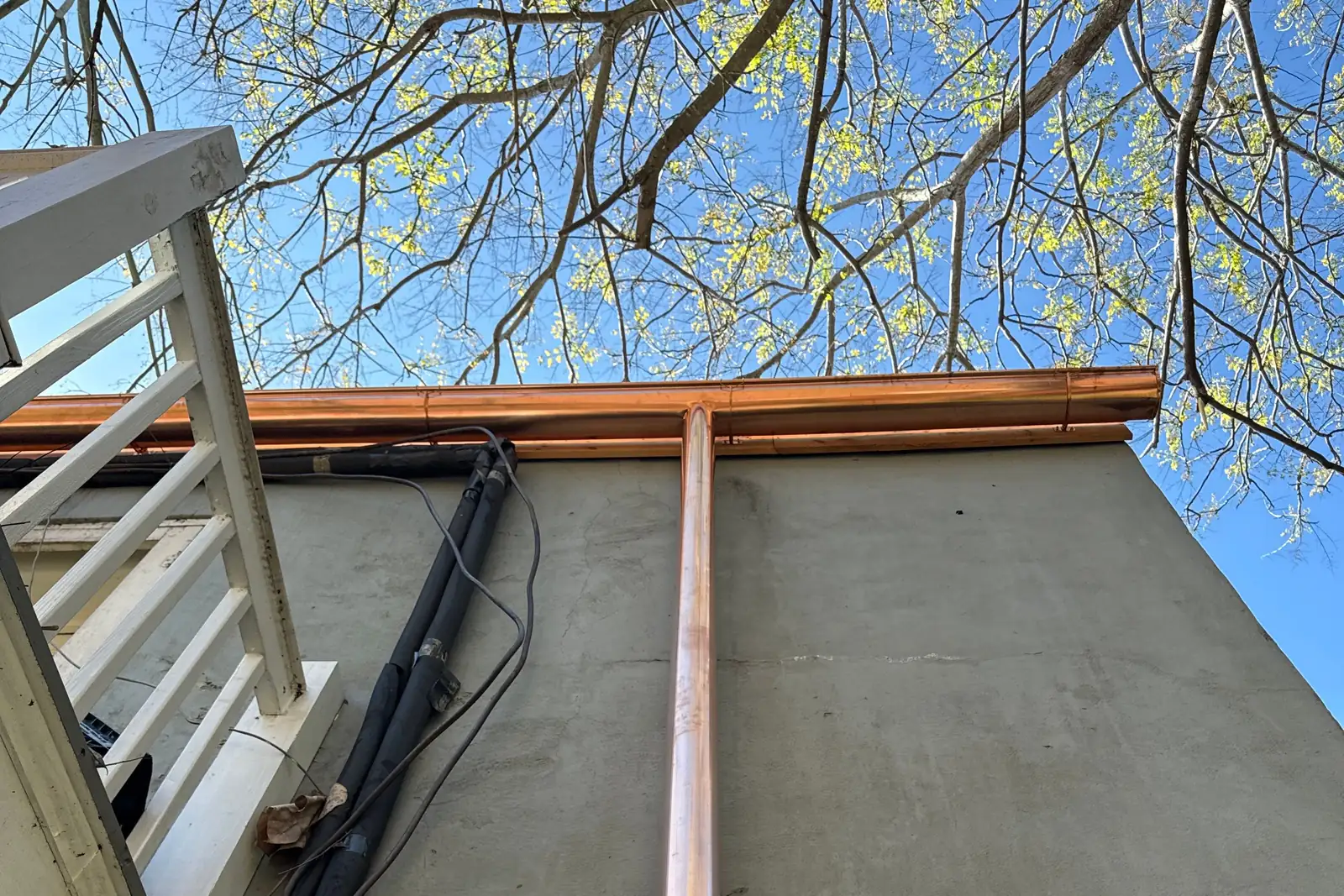
St. Louis Gutter Installation
Seamless K-Style with Ice-Dam Awareness and Snow-Load Spacing
St. Louis gutters live in a different climate from our southern markets. The dominant failure modes are ice damming at the eaves, freeze-thaw stress on aluminum, hail damage, and snow-load uplift. We install seamless aluminum K-style with hidden hangers spaced for snow load, heat-tape options for chronic ice-dam homes, and micromesh guards where the local debris pattern demands them.
Prefer to book online? Schedule your free St. Louis estimate
Schedule Your FREE
Roof Inspection & Estimate
Request a written estimate
Where is your property?
We serve Texas, Louisiana & Missouri
What do you need?
Almost done!
How can we reach you?
By submitting, you consent to follow-up messages. Reply STOP to opt out.
Sources we use
Check the scope against current guidance
Official sources reviewed September 7, 2026, plus a planning tool for comparing the decisions in your estimate.
MSD Project Clear
Protect homes and property during storms
Reviewed September 7, 2026. Keep gutters and outlets clear and direct runoff away from the building.
Read the official guidance →City of St. Louis
City residential permit criteria
Reviewed September 7, 2026. Distinguishes like-material roof work and sheathing extent; historic properties require separate attention. City guidance does not establish suburban requirements.
Read the official guidance →What gutters work best for St. Louis?
5-inch K-style aluminum is adequate for most St. Louis homes; 6-inch for larger drainage areas or homes with chronic overflow. .032 gauge aluminum standard. The bigger St. Louis-specific spec issues are ice damming (which can require heat tape on north-facing eaves with chronic problems), snow-load on hidden hangers (we space at 24-inch maximum on north-facing eaves), and freeze-thaw expansion stress on aluminum. Hurricane wind and salt corrosion are not factors.
- 5-inch K-style standard for most St. Louis homes
- Hidden hangers at 24-inch max on north-facing eaves
- Heat tape recommended for chronic ice-dam homes
- .032 gauge aluminum standard
- NO hurricane content; NO salt corrosion content; NO FORTIFIED grant
How St. Louis Conditions Drive Gutter Specs
Hail, Freeze-Thaw, Ice Dams, Snow Load — Not Hurricane
St. Louis combines hail belt conditions with cold-climate freeze-thaw, ice damming, and snow-load considerations. Hurricane wind and salt corrosion are not factors here.
Hail Damage to Gutters
Impact: St. Louis hail belt conditions damage gutters routinely. Aluminum gutters dent on impact; severe events crease gutters and break hangers. Hail damage is consistently claimable when documented.
Our Solution: .032 gauge aluminum (heavier than .027) holds up better than thinner gauge. Copper is hail-resistant but expensive. We document hail damage with the same photo-by-elevation approach we use for roof claims.
Ice Damming at North-Facing Eaves
Impact: Inadequate attic insulation and ventilation drive ice dam formation. Where the dam forms in the gutter, water can back up under shingles and into the wall behind the gutter. Heavy ice load can also pull the gutter off the fascia.
Our Solution: For chronic ice-dam homes, heat tape (heating cable) in the gutter and downspout keeps the drainage path open during freeze-thaw cycles. This is not a substitute for proper attic insulation and ventilation (which is the actual fix), but it mitigates symptoms while attic work is planned. Tighter hidden hanger spacing (24-inch max) on north-facing eaves resists snow-load uplift.
Freeze-Thaw Expansion Stress
Impact: Aluminum expands and contracts more than the underlying fascia material across St. Louis temperature swings. Inadequate fastening leads to creep and progressive separation from the fascia.
Our Solution: Hidden hangers screw-fastened through fascia into rafter tail or sub-fascia. Standard residential 24-32 inch spacing in non-snow-load areas; tighter 24-inch max on north-facing eaves and corners.
Spring Storm and Hail Season Debris
Impact: Maple, oak, and other deciduous canopy in older St. Louis neighborhoods drops significant fall debris. Ice and freeze-thaw can complicate cleaning during winter and early spring.
Our Solution: Micromesh gutter guards (200-275 micron stainless steel) handle fine debris and reduce winter cleanout requirements. Some micromesh systems advertise improved ice/snow performance — we verify on the actual product spec.
No Hurricane, No Salt Air
Impact: St. Louis does not face hurricane wind, gulf-coast salt corrosion, or coastal-rated hidden hanger spacing requirements.
Our Solution: Standard residential hanger spacing (24-32 inches) is adequate in non-snow-load areas. Standard galvanized fasteners are fine — no salt-resistance requirement.
St. Louis Gutter Considerations by Area
Architecture, age, and tree canopy vary across the metro:
Central West End + Forest Park-Adjacent
Historic homes, often with brick primary cladding and integrated drainage. Mature canopy.
Copper half-round is aesthetically appropriate and provides 50+ year service life. Micromesh guards essential under heavy canopy.
Webster Groves + Kirkwood
Older homes from various eras, mature canopy, often with chronic ice-dam issues on north elevations.
Heat tape upgrade common for chronic-ice-dam homes. Fascia inspection and replacement frequently needed. Micromesh guards.
St. Louis County Suburbs (Chesterfield, Ballwin, Wildwood)
Newer subdivisions with original builder gutters aging out, often undersized for actual roof drainage.
5-inch K-style with adequate downspouts is the standard upgrade. 6-inch for complex roofs. Builder-grade hangers often replaced.
South County + Affton + Mehlville
Mix of post-war ranches and infill construction. Variable canopy.
Standard 5-inch K-style spec. Hail-aware gauge selection (.032 over .027).
St. Louis Gutter Installation Cost Ranges
St. Louis gutter pricing reflects 5-inch K-style as the standard residential default, with upgrades for ice-dam homes and historic premium installations:
5" K-style aluminum, .032 gauge
Standard tier per LF
Default St. Louis residential spec.
6" K-style aluminum, .032 gauge, 3x4 downspouts
Modest upgrade per LF
For complex roofs or large drainage areas.
6" half-round copper
Premium tier per LF
3-5x aluminum cost. Hail-resistant; appropriate for historic homes.
Heat tape (gutter + downspout)
Add per LF of heat tape run
For chronic ice-dam homes. Includes electrical connection.
Coarse-mesh or screen guards
Modest add per LF
Budget-tier debris management.
Micromesh guards (LeafFilter, MasterShield)
Significant add per LF
Filters fine debris; some advertise improved ice/snow performance.
Factors Affecting Price
- 1Total linear footage and downspout count
- 2Material gauge (.027 vs .032 — we default .032 for hail)
- 3Heat tape requirement (chronic ice-dam homes only)
- 4Tree canopy density (drives guard selection)
- 5Fascia repair scope from existing rot or damage
Ranges represent typical St. Louis contractor pricing for residential gutters as of mid-2026. Heat-tape installations and historic copper work run higher than baseline.
Our St. Louis Gutter Installation Process
St. Louis install priorities: hail-aware gauge selection, snow-load hanger spacing, ice-dam-aware integration with roof scope, heat tape for chronic-ice-dam homes.
Site Walk and Sizing
Drainage area calculation, downspout discharge planning, fascia condition check, ice-dam history discussion.
Local Note: For chronic ice-dam homes we discuss heat tape during the bid walk and also address the upstream attic insulation and ventilation issues.
Existing Gutter Removal
Old gutters and hangers removed without further damaging fascia. Fascia rot from years of ice-dam water intrusion frequently revealed.
Fascia Repair (If Needed)
Rotted fascia replaced before new gutters go up. Hardie or composite trim alternatives for rot-resistant replacement.
On-Site Seamless Forming
Color-matched .032 aluminum coil fed through portable forming machine. Continuous gutter formed to exact length.
Snow-Load Hanger Layout
Hidden hangers screw-fastened through fascia into rafter tail or sub-fascia. 24-inch maximum spacing on north-facing eaves and corners. 24-32 inch standard elsewhere.
Slope and Pitch
About 1/4-inch fall per 10 feet of run toward the downspout.
End Caps, Miters, Outlets
Inside and outside corners formed and sealed with manufacturer-approved elastomeric sealant (standard latex caulks fail in St. Louis freeze-thaw).
Downspouts and Discharge
Downspouts hung plumb, secured every 6-8 feet. Discharge configured 4-6 feet from foundation to prevent ice buildup at foundation perimeter.
Heat Tape Installation (If Selected)
For chronic ice-dam homes, heat tape installed in gutter trough and downspout per manufacturer instructions. Electrical connection coordinated with licensed electrician.
Gutter Guard Install (If Selected)
Micromesh, reverse-curve, or screen guards per manufacturer instructions.
Water Test and Walk
Hose test at multiple points. Photo documentation. Manufacturer warranty registration.
Recommended Gutter Specs for St. Louis
St. Louis residential default is 5-inch K-style aluminum at .032 gauge with hail-aware gauge selection. Premium and ice-dam upgrades:
5" K-Style Aluminum, .032 Gauge
Why for St. Louis
Adequate capacity for typical St. Louis home drainage areas. .032 gauge resists hail dents better than .027 and holds up to wind uplift and snow load.
Best For
Standard St. Louis residential spec, most homes.
Considerations
6-inch upgrade for complex roofs, large drainage areas, or chronic-overflow homes.
Heat Tape (Heating Cable) for Ice Dam Mitigation
Why for St. Louis
For chronic-ice-dam homes (typically older homes with inadequate attic insulation/ventilation), heat tape in the gutter trough and downspout keeps the drainage path open during freeze-thaw cycles.
Best For
Homes with documented chronic ice-dam issues, particularly on north-facing low-slope eaves.
Considerations
Not a substitute for proper attic insulation and ventilation, which is the actual fix for ice dams. Electrical connection required. Operates seasonally.
Micromesh Gutter Guards
Why for St. Louis
Maple, oak, and deciduous canopy in older St. Louis neighborhoods drops significant fall debris. Micromesh handles fine debris better than reverse-curve and reduces winter cleanout requirements.
Best For
Homes under heavy canopy.
Considerations
Some micromesh systems advertise improved ice/snow performance — we verify on actual product spec rather than marketing claim. Lifetime transferable warranties common.
Why Hire Lapeyre for St. Louis Gutters
St. Louis gutters need hail-aware gauge selection, snow-load hanger spacing, and ice-dam-aware integration with roof scope. Coming from roofing in our recently-launched St. Louis market, we bring direct ice-dam experience.
Hail-Aware Gauge Selection
.032 gauge aluminum standard for hail durability. We do not default to thinner .027 in hail belt conditions.
Snow-Load Hanger Spacing
24-inch maximum hidden hanger spacing on north-facing eaves and corners. Standard residential 24-32 inch elsewhere.
Ice-Dam-Aware Install Detail
Drip edge integration, kickout flashing at every roof-to-wall transition, ice/water shield termination coordinated with roof scope.
Heat Tape for Chronic-Ice-Dam Homes
Real consideration for older homes with chronic problems. Combined with attic work for the actual fix.
Insurance-Claim Documentation
After hail events, slope-by-slope and photo-by-elevation documentation. Same playbook we use for roof claims.
Design the gutter outlet as carefully as the gutter run
Start with where roof runoff lands and where it can safely leave the house. Record the roof sections feeding each run, concentrated valley discharge, current overflow locations, downspout positions, and the condition of fascia and attachments. A larger gutter alone will not resolve a blocked outlet or a discharge path that directs water back toward the building. Ask the quote to identify the outlet and drainage assumptions, not just total linear feet.
MSD Project Clear advises keeping gutters and downspouts clear and directing downspout water away from the house. Use that guidance to inspect the whole route from roof edge to discharge. If a downspout enters an underground line, identify that line and its condition before assuming a new gutter fixes downstream drainage. Confirm any proposed connection or disconnection with the responsible authority rather than rerouting water toward a neighboring property or walk.
Compare gutter profile and size, material, seams, corners, hangers, outlets, downspouts, fascia repair, and disposal in each proposal. Ask which parts of an existing system are retained and why. Treat guards as a separate choice with a cleaning and access plan, not a promise of no maintenance. For an older or historic City property, check whether visible gutter changes require review. The written closeout should show outlet locations, corrected drainage issues, remaining limitations, and how the homeowner can keep the system serviceable.
Compare your options before signing
Compare roof financing payments
Enter the actual financed amount, APR, and term to compare monthly payments and total repayment.
Read more about this roofing decision
Gutter Sizing Guide: SMACNA Examples
Most residential gutter overflow problems are sizing problems, not material problems. Here is how SMACNA actually sizes K-style gutters and downspouts — with worked examples for the four metros we work in.
Gutter Guards Compared: LeafFilter vs LeafGuard
Four major gutter guard categories (micromesh, reverse-curve, screen, foam) handle four different debris patterns. Here is which guard actually works for your trees and climate.
FAQ
Frequently Asked Questions
Why can new gutters still overflow?
The cause may be a blocked outlet, an unsuitable discharge route, an underground line problem, or concentrated runoff beyond the proposed design. Ask the inspection to identify the cause before choosing replacement size.
Do gutter guards eliminate maintenance?
No. Ask how the proposed guard handles the debris at your property and how the gutter and outlets can be accessed for cleaning. Include inspection and cleaning expectations when comparing products.
Do I need 5-inch or 6-inch gutters in St. Louis?
5-inch K-style is adequate for most St. Louis homes. SMACNA reference tables show 5-inch handles roughly 5,520 square feet of drainage area at 4 inches per hour rainfall. We step up to 6-inch with 3x4 downspouts on larger drainage areas, complex roofs with multiple valleys feeding one run, and homes with chronic overflow history.
Should I get heat tape on my St. Louis gutters?
Heat tape (heating cable) is a real consideration for chronic-ice-dam homes — typically older homes with inadequate attic insulation and ventilation. It keeps the drainage path open during freeze-thaw cycles. Important: heat tape is not a substitute for fixing the upstream attic problem, which is the actual fix for ice dams. We discuss heat tape on a per-home basis after looking at the attic and the eave geometry. For homes with proper attic insulation/ventilation, heat tape is unnecessary.
What gauge aluminum should I use?
.032 gauge as standard for St. Louis. The lighter .027 gauge is acceptable in milder climates but loses ground in hail belt conditions and freeze-thaw stress. .032 holds up better against hail dents, snow load, and the freeze-thaw expansion that loosens hangers over time.
Why tighter hanger spacing on north-facing eaves?
Snow load on the gutter lip on north-facing eaves stays longer through winter and creates ongoing uplift force on the hidden hangers. 24-inch maximum spacing distributes that load across more attachment points and prevents the gutter from progressively pulling away from the fascia. Standard residential 24-32 inch spacing is adequate on south-facing eaves and corners where snow melts faster.
How do gutters interact with ice dams?
Ice dams typically start at the eave when warm air from the attic melts snow on the upper roof, the meltwater runs down to the cold eave, and refreezes. The dam blocks subsequent meltwater from draining, and the water can back up under shingles and into the wall. Where the dam forms in the gutter, the gutter can fill with ice and pull off the fascia under the weight. The fix is upstream: attic insulation and ventilation. Heat tape in the gutter mitigates symptoms but does not address the root cause.
Will hail damage to gutters be covered by insurance?
Hail dents on gutters are typically covered when the underlying storm event is documented for the roof claim. Cosmetic-only dents on aluminum are sometimes contested by carriers, but functional damage (creased gutters, separated hangers, downspout damage) is consistently covered. We document gutter damage with the same photo-by-elevation approach we use for roofs.
Which gutter guards work best for St. Louis?
For homes under maple, oak, or other deciduous canopy, micromesh guards with 200-275 micron stainless steel mesh handle fall debris well and reduce winter cleanout requirements. Some micromesh systems advertise improved ice/snow performance — we verify on the actual product spec rather than marketing claim. Reverse-curve guards work well against larger leaves but can struggle with seed pods and very fine debris.
How long does St. Louis gutter installation take?
Most installs complete in 1-2 working days. Seamless forming happens on-site. Fascia repair (when rot from ice-dam history is found) is the main schedule variable. Heat-tape installations add an electrician coordination step. Winter installs are possible with weather watching but we avoid sub-freezing temperatures for sealant work.
Do I need salt-resistant fasteners?
No. St. Louis does not have chronic salt-air exposure. Standard hot-dip galvanized fasteners are adequate. Stainless or hot-dip galvanized are coastal-Houston and lake-adjacent-NOLA considerations, not St. Louis.
Are copper gutters worth it in St. Louis?
For historic Central West End and architecturally significant homes, often yes. Copper has a 50+ year service life, develops a green verdigris patina that ages alongside historic architecture, and is more hail-resistant than aluminum. The cost premium is significant — typically 3 to 5 times equivalent aluminum K-style. For most St. Louis homes, .032 aluminum is the right balance of cost and performance.
Contact information
Thank you for considering us for roofing needs. We will get back to you during normal business hours.


Send us a message