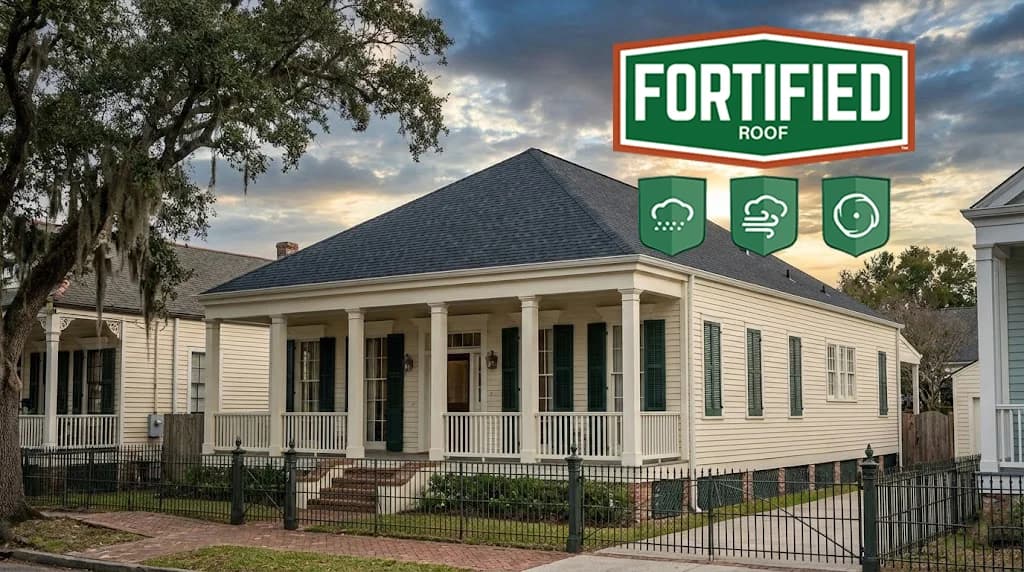
FORTIFIED Roofing Guide: Costs, Grants & Certification

Lapeyre's FORTIFIED roofing hub. Start here to find your city's cost guide for New Orleans, Houston or Austin, plus the IBHS basics, installation process, and insurance math.
FORTIFIED is a voluntary construction and re-roofing standard from the Insurance Institute for Business & Home Safety (IBHS) that hardens your roof against hurricanes, high winds, hail, and water intrusion. Lapeyre installs FORTIFIED roofs across Louisiana, Alabama, and Texas — each state has a different mix of grants, insurance mandates, and pricing.
Find your city's cost guide
This hub page covers what FORTIFIED is, the certification levels, how the evaluator process works, and what documentation official programs and carriers may require. The specific grant math, pricing, and incentive stacking live on the city-specific cost guides above. For a program-focused breakdown of Louisiana incentives (LFHG + Act 404/473), read our Louisiana roof grants and tax credits guide →
Texas program update — July 30, 2026
Governor Greg Abbott proposed a $400 million Texas roof fortification fund with grants up to $10,000. The program is not law, no application is open, and eligibility rules have not been published. Follow our Texas FORTIFIED roof grant status tracker for the confirmed facts and legislative timeline.
In our Louisiana market, 72% of the roofs we install are FORTIFIED-certified because the benefits far outweigh the costs. If you want the official program requirements and contractor/evaluator directory, start with fortifiedhome.org.
What is FORTIFIED?
FORTIFIED is a voluntary construction and re-roofing program developed by IBHS, an independent nonprofit funded by insurance companies. The program establishes building standards that go beyond minimum code requirements to provide meaningful protection against hurricanes, high winds, hail, and severe thunderstorms.
Why FORTIFIED Matters
Standard building codes establish minimums—they're designed to prevent catastrophic failure, not to prevent damage. FORTIFIED standards address the vulnerabilities that cause most storm damage:
- Roof-to-wall connections — The roof staying attached to the house during high winds
- Roof deck attachment — The plywood staying attached to the rafters
- Sealed roof deck — Preventing water intrusion even if shingles blow off
- Edge and ridge protection — Reinforcing the most vulnerable areas
- Proper ventilation — Maintaining attic pressure balance during storms
Proven Performance
FORTIFIED isn't theoretical—it's been validated by real hurricanes:
- Hurricane Michael (2018) — FORTIFIED homes in Mexico Beach, FL survived Category 5 winds while neighboring homes were destroyed
- Hurricane Laura (2020) — Studies showed FORTIFIED homes had significantly less damage than conventional construction
- Hurricane Ida (2021) — FORTIFIED homes in Louisiana demonstrated markedly better performance
Our perspective: We've seen the difference firsthand. After every major storm, we return to neighborhoods where we've installed both FORTIFIED and conventional roofs. The FORTIFIED roofs consistently perform better—fewer missing shingles, no water intrusion, less damage to call back and repair.
FORTIFIED Certification Levels
FORTIFIED offers three certification levels, each building on the previous one. For roof replacements, most homeowners pursue FORTIFIED Roof (the entry level), which provides the majority of the protection benefits.
FORTIFIED Roof™ (Bronze)
The most common certification for existing homes having their roof replaced. FORTIFIED Roof focuses on the roof system alone.
Requirements include:
- Sealed roof deck (self-adhering underlayment or sealed plywood joints)
- Enhanced nail pattern (more nails, closer spacing)
- Proper drip edge and starter strip installation
- Ridge cap shingles with enhanced fastening
- Attic ventilation meeting specific standards
- All roof penetrations properly sealed
Best for: Homeowners replacing their roof who want better storm protection and evaluator documentation without structural modifications.
FORTIFIED Silver™
Adds opening protection (windows and doors) to the FORTIFIED Roof requirements. Windows and doors are the second most common failure point in hurricanes after roofs.
Additional requirements:
- Impact-rated windows and doors, OR
- Tested hurricane shutters for all openings
- Reinforced garage door (common failure point)
Best for: Homeowners doing a comprehensive renovation who want whole-house protection.
FORTIFIED Gold™
The highest level, adding structural requirements to connect the entire load path from roof to foundation.
Additional requirements:
- Roof-to-wall connections (hurricane straps or clips)
- Wall-to-floor connections
- Floor-to-foundation connections
- Continuous load path from roof to ground
Best for: New construction or major renovations where walls are open for structural work.
Insurance Documentation
FORTIFIED certification can matter during carrier review, but the financial treatment depends on current state rules, your policy, and your insurer's paperwork requirements.
Louisiana Carrier Review
Louisiana has official mitigation-credit rules for FORTIFIED-certified homes, and those rules can change by effective date, geography, and policy type. Verify current treatment with LDI and your carrier before assuming a dollar amount.
- FORTIFIED Roof — roof-level designation documentation for carrier review
- FORTIFIED Silver — stronger envelope-level documentation for carrier review
- FORTIFIED Gold — whole-structure load-path documentation for carrier review
Your actual premium impact, if any, depends on the hurricane/wind portion of the policy and the insurer's current filed rules.
Texas Wind/Hail Documentation
Texas carrier treatment is voluntary and carrier-specific. Ask your insurer what documentation they require before choosing a material or FORTIFIED path:
- Impact-resistant roof covering product label and installation invoice
- Sealed roof deck documentation
- Enhanced roof-to-wall connection documentation when applicable
Contact your Texas insurer to ask specifically about Class 4 or FORTIFIED documentation. Availability and value vary by carrier.
Planning Example
Use a planning worksheet, not a promised return, before deciding:
Sample FORTIFIED planning checklist
- Standard roof replacement cost: $18,000
- FORTIFIED upgrade cost: +$2,500 (additional materials and labor)
- Official grant or tax-credit status: verify before work starts
- Carrier documentation required: verify before choosing materials
- Decision point: compare resilience value, available programs, and confirmed carrier treatment
This does not replace program, carrier, or tax advice. It keeps the decision grounded before work begins.
Louisiana Fortify Homes Grant (LFHG)
Louisiana's Department of Insurance (LDI) periodically offers grant funding through the Louisiana Fortify Homes Grant (LFHG) program to help homeowners offset the cost of FORTIFIED upgrades. When available, these grants can cover a significant portion of the upgrade cost.
Program Overview
The Louisiana Fortify Homes Grant (LFHG) program provides grants to help homeowners strengthen their roofs to FORTIFIED standards. Key details:
- Grant amounts — Typically up to $10,000 for roof retrofits
- Eligibility — Louisiana homeowners with owner-occupied primary residences
- Income requirements — Some grant rounds prioritize low-to-moderate income households
- Application — Online application through LDI when program is open
Combining with Carrier Review
The real power comes from combining available grant funding with carrier-review documentation:
- Grant covers upfront FORTIFIED upgrade cost
- FORTIFIED certificate and invoices support carrier review
- Result: Better documentation before you make a financial decision
Program availability: The Louisiana Fortify Homes Grant (LFHG) opens and closes based on legislative funding. Check LDI Fortify Homes for current program status, or ask us—we stay current on availability and can help you apply.
The FORTIFIED Certification Process
Getting FORTIFIED certification requires more than just installing the right materials—it requires third-party verification by an independent evaluator.
Step 1: Choose a FORTIFIED-Trained Contractor
Not all roofers understand FORTIFIED requirements. Look for contractors who:
- Have completed IBHS FORTIFIED training
- Have documented experience with FORTIFIED installations
- Can provide references from previous FORTIFIED projects
- Coordinate with FORTIFIED evaluators regularly
Step 2: Evaluator Pre-Inspection
Before installation begins, an IBHS-licensed FORTIFIED Evaluator inspects your existing roof to document conditions and confirm that FORTIFIED certification is achievable.
Step 3: Installation with Documentation
During installation, the contractor must photograph and document specific construction details that prove FORTIFIED standards were met. This includes:
- Sealed roof deck (before shingles installed)
- Nail pattern and spacing
- Drip edge installation
- Ridge cap fastening
- Attic ventilation
- All penetrations and flashing
Step 4: Final Evaluation
After installation, the FORTIFIED Evaluator returns to verify that all requirements were met. They review the photographic documentation and inspect the completed roof.
Step 5: Certification Issued
Once the evaluator confirms compliance, IBHS issues an official FORTIFIED designation certificate. This certificate is what you provide to your insurance company for carrier review.
Timeline: For a typical roof replacement, the FORTIFIED certification process adds about 1-2 weeks to the overall project timeline.
Cost & ROI
FORTIFIED certification adds cost to a roof replacement, but the additional investment is typically modest compared to the benefits.
Additional Costs for FORTIFIED
The upgrade from a standard roof replacement to FORTIFIED Roof typically includes:
- Sealed roof deck materials — Self-adhering membrane or deck tape ($500-$1,500)
- Additional fasteners/nails — Enhanced nail pattern requires more nails ($100-$300)
- Evaluator fees — Pre-inspection and final evaluation ($400-$800)
- Additional labor — Extra time for documentation and precise installation ($500-$1,000)
- Total typical upgrade cost: $1,500-$3,500 beyond standard replacement
Financial Planning
In Louisiana, the decision often favors FORTIFIED when the homeowner values storm resilience and can verify any available program path before work starts:
- Typical upgrade costs: confirm from your scope, roof size, and evaluator requirements
- Possible program paths: LFHP, tax-credit rules, local programs, carrier review, or lender-administered funds may apply depending on status and eligibility
- Timing risk: starting work before approval can make some programs unavailable
- Certification duration: 5 years (renewable)
Over a roof's lifespan, FORTIFIED's value comes from stronger construction, third-party documentation, and any verified program or carrier treatment available to that homeowner.
See detailed FORTIFIED cost breakdown →
Get FORTIFIED Certification
We're experienced FORTIFIED installers serving Louisiana and Texas. Let us help you protect your home, document the work properly, and verify the official paths before you commit.
Louisiana Service Areas
Texas Service Areas
Common questions
Frequently asked
In Louisiana, FORTIFIED can be very compelling because it improves storm performance and creates evaluator documentation that carriers or public programs may review under current rules. In Texas, the value depends on your specific insurance policy and whether your carrier recognizes FORTIFIED or Class 4 documentation. Confirm current treatment with your carrier before relying on premium savings.

Hunter Lapeyre
Owner, Lapeyre Roofing
Found this helpful? Choose Lapeyre Roofing as a source you want to see on Google.
Add Lapeyre Roofing as a preferred source on Google (opens a Google window)