FORTIFIED Roofs in New Orleans: What Homeowners Need to Know Before They Upgrade
Clear roofing decisions for New Orleans homeowners
Most people think a roof is the shingles. It isn't.
Prefer to book online? Schedule your free New Orleans estimate
Schedule Your FREE
Roof Inspection & Estimate
Request a written estimate
Where is your property?
We serve Texas, Louisiana & Missouri
What do you need?
Almost done!
How can we reach you?
By submitting, you consent to follow-up messages. Reply STOP to opt out.
Sources we use
Official sources for the New Orleans FORTIFIED path
Program windows and carrier treatment can change. These are the sources to check before the budget or schedule assumes an incentive.
Louisiana Department of Insurance
Louisiana Fortify Homes Program
Shows current lottery status and the state program path. When funded, the program describes grants of up to $10,000 for eligible existing homes.
Read the official guidance →Louisiana Department of Insurance
Louisiana Fortify Homes FAQ
Explains selection timing, evaluator and contractor roles, eligible work, payment, homeowner overage, and designation documentation.
Read the official guidance →City of New Orleans
Residential re-roofing permit
Covers the dedicated permit for qualifying re-roofs, geotagged progress documentation, and possible historic-district review.
Read the official guidance →Insurance Institute for Business & Home Safety
FORTIFIED Roof
Describes the voluntary roof standard and its application across common roof-cover systems.
Read the official guidance →Insurance Institute for Business & Home Safety
Louisiana FORTIFIED incentives
Summarizes available Louisiana grant and insurance-incentive pathways and links homeowners to official programs.
Read the official guidance →What Makes a Roof FORTIFIED, Not Just New
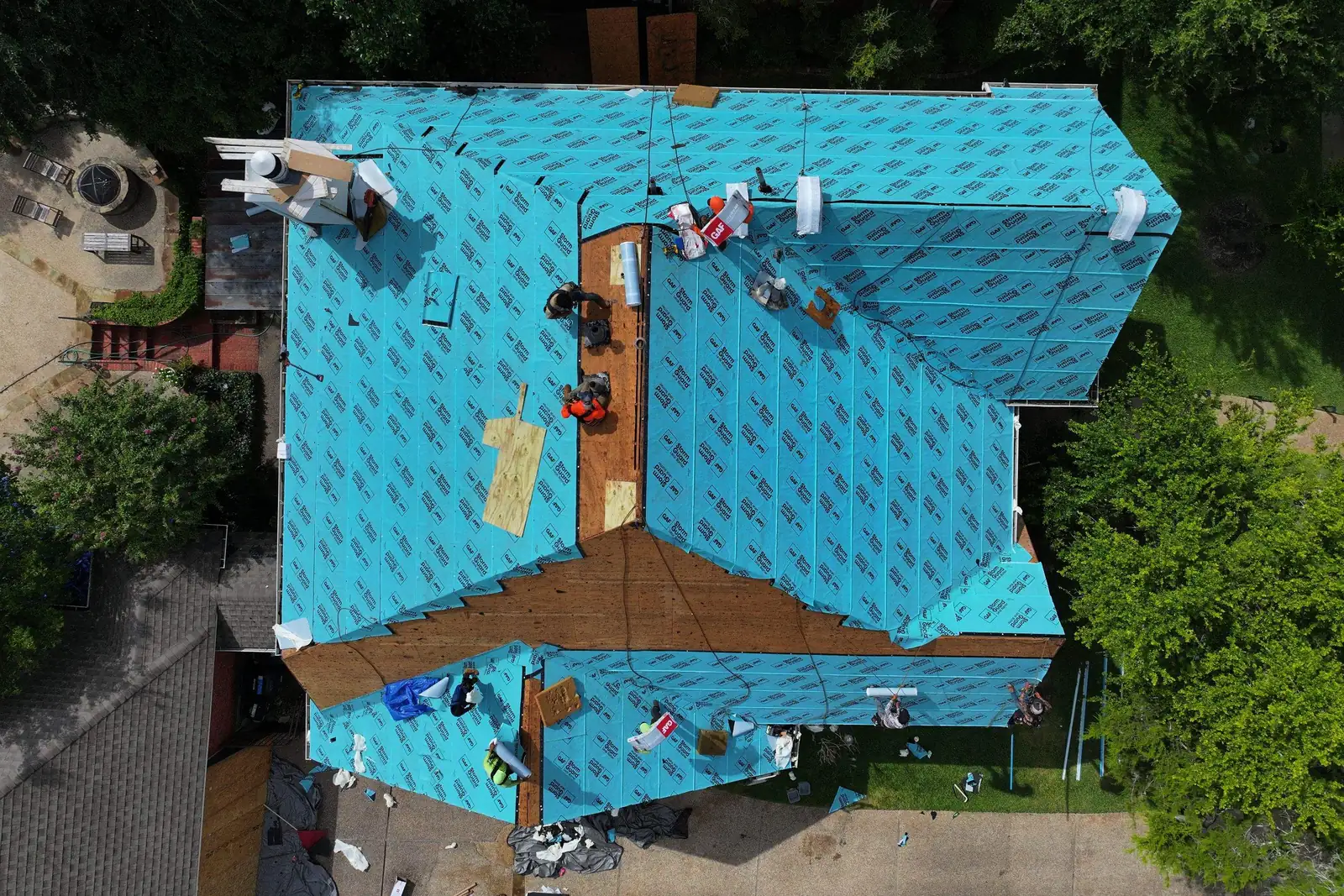
Most people think a roof is the shingles. It isn't. The shingles are the last layer on top. Underneath sits the decking, the fasteners holding that decking to the rafters, the underlayment, and the metal that wraps every edge. That's the part that decides how your roof behaves in a storm. And it's the part nobody sees once the job is done. A FORTIFIED roof starts with a sealed roof deck. Every seam between the plywood or board decking gets taped or covered, then the whole deck gets a full underlayment. So if wind peels shingles off during a storm, water still doesn't pour into your attic. We've walked plenty of attics after a blow where the shingles were gone but the ceiling below was dry, that's the sealed deck doing its job.
- The contractor builds the scope; an independent evaluator verifies it
- Grant selection and program approval may be required before construction
- New Orleans permit photos and evaluator evidence should be planned together
- A FORTIFIED designation is not an insurance-coverage or savings guarantee
- Current program status must be checked at the official source before signing
Four lanes that must stay coordinated
One roof project, four different decision-makers
Here's the part most homeowners don't see coming. A FORTIFIED roof isn't just better shingles. The whole system starts at the wood under your feet, and a lot of houses here were built with plank decking instead of plywood. Those boards are often 1x6 or 1x8, spaced with gaps, sometimes cupped from a century of heat and damp.
Construction standard
Impact: The deck, sealed water barrier, attachment, edges, penetrations, and roof cover must be installed to the current applicable standard.
Our Solution: The proposal names the assembly and checkpoints instead of selling “FORTIFIED” as a product upgrade.
Independent evaluation
Impact: Critical work becomes concealed as construction progresses, so missing evidence cannot always be recreated after the roof is complete.
Our Solution: The evaluator is engaged before tear-off and the schedule protects every required observation and photo checkpoint.
City permit evidence
Impact: Qualifying New Orleans re-roofs have a city permit and progress-documentation path separate from the FORTIFIED designation.
Our Solution: We map both evidence sets so the city and evaluator receive what each requires while the work is visible.
Grant, tax, and insurance treatment
Impact: Program status, eligibility, award timing, eligible costs, tax rules, endorsements, and carrier credits are not controlled by the roofer.
Our Solution: The homeowner verifies the current official rules in writing before using an incentive to close the budget.
Property questions that change the FORTIFIED scope
Eligibility and construction details belong to the building and the current program—not a neighborhood stereotype.
Homes with solid structural roof decking
Existing plywood or OSB may simplify part of the path if condition and attachment meet the required evaluation.
Do not assume eligibility from age alone; the evaluator and exposed conditions determine required work.
Older or mixed-deck homes
Board decking, prior overlays, additions, and concealed deterioration can change the assembly and budget.
Define deck assumptions, unit pricing, evaluator checkpoints, and approval rules before tear-off.
Historic or specialty-cover roofs
Slate, tile, metal, visible details, and review jurisdiction can affect both the exterior solution and documentation sequence.
Coordinate salvage, material match, city or commission review, and the applicable FORTIFIED roof-cover details before ordering.
The FORTIFIED sequence that protects eligibility and evidence
Here's the part most homeowners don't expect. The certification isn't something we hand you ourselves. An independent FORTIFIED evaluator checks the work, and the designation comes from the Insurance Institute for Business and Home Safety. We build to the standard. Somebody else confirms we did.
Choose and verify the path
Check the current LFHP or other program status, award or endorsement rules, property eligibility, eligible expenses, and any tax interaction before authorizing work.
Engage the independent evaluator
The evaluator reviews the property and applicable standard, identifies documentation needs, and remains separate from the contractor’s construction role.
Write the construction and permit scope
The proposal coordinates roof-cover removal, deck assumptions, sealed-deck method, attachment, edges, flashings, penetrations, product records, city permit, and historic review if applicable.
Schedule visible checkpoints
City and evaluator photos or observations are captured while deck, sealing, attachment, and edge work remain visible.
Close construction gaps in real time
Newly exposed conditions are documented and approved before they are concealed; the evaluator determines whether corrective evidence is sufficient.
Submit and retain the records
The evaluator handles the designation package. The homeowner keeps the designation, permit, invoices, product labels, photos, and any program or carrier correspondence together.
FORTIFIED is the assembly, not the exposed material
Most people think a roof is the shingles. It isn't.
Architectural shingles
Why for New Orleans
A common path with accessible product choices and a defined complete assembly.
Best For
Homeowners balancing initial cost, repairability, and designation goals.
Considerations
Product wind claims do not replace deck sealing, edge, starter, attachment, flashing, and evaluator requirements.
Standing-seam metal
Why for New Orleans
A long-service-life option when panels, clips, substrate, transitions, and corrosion exposure are specified together.
Best For
Long-hold properties and designs where metal suits the architecture and review path.
Considerations
Not every metal specification is automatically FORTIFIED-compliant; verify the complete tested or accepted assembly.
Slate or clay tile
Why for New Orleans
Specialty covers can preserve New Orleans architecture while the underlying system is strengthened.
Best For
Historic and premium roofs with viable salvage or matching strategies.
Considerations
Weight, attachment, salvage, matching, flashing metals, commission review, and evaluator documentation require early coordination.
The value is disciplined coordination, not a badge
Our job is to build the roof and preserve the evidence. We do not award the designation, select grant recipients, interpret tax law, or promise an insurance result.
Sequence before sales
Program and evaluator steps are identified before construction so the homeowner does not learn about a missed prerequisite after tear-off.
One evidence map
The scope distinguishes city permit photos, evaluator proof, contractor closeout records, and homeowner program or carrier documents.
No incentive math without verification
Grant, tax, endorsement, and insurance language points back to the current official reviewer instead of becoming a roofing promise.
Specialty-roof capability
The FORTIFIED conversation can include shingle, metal, slate, tile, and mixed roof sections instead of forcing every property into one product.
When a Full FORTIFIED Upgrade Isn't the Right Move Yet
Not every roof is ready for this. We'll say that out loud, because plenty of folks call us wanting a FORTIFIED designation on a roof that's only six years old and in good shape. Sometimes the honest answer is wait.
Here's the thing people miss. FORTIFIED standards are built around the roof deck, the fasteners, the sealed seams and the edges. Most of that work only happens when the covering comes off. So if your shingles have real life left in them, you'd be tearing off a working roof to get there. That's a decision worth making on purpose, not on impulse.
Situations where we usually tell homeowners to hold off:
The roof is young and the inspection shows no lifted tabs, no exposed nails, no soft decking.
There's one clear problem, like a flashing leak at a chimney or a few slipped slates, and a targeted roof repair solves it.
The structure itself needs attention first. Rotted rafters or a sagging ridge come before any covering conversation.
You're planning an addition, a dormer, or solar in the next year or two. Do the roof once, after the framing is final.
You haven't had a written scope and photos yet, so nobody knows what's under there.
That last one matters more than the rest. We photograph what we find and put it in writing, and about half the time the pictures change what the homeowner wants to do. Old New Orleans housing stock hides a lot under the felt. Board decking with gaps, layers from decades ago, previous patch work nobody documented.
And eligibility isn't automatic either. FORTIFIED requirements, permit rules and any program participation have to be checked for your specific property and project. Nobody should promise you an outcome before that check happens.
So the question isn't whether FORTIFIED is worth doing. It's whether your roof is at the point where doing it makes sense - and a real inspection answers that faster than any quote will.
Compare your options before signing
Compare a written roof estimate
Use measured roof area, installed prices, and separate allowances to compare scope. Planning output is not a project quote.
Read more about this roofing decision
What Is a FORTIFIED Roof? (2026)
A FORTIFIED roof is a roof built to the IBHS FORTIFIED standard, an engineered system designed to stay on your house in a hurricane. Here is what it actually requires physically, the three levels, the real cost difference, and the storm data that proves it works.
FORTIFIED Roof Certification: Evidence, Designation, and Renewal
A FORTIFIED roof designation comes from IBHS after the required evaluation and documentation process. Installing products advertised as strong or impact-resistant does not by itself establish designation. Coordinate the evaluator and evidence requirements before construction conceals the work.
FORTIFIED Roof Cost in Louisiana: New Orleans Pricing
Compare the full replacement budget with the FORTIFIED upgrade cost, understand roof-area measurements, and check which fees your estimate includes.
Choose the right next step
New Orleans roof decision center
Start with the New Orleans market overview, then compare repair, replacement, and FORTIFIED documentation paths without assuming the largest job is the right one.
FAQ
Frequently Asked Questions
How do I know if my New Orleans home needs deck work before going FORTIFIED?
You'll likely need deck work if your home still has original plank decking. Many New Orleans shotgun doubles and raised-basement homes were built with 1x6 or 1x8 boards, not plywood. Those boards can have gaps or soft spots from years of heat and moisture near the eaves. An inspection helps establish the likely scope, but concealed decking damage may only become visible during tear-off.
What happens during a FORTIFIED roof inspection?
We check the decking condition, fastener patterns, and edge details, and photograph each stage as we go. This documentation matters later for insurance, buyers, or lenders who want proof of what's under your shingles. We tear off down to bare deck so every board is visible, not just the areas that look suspect from the ground. You get a written record instead of guesswork.
Is a FORTIFIED roof the same as getting an insurance discount automatically?
No, these are two separate things. The discount comes from your insurance carrier, and Louisiana law requires them to offer a break for a FORTIFIED designation, but each carrier sets its own paperwork and timing. You need to ask your carrier directly what they require and when the discount starts. Getting the roof certified is the first step, but the discount conversation happens separately with your insurer.
Are the state grant program and insurance discounts the same thing?
No, they're completely separate paths. The insurance discount comes from your carrier and applies once your roof has a FORTIFIED designation. The state grant program is run on its own schedule, with its own eligibility rules and application windows that open and close. Your roof's certificate supports both conversations, but qualifying for the grant depends on your specific property and the program rules in effect that cycle.
Why does a FORTIFIED roof cost more than a standard reroof in New Orleans?
The cost difference usually comes from deck work, not the shingles themselves. Older New Orleans homes with original plank decking need more repair before the deck can be sealed properly. Two houses on the same block can need very different scopes, one with solid plywood from a past reroof, another with original planks and layers of history on top. Ask your contractor how they price deck repairs before signing anything.
What makes New Orleans homes especially vulnerable to wind damage on the roof edges?
Wind attacks the edges and corners of a roof first, not the middle, and older New Orleans homes often weren't built for that. Many shotgun and bungalow homes have wide eave overhangs with board decking fastened using just two nails per rafter. That's not enough for today's wind speeds. A FORTIFIED scope addresses this with tighter nailing patterns and reinforced edge metal specifically at those vulnerable points.
How long does a FORTIFIED designation last?
The current program uses a time-limited designation and renewal process. Keep the certificate and maintenance records, and confirm the current renewal requirements with FORTIFIED before the designation expires.
Can a historic New Orleans roof be FORTIFIED?
Potentially, depending on the building, roof cover, structure, evaluator requirements, and historic-review path. Slate, tile, and metal projects need early coordination because salvage, matching, visible details, and documentation all affect the scope.
Want the complete picture?
Learn about IBHS FORTIFIED standards, carrier documentation, and why storm-resistant roofing matters for Gulf Coast homes.
Read our FORTIFIED Roofing GuideContact information
Thank you for considering us for roofing needs. We will get back to you during normal business hours.


Send us a message