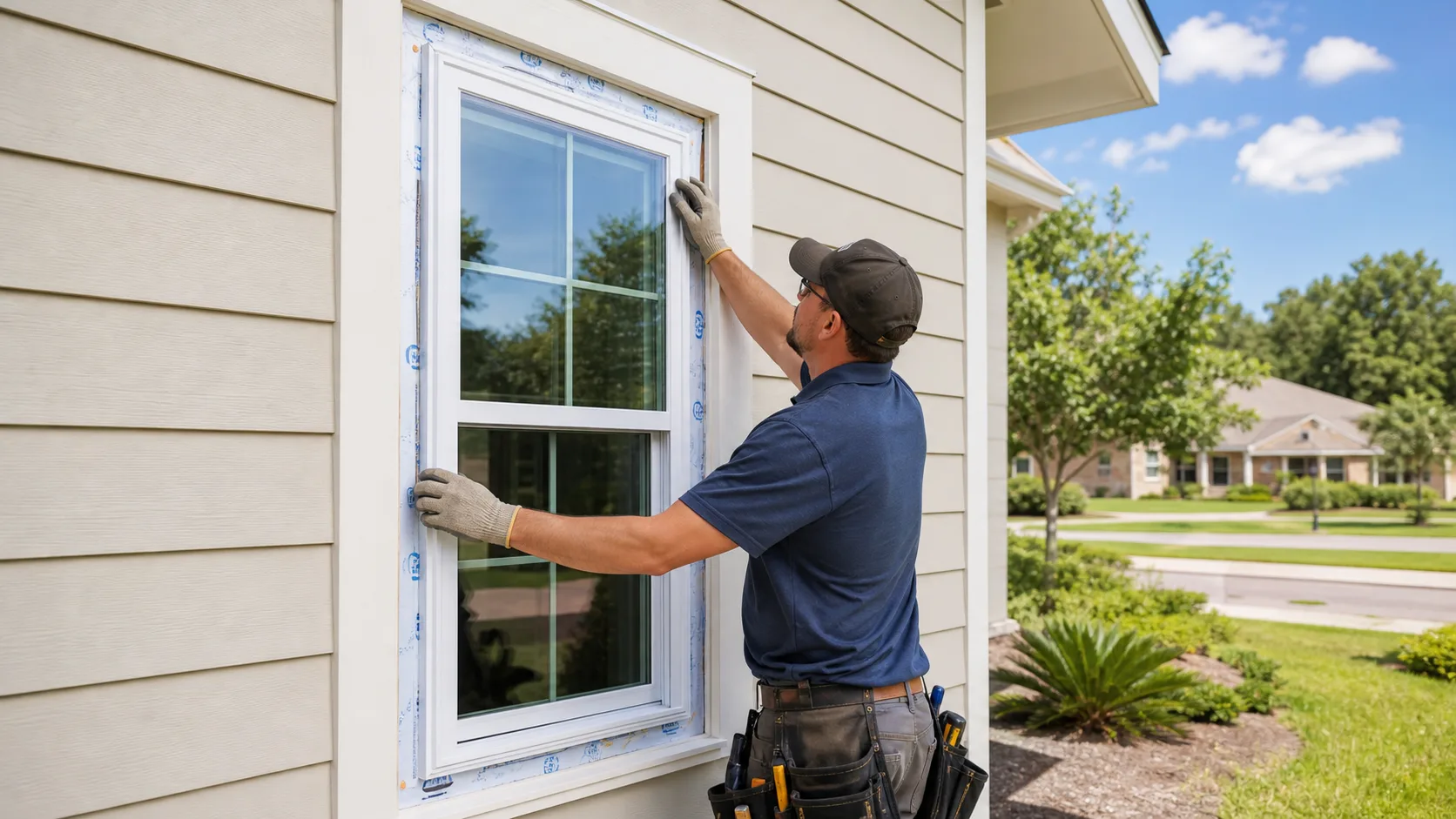
Window Replacement: The Complete 2026 Guide

Window replacement got harder in October 2023 when Energy Star Version 7.0 took effect. Different climate zones now demand different glass packages. This guide covers the v7.0 numbers, frame and glazing options, hurricane impact requirements, and how to actually pick.
In October 2023, the Environmental Protection Agency rolled out Energy Star Version 7.0 for residential windows. Every product manufactured after that date has to meet the v7.0 numbers to carry the Energy Star label. Those numbers got significantly more stringent — and they vary by climate zone. A window that qualifies in St. Louis might not qualify in Houston, and vice versa.
This guide covers what changed, how to read an NFRC label, what frame and glass packages actually matter for your climate, and when hurricane impact rating moves from "nice to have" to "code-required."
When Replacement Actually Pays Off
Honest answer first: window replacement is one of the slowest-paying home improvements when judged on energy savings alone. If your existing windows are double-pane vinyl from the last 15 years, the energy delta to a v7.0 unit is real but small. If they are single-pane wood or aluminum from the 1970s, the delta is much larger.
The real reasons people replace windows in 2026:
- Failed seals on insulating glass units (IGUs) — fogging between the panes means the seal is gone and the inert gas fill has escaped
- Storm damage — broken glass, racked frames, or impact damage that a like-for-like replacement may not cover under current code
- Comfort — drafty rooms, cold-glass downdrafts in winter, hot-glass radiation in summer
- Sound — flight paths, busy roads, multi-pane laminated glass cuts noise meaningfully
- Operation — sashes that no longer balance, tilt, or lock
- Hurricane code compliance — replacing single-pane glazing in coastal Louisiana or windstorm-designated Texas counties may trigger impact-rated requirements
Energy Star v7.0 by Climate Zone
Energy Star segments the country into four climate zones for windows. Each zone has different U-factor and SHGC requirements:
| Climate Zone | U-factor | SHGC | Our Markets |
|---|---|---|---|
| Northern | ≤ 0.22 | ≥ 0.17 (minimum) | — |
| North-Central | ≤ 0.25 | ≤ 0.40 | St. Louis |
| South-Central | ≤ 0.28 | ≤ 0.23 | Austin, Houston, New Orleans |
| Southern | ≤ 0.32 | ≤ 0.23 | — |
U-factor measures how well the window resists heat flow — lower is better in any climate. SHGC (Solar Heat Gain Coefficient) measures how much solar radiation the window admits — lower is better in cooling-dominant climates, higher is helpful in heating-dominant climates.
Notice that the Northern zone now requires a minimum SHGC of 0.17 for the first time in v7.0. That is the EPA acknowledging that in cold climates, free winter solar gain is a real heating subsidy worth preserving. In Texas and Louisiana, we want the opposite — block as much solar gain as possible to ease summer cooling load.
How to Read an NFRC Label
Every certified window carries a National Fenestration Rating Council (NFRC) label with five numbers. We check all five before installation:
- U-factor — heat transfer rate. Lower is better.
- SHGC — solar heat gain coefficient, 0 to 1. Lower blocks more solar; higher admits more.
- VT (Visible Transmittance) — how much visible light passes through, 0 to 1. Higher is brighter rooms.
- AL (Air Leakage) — measured at standardized conditions; lower is tighter.
- CR (Condensation Resistance) — relative ranking 1 to 100 for resistance to condensation; higher is better in cold climates.
If the salesperson cannot show you an NFRC label, that is a problem. Energy Star certification depends on NFRC verification.
Frame Materials
Vinyl
Vinyl frames are the most-installed replacement window in North America. PVC composition, hollow chambers (sometimes foam-filled for higher thermal performance), welded corners on most lines. Strengths: low cost, no painting, strong U-factor when chambered correctly. Weaknesses: dimensional movement across temperature swings (Texas summer to winter), color limitations, surface degradation under sustained UV exposure on dark colors.
Fiberglass
Pultruded fiberglass frames offer better dimensional stability than vinyl across temperature extremes. Coefficient of thermal expansion is much closer to glass, so the frame and the glazing move together — important for IGU seal life over decades of cycling. Cost is higher than vinyl, but lower than wood-clad. Strong choice for Texas heat and Missouri freeze-thaw.
Aluminum
Aluminum frames are durable and lightweight, common in commercial work and in older residential. The downside is thermal conductivity — aluminum is a heat highway. Modern thermally-broken aluminum frames mitigate this with a polyamide or polyurethane break inside the frame, but they still under-perform vinyl and fiberglass on U-factor. We rarely specify aluminum for residential replacements outside of historic-match scenarios.
Wood and Wood-Clad
Solid wood is reserved for historic restorations. Wood-clad — wood interior with aluminum or fiberglass exterior — gives you the warm interior look with weather-resistant exterior. Premium price tier, beautiful when done right, requires meticulous flashing details to keep water out of the wood substrate. Brands like Marvin, Pella, and Andersen all sell wood-clad lines.
Glass Packages
- Single-pane. Original 1950s-1970s wood and aluminum windows. Should not be installed new in 2026 except in historic-restoration scenarios with exterior storm panels.
- Double-pane (IGU). Two glass lites with a sealed cavity, typically argon-filled. The standard residential glazing in 2026.
- Triple-pane. Three lites, two sealed cavities. Significantly better U-factor — particularly valuable in cold-climate North-Central installs in St. Louis. Cost premium runs roughly 10-30% over a double-pane equivalent.
- Low-E coatings. Microscopically thin metallic oxide coatings on one or more glass surfaces. Different coatings tune for cooling-dominant vs heating-dominant climates. In Texas and Louisiana, we use "low-solar low-E" to minimize SHGC. In St. Louis, "moderate-solar low-E" preserves winter heat gain while still cutting summer load.
- Inert gas fill. Argon is standard; krypton is denser and more insulating, used in narrower cavities common to triple-pane assemblies.
- Warm-edge spacer. The spacer that holds the lites apart and seals the IGU. Older aluminum spacers conduct heat and create cold-edge condensation lines. Modern warm-edge spacers (foam, stainless steel hybrid, etc.) are now standard on quality windows.
Hurricane Impact and Performance Class
Two separate technical conversations matter for hurricane country: impact rating (does the glazing survive flying debris?) and design pressure (does the assembly survive wind load?). They are tested separately and labeled separately.
ASTM E1996 / E1886 Impact Testing
ASTM E1996 is the spec for windborne debris impact protection in hurricane regions. The test method itself is ASTM E1886. Two missile sizes:
- Large missile — a nominal 9-pound 2x4 wood member, fired at the glazing at velocities that vary by wind speed region, building height, and exposure category (typically 34 to 80 feet per second). This simulates structural debris.
- Small missile — small steel balls representing gravel ballast from flat commercial roofs upwind. Tested at higher velocities.
An assembly that passes both is "impact-rated" or "windborne debris rated." Visually, impact-rated windows look the same as standard windows — the work is done in the laminated glass interlayer (typically PVB or SentryGlas) and the frame anchoring.
AAMA/WDMA/CSA 101/I.S.2/A440 (NAFS) Performance Class
This is the North American Fenestration Standard. It defines four performance classes, ordered from least to most stringent:
- R — one- and two-family dwellings. Most residential replacement windows.
- LC — low-rise and mid-rise multi-family, larger sizes, higher loads.
- CW — low-rise and mid-rise commercial, larger sizes, deflection limits, heavy use.
- AW — high-rise and heavy-commercial, maximum loads and deflection limits.
NAFS-certified windows carry a Performance Grade (PG) rating that indicates the design pressure (DP) the assembly is rated to. Higher coastal-wind requirements in Texas TDI windstorm counties and Louisiana hurricane parishes drive higher DP requirements, which often push the spec to LC or CW class for residential applications.
Climate-Specific Picks
Austin and Texas Hill Country
Austin needs the South-Central Energy Star spec: U ≤ 0.28, SHGC ≤ 0.23. Cooling-dominant climate with brutal west-facing summer exposure, so SHGC matters more than U-factor. Vinyl and fiberglass frames both work; we lean fiberglass on west and south elevations where thermal cycling stresses are highest.
Travis County is not a Texas Department of Insurance windstorm-designated county, so impact rating is not code-driven. Hail-rated upgrades can make sense for clients with insurance-claim history.
Houston and Gulf Coast Texas
Houston needs the same South-Central numbers, plus a hurricane wind load conversation. Specific coastal counties and ZIPs in the TDI windstorm program require WPI-8 inspection, which dictates anchor patterns and may trigger an impact-rated specification. Outside those ZIPs, impact glass is optional but still worth considering for the hurricane wind events the broader metro experiences.
Manufacturers maintain dedicated coastal product lines: Andersen Stormwatch, Pella Hurricane Shield, Marvin Coastline, Milgard hurricane-rated, Simonton storm-rated. We verify ASTM E1996 certification on the actual product label before installation, not on the marketing page.
New Orleans and Southeast Louisiana
New Orleans has a layered code conversation. Louisiana state building code requires impact-rated glazing or shutters in many wind-zone designations within Orleans Parish and the surrounding hurricane-exposure parishes. The Louisiana Fortify Homes Program grant focuses on FORTIFIED Roof, but impact-rated openings figure heavily into FORTIFIED Silver and Gold designations.
Energy Star spec is the same South-Central numbers as Texas. Salt air drives frame material choice — vinyl and fiberglass over aluminum. Driving rain at the head and sill is the dominant water-intrusion failure mode, which puts pan flashing details under more scrutiny than in inland markets.
St. Louis and the Hail Belt
St. Louis falls in the North-Central climate zone: U ≤ 0.25, SHGC ≤ 0.40. Triple-pane assemblies make a real difference in this climate, particularly on north-facing rooms where condensation resistance also matters. We specify warm-edge spacers and moderate-solar low-E to preserve winter solar gain.
Hail is the dominant storm risk. Laminated glass options that pass small-missile testing also resist hail impact better than standard tempered glazing. Missouri does not have a state FORTIFIED grant program, and impact-rated assemblies are not code-mandated. We discuss laminated upgrades on a cost-benefit basis.
What Replacement Costs
Window costs depend on size, frame material, glass package, opening configuration, and install complexity. Rough order-of-magnitude tiers:
- Vinyl, double-pane, low-E argon, standard double-hung — the baseline replacement window in 2026
- Fiberglass, double-pane, low-E argon — typically 30 to 50 percent above the vinyl baseline
- Vinyl or fiberglass, triple-pane, krypton — incremental premium over double-pane, particularly in North-Central
- Impact-rated assemblies — meaningful premium over standard glass; required code-driven upgrade in many coastal Louisiana and TDI Texas ZIPs
- Wood-clad premium lines — top of the residential range; reserved for high-end remodels and historic-match work
We provide written estimates per opening after a measure-up. Bulk pricing across a whole-house replacement typically improves the per-window number compared to a single-window job.
How a Real Install Works
- Measurement and ordering. Each opening measured to the eighth-inch in three places (top, middle, bottom for width; left, middle, right for height), with the smallest dimension governing the order.
- Existing window removal. Glazing taped to prevent shatter, sash and frame components removed without damaging the surrounding wall, debris contained.
- Rough-opening prep. Old caulk and shims out, sill checked for level and rot, sheathing checked for water damage.
- Pan flashing at the sill. A self-adhered membrane or formed pan that turns up at the sides and slopes outward. This is the single most important detail in a long-lasting window install. Skip it and any future water intrusion goes straight to the framing.
- Window set and anchor. Window placed into the opening, shimmed plumb and square, anchored per manufacturer fastening pattern. For impact-rated assemblies in hurricane zones, anchor density and embedment depth are non-negotiable.
- Insulation and air-seal. Low-expansion foam at the perimeter (high-expansion foam can bow the frame). Backer rod and sealant where the spec calls for it.
- Head flashing and trim. Drip cap or head flashing tied into the WRB above. Exterior trim caulked at the top and sides, left open at the bottom to let any incidental water exit.
- Operation check and final cleaning. Sash balances tested, locks engaged, weatherstripping checked for proper seal. Glass cleaned, NFRC label left in place per Energy Star requirements.
Storm Damage and Insurance
Window storm damage often gets under-scoped on the initial adjuster visit. Common misses:
- Failed seals from impact — IGU seal compromised by debris hit, fogging shows up weeks later
- Racked frames — wind load racked the frame even though the glass survived, sashes no longer balance
- Pre-loss DP rating — code requires like-for-like or better replacement; if the original window was a DP50 impact-rated unit, the replacement scope must reflect that
- Cosmetic vs functional damage — scratched glass or pitted frames may be cosmetic, but compromised laminated interlayers in impact assemblies are functional and warrant replacement
We document each damaged opening with the existing NFRC label (where preserved), pre-loss assembly type, and replacement scope. The same supplement strategy that works on roof claims applies here. For the broader playbook, see our roof insurance claims guide.
Frequently Asked Questions
This guide is part of our exterior services topic cluster. See also: siding guide and gutters guide.
Common questions
Frequently asked
It depends on your Energy Star Version 7.0 climate zone. For Austin, Houston, and New Orleans (South-Central), windows must have U-factor at or below 0.28 and SHGC at or below 0.23. For St. Louis (North-Central), U-factor at or below 0.25 and SHGC at or below 0.40. The numbers come straight from the NFRC label on each window — we verify before installation, never relying on marketing claims.

Hunter Lapeyre
Owner, Lapeyre Roofing