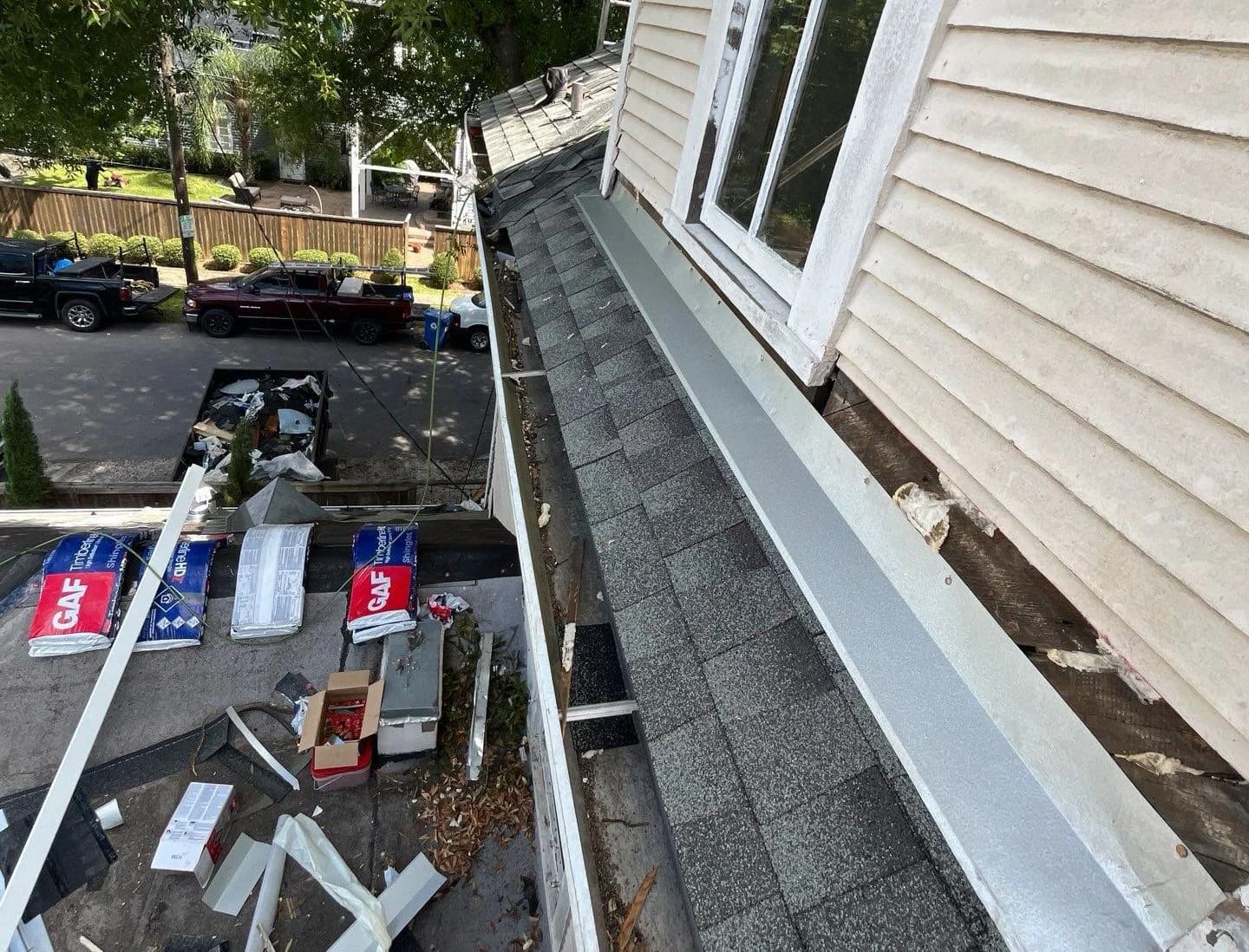
Gutters: The Complete 2026 Sizing and Installation Guide

A gutter that overflows is a gutter that was sized wrong. This guide covers SMACNA sizing math, K-style vs half-round, 5-inch vs 6-inch capacity, downspout configuration, gutter guard options, and how to pick for Austin, Houston, New Orleans, or St. Louis rainfall.
A gutter that overflows once a season was sized wrong. Most residential gutter problems are not material problems or maintenance problems — they are sizing and downspout problems that nobody bothered to do the math on at install.
This guide walks through the actual math, the profile and material trade-offs, the four major gutter guard categories, and how to spec a system for the four metros we work in. The reference standard for sizing is the SMACNA Architectural Sheet Metal Manual, with rainfall intensity data from NOAA Atlas 14.
Why Sizing Matters
Gutters are not decorative. They are the front-line drainage system that protects:
- Foundation and basement. Water shed off the roof and dumped at the foundation perimeter is the leading cause of basement intrusion and foundation settling. Properly sized gutters with downspouts extended away from the foundation eliminate the problem.
- Fascia and soffit. Overflow at undersized gutters wets the fascia board behind the gutter, leading to rot and paint failure. The fascia is also what the gutter is attached to — when it rots, the gutter pulls away.
- Siding and lower walls. Splash-back from overflowing gutters drives water against the lower courses of siding, accelerating paint failure, and on masonry, drives efflorescence and freeze-thaw damage.
- The roof system. Backed-up gutters can hold water against the drip edge and underlayment, creating ice dams in cold climates and water intrusion in any climate.
- Landscaping and hardscape. Erosion at planting beds, frost heave on walkways, and saturated soil that kills root zones near the foundation.
The SMACNA Sizing Math
The math is straightforward once you have the inputs:
- Drainage area. The roof plan area that drains to a given gutter run. For a simple gable, half the roof drains to one side. For a complex roof with multiple valleys feeding one gutter, the drainage area can be much larger than the eave length suggests.
- Roof pitch factor. Steeper roofs catch more wind-driven rain per square foot of plan area. SMACNA tables apply a multiplier — flat roofs use 1.0; steep roofs can multiply the effective drainage area by 1.2 or more.
- Rainfall intensity. The design rainfall rate in inches per hour. Most residential sizing uses a regional 100-year, 5-minute or 60-minute intensity from NOAA Atlas 14. SMACNA references commonly use 4 inches per hour as a baseline benchmark.
- Gutter cross-sectional capacity. A 5-inch K-style gutter holds approximately 1.2 gallons per linear foot. A 6-inch K-style gutter holds approximately 2.0 gallons per linear foot — about 67 percent more volume per LF.
- Downspout sizing and spacing. The downspout is the bottleneck. Two 3x4 downspouts on a long run move significantly more water than one larger gutter alone.
SMACNA's published reference: a 5-inch K-style gutter at 4 inches per hour rainfall handles roughly 5,520 square feet of drainage area; a 6-inch K-style handles roughly 7,960 square feet — a 44 percent capacity increase. In metros where peak rainfall intensity exceeds 4 in/hr, those numbers come down. The Houston and New Orleans 100-year, 60-minute intensities run higher than the 4 in/hr benchmark, which is why we default to 6-inch gutters in both markets.
For homeowners who want to run the numbers directly, SMACNA publishes an online Downspout and Gutter Sizing Calculator that uses their published tables.
K-Style vs Half-Round
Two common residential gutter profiles:
- K-style. The dominant residential profile. Flat back, decorative front face that mimics crown molding, holds more water per inch of width than half-round. Available in 5-inch and 6-inch widths.
- Half-round. True semi-circular profile. Cleaner look on historic homes, easier to clean (no flat bottom corners), but holds less water per inch of width and typically costs more. Common in copper installations on traditional and historic architecture.
For most homes, K-style is the right call. We specify half-round when the architecture calls for it (typically older homes in Garden District or Uptown New Orleans, or restoration work) or when the homeowner wants the cleaner aesthetic.
Aluminum, Copper, Steel
- Aluminum. Standard residential gutter material in 2026. Available in two common gauges: .027 (lighter) and .032 (heavier). We default to .032 on 6-inch runs and on any home in a heavy snow-load or hurricane-exposure area. Aluminum will not rust, but can corrode in chronic salt exposure.
- Copper. Premium material with a 50+ year service life. Develops a verdigris patina over time. Significant cost premium. Salt-tolerant. Common on high-end coastal and historic installations.
- Galvanized or galvalume steel. Less common in residential. Stronger than aluminum but susceptible to rust as the protective coating wears. Used occasionally on commercial and large-volume installations.
Color-matched aluminum is the dominant choice for most of our work. We spec .032 gauge when sizing or wind/snow load conditions call for it.
Downspouts: 2x3 vs 3x4
The downspout is where many residential gutter systems bottleneck. Two common sizes:
- 2x3 downspouts (two inches by three inches) — the standard residential size. Adequate for typical 5-inch K-style on a moderately-sized roof in moderate rainfall.
- 3x4 downspouts — roughly 75 percent more cross-sectional area than 2x3. We pair 3x4 downspouts with 6-inch gutters as a default. In Houston and New Orleans, 3x4 is the right choice on most residential runs.
Downspout count matters as much as size. A long gutter run with one downspout at the far end is asking for trouble — the water has to travel the full length of the gutter to drain. We add intermediate downspouts on long runs and at internal high points.
Gutter Guards: Four Categories
Gutter guards reduce maintenance, but no guard eliminates it. The four major categories:
Micromesh
A fine stainless steel mesh stretched over the gutter opening, typically supported by an aluminum or stainless frame. Mesh openings in the 200-275 micron range filter shingle grit, pine needles, and seed pods.
LeafFilter uses a 275-micron surgical-grade stainless steel micro-mesh. They offer a lifetime transferable warranty that covers both the product and the installation, with a no-clog guarantee. MasterShield is another professionally installed micromesh option. Aftermarket options like Raptor Gutter Guard offer DIY-installed micromesh at lower cost without the professional installer warranty.
Strengths: highest debris rejection, particularly for fine debris like pine needles and shingle granules. Weaknesses: cost; potential for micromesh to clog with surface sediment over years requiring occasional rinsing.
Reverse-Curve (Surface-Tension)
A solid cover that uses water surface tension to follow the curve of the cover and into the gutter while leaves and debris fall off the front edge. Gutter Helmet uses a reverse-curve design with a textured surface and stiffening ribs. LeafGuard sells a one-piece reverse-curve gutter where the gutter and guard are a single seamless extrusion.
Strengths: handles large leaves well, works with high-volume runoff. Weaknesses: can struggle in heavy rain when surface tension is overwhelmed and water shoots past the opening; pine needles and seed pods can defeat the system. Both manufacturers offer lifetime transferable warranties, though warranty coverage of clogging differs by brand.
Foam Inserts
Foam blocks dropped into the gutter trough. Cheap, DIY-friendly, and largely ineffective. Foam degrades, traps debris on top, and creates a wet sponge in the gutter that accelerates aluminum corrosion. We do not install foam inserts.
Screens (Mesh and Perforated Metal)
Coarse-mesh screens or perforated metal lids snap or screw onto the gutter top. The cheapest professional option. Effective against large leaves, less effective against fine debris that settles on top. Reasonable choice on lower-budget jobs in low-debris environments.
Climate-Specific Picks
Austin and Texas Hill Country
Austin's design rainfall is moderate by gulf-coast standards. 5-inch K-style aluminum with 2x3 downspouts is adequate for most homes; we step up to 6-inch and 3x4 on homes with cedar shake debris (oak country), large drainage areas, or complex roof geometry. Spring thunderstorms are intense but short-duration. Pollen and oak debris in March-May make micromesh guards a strong upgrade for homes near mature oaks.
Houston and Gulf Coast Texas
Houston's rainfall intensity is among the highest in our service area, and 1- to 2-hour deluge events at well over 4 in/hr are common. We default to 6-inch K-style with 3x4 downspouts on residential and add intermediate downspouts on long runs. .032 gauge aluminum is standard. For inner-loop homes within reach of Galveston salt air, copper is a worthwhile upgrade for the corrosion resistance.
New Orleans and Southeast Louisiana
New Orleans gets frequent heavy rain and tropical-system overflow events. 6-inch K-style with 3x4 downspouts is our default, with hidden hangers at tighter spacing for hurricane wind-load uplift. Live oak and cypress debris in older neighborhoods (Garden District, Uptown, parts of Mid-City) drives gutter-guard selection — we lean micromesh for these areas. Copper is common on historic homes for both aesthetic and longevity reasons.
St. Louis and the Hail Belt
St. Louis layers two distinct challenges: hail damage to gutters themselves, and ice damming at the eaves. 5-inch K-style with 3x4 downspouts is adequate for typical homes, stepping to 6-inch on larger drainage areas. .032 gauge aluminum is standard.
For ice dam mitigation, hidden hangers spaced at 24 inches maximum on north-facing eaves resist the snow load that builds on the gutter lip. Heat tape (heating cable) in the gutter and downspout is a real consideration for homes with chronic ice dam issues — it does not solve the underlying attic insulation and ventilation problem, but it keeps the drainage path open during freeze-thaw events. We discuss this on a per-home basis.
Hail will dent any aluminum gutter. .032 gauge holds up better than .027, and copper holds up better than aluminum, but no residential gutter is hail-proof. Cosmetic dents from hail are typically claimable when the underlying storm event is documented.
What Gutters Cost
Residential gutter pricing depends on linear footage, profile (K-style vs half-round), material (aluminum vs copper), gauge, downspout count and size, and gutter guard selection. Rough order-of-magnitude tiers:
- 5-inch K-style aluminum, .027 gauge, 2x3 downspouts, no guards — the budget tier
- 5-inch or 6-inch K-style aluminum, .032 gauge, 3x4 downspouts, no guards — our standard residential spec
- Add screen or coarse-mesh guards — modest add-on per linear foot
- Add micromesh guards (LeafFilter, MasterShield) — significant add-on per linear foot, lifetime warranty
- Half-round copper — premium tier, 3-5x the cost of aluminum K-style on a like-for-like installation
Install labor is the dominant cost variable on most jobs after material. Two-story homes, complex eave geometry, and inaccessible runs all increase labor.
How a Real Install Works
- Site visit and measure. Linear footage by elevation, downspout count and locations, drainage paths from downspouts, fascia condition check.
- Sizing decision. Apply SMACNA tables to drainage area and rainfall intensity. Confirm 5-inch vs 6-inch and 2x3 vs 3x4 downspouts.
- Old gutter removal. If replacing existing, careful removal to avoid fascia damage. Existing fascia inspected for rot and replaced where needed.
- Seamless gutter forming. A coil of color-matched aluminum is fed through a portable forming machine on-site, producing a continuous gutter to the exact length needed.
- Hanger layout. Hidden hangers screwed through fascia into the rafter tail or sub-fascia. Spacing varies by snow load and wind exposure: typically 24-32 inches in standard zones, 24 inches max in hurricane and heavy snow zones.
- Slope and pitch. Gutter is hung with a slight pitch (typically about 1/4 inch per 10 feet) toward the downspout. Too much pitch is visually obvious and looks bad. Too little pitch holds water and breeds mosquitoes.
- End caps and miters. Inside and outside corners formed and sealed. Strip miters or boxed miters depending on profile. Sealant only where the spec calls for it.
- Downspout outlets and downspouts. Outlets cut and crimped into the gutter, downspouts hung plumb, secured to the wall with downspout straps every 6-8 feet.
- Discharge. Splash blocks, downspout extensions, or underground drain tie-ins to direct water at least 4-6 feet from the foundation.
- Water test and walk. Hose test with the homeowner, photo documentation, walk-through with the punch list.
Frequently Asked Questions
This guide is part of our exterior services topic cluster. See also: siding guide and windows guide.
Common questions
Frequently asked
It depends on your drainage area and your local rainfall intensity. SMACNA reference tables show a 5-inch K-style handles roughly 5,520 sq ft of drainage area at 4 in/hr; a 6-inch K-style handles roughly 7,960 sq ft. For Houston and New Orleans, where peak rainfall intensity exceeds 4 in/hr, we default to 6-inch with 3x4 downspouts. For Austin and St. Louis, 5-inch is adequate for most homes, with 6-inch for larger drainage areas, complex roofs, or homes with chronic overflow issues.

Hunter Lapeyre
Owner, Lapeyre Roofing