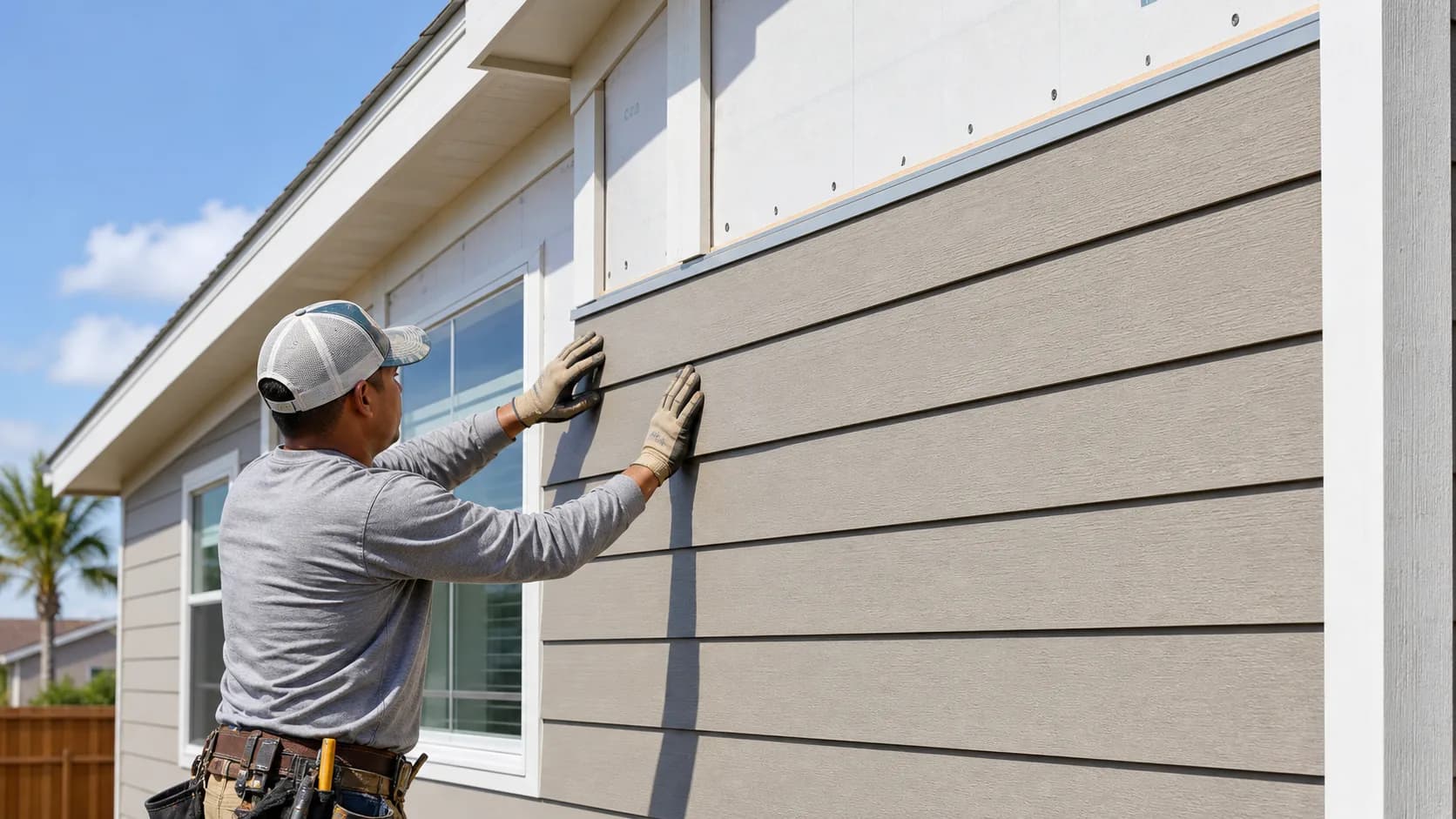
Siding Installation: The Complete 2026 Guide

Choosing siding is mostly choosing for climate, then for warranty, then for budget. This guide covers the three product families that matter, what each one survives, what each one fails at, and how to pick for Austin, Houston, New Orleans, or St. Louis.
Siding is the second-most expensive cladding decision you make on a house, after the roof. It is also the one most people get wrong, because they shop on color first and performance second.
This guide flips that order. It walks through the three siding material families that matter in 2026, what each one is actually engineered for, and how to pick the right one for your climate. We are roofers first, so we approach siding the same way we approach a roof: as a system that has to survive specific weather, not a finish layer.
What Siding Actually Does
Siding is the visible weather skin of your wall. Its job is to shed water, resist wind uplift, take impact from hail and wind-driven debris, and transmit those loads to the structure behind it without buckling, cracking, or letting moisture into the wall cavity.
Underneath the siding sits the rest of the wall assembly:
- Sheathing — typically OSB or plywood, structural and air-sealing
- Weather-resistive barrier (WRB) — the secondary defense against bulk water that gets past the siding
- Flashing — at every penetration, transition, and termination, where most failures actually occur
- Window and door rough-opening details — pan flashing, head flashing, sill protection
Siding is the front line, but the wall is the system. A premium siding product over poor flashing details is a leak waiting for a storm to find it. That is why we install siding the same way we approach a roof tear-off — start at the WRB and flashing, then work outward.
The Three Material Families That Matter
Fiber Cement
Fiber cement is the dominant premium siding category in North America, and James Hardie is the dominant brand. Material composition is portland cement, sand, cellulose fiber, and water, formed into planks and cured. The result is non-combustible (rated to ASTM E136), pest-resistant, and dimensionally stable.
Hardie sells through their HardieZone System, which segments products into two formulations:
- HZ5 — engineered for cold-climate zones 1 through 5. Reduced water absorption, more strength in freezing climates, and a modified profile with a drip edge for improved water management. This is the right product in St. Louis.
- HZ10 — engineered for hot, humid, hurricane-exposed zones 6 through 10. Resists cracking, splitting, rotting, and swelling through hurricane and tropical storm seasons. This is the right product in Austin, Houston, and New Orleans.
Hardie's standard substrate warranty is 30 years, non-prorated, and transferable. The ColorPlus baked-on factory finish has its own separate warranty. Both warranties assume installation per Hardie's technical bulletins, which include specific fastener types, blind-nailing patterns, expansion gaps at butt joints, and clearance-from-grade minimums. Skip those specs and the warranty does not apply.
Engineered Wood
LP SmartSide is the dominant engineered-wood product. The substrate is wood strand bonded with resins and treated with the proprietary SmartGuard process — zinc borate, waxes, and resins that resist termites, fungal decay, and moisture penetration.
The big differentiators against fiber cement are weight and warranty structure:
- 5/50/15 warranty — five years of 100% labor and material replacement, fifty years of prorated substrate coverage, and fifteen years on the ExpertFinish prefinished line
- Hail damage warranty — covers hail up to 1.75 inches in diameter when the siding is properly installed and maintained. This is one of the few siding warranties that names a specific hail size, and it matters in St. Louis and Austin where hail is the dominant claim driver
- Lighter weight than fiber cement — easier and faster to install, which can offset the slightly higher material cost in some markets
- Cuts and fastens like wood — standard carpentry tools, no specialty blades or dust collection
Sources: LP hail warranty announcement; LP 5/50 limited warranty.
Vinyl and Insulated Vinyl
Vinyl is the budget-tier siding that still has a real place in the market when the right grade is chosen and installed correctly. The reference standard is ASTM D3679, which tests weatherability, wind load, and impact resistance. The VSI Vinyl Siding Product Certification Program, administered by Intertek, provides third-party verification that a vinyl product meets D3679.
Wind ratings vary dramatically by grade. Standard-grade vinyl typically rates to 110 mph. Premium grades — defined by panel thickness in the 0.048" to 0.055" range with full rollover nail hems — can rate to 150-200+ mph when installed correctly per the VSI Installation Manual.
Where vinyl loses to fiber cement and engineered wood:
- Heat distortion. Dark-color vinyl on a south-facing Texas wall in August can soften enough to warp. Premium grades and "color-hold" formulations are better, but physics still applies.
- Hail performance. Vinyl cracks at impact in cold weather. In a St. Louis April hailstorm at 40°F, even good vinyl is brittle.
- Repair color match. UV fades vinyl unevenly. Spot-replacing damaged panels rarely matches.
Insulated vinyl is a step up: a foam backer is bonded to the back of each panel, adding around R-2 to R-3 of continuous insulation, reducing oil-canning, and improving impact performance. The cost premium over standard vinyl is moderate; the performance gain is real, especially in hail-prone areas.
Side-by-Side Comparison
| Property | Fiber Cement (Hardie) | Engineered Wood (LP SmartSide) | Premium Vinyl |
|---|---|---|---|
| Substrate warranty | 30 yr non-prorated | 50 yr prorated | Lifetime limited (varies) |
| Hail warranty | Not separately specified | Up to 1.75" diameter | Varies by manufacturer |
| Fire rating | Non-combustible (ASTM E136) | Class A when assembled per spec | Combustible (Class B/C typical) |
| Termite/pest | Inedible | SmartGuard treated | Inedible |
| Wind rating (typical) | High when fastened to spec | High when fastened to spec | 110 mph standard / 150-200+ mph premium |
| Best climate match | All four markets (HZ5/HZ10) | All four markets | Mild climates; cooler regions |
| Repaint cycle | 15+ yrs (ColorPlus) | 10-15 yrs (ExpertFinish) | Color is integral; not painted |
The honest takeaway: fiber cement and engineered wood are both excellent, and the choice between them is more about installation logistics, weight, and warranty preferences than about performance gaps. Vinyl is a budget play that still works in the right conditions, but loses ground fast in hail-prone or hurricane-prone markets.
Climate-Specific Picks
Austin and Texas Hill Country
Austin's siding challenges are UV degradation, thermal cycling, and hail. Hurricane wind is not a meaningful factor inland — Travis County is not a Texas Department of Insurance windstorm-designated county. The TDI windstorm program applies to specific coastal counties.
Our recommendation: Hardie HZ10 fiber cement as the default, LP SmartSide as a strong alternative — particularly when the hail-coverage warranty is a meaningful factor for the homeowner. For UV-stable color performance on south- and west-facing elevations, ColorPlus or ExpertFinish factory finishes hold up substantially better than field-painted siding.
Houston and Gulf Coast Texas
Houston layers hurricane wind on top of UV and humidity. Hardie HZ10 is the right product line, engineered specifically for this combination. For homes within the Texas windstorm-designated coastal counties, the entire wall assembly may be subject to TDI WPI-8 inspection and certification, which dictates fastening density and detailing.
Salt air is real near the bay and Galveston, less so in inner-loop Houston. Where salt is a factor, stainless or coated fasteners and copper trim accents extend service life. We do not recommend uninsulated standard-grade vinyl in coastal-adjacent ZIPs — the wind ratings are achievable, but durability against driven rain at fastener penetrations is not.
New Orleans and Southeast Louisiana
New Orleans gets the full hurricane package — wind, driven rain, salt air — plus high humidity, year-round termite pressure, and flood-elevation considerations on many homes. Hardie HZ10 is again the default. Where the home is being upgraded toward IBHS FORTIFIED Silver or Gold, the wall cladding becomes part of the FORTIFIED specification and fastening, sealing, and opening protection details all tighten.
Louisiana also runs the Louisiana Fortify Homes Program through the Department of Insurance, offering grants of up to $10,000 toward FORTIFIED Roof installations on a lottery basis. The grant focuses on the roof, not siding directly, but it can be a significant offset when bundling FORTIFIED Roof with broader exterior work.
For historic Garden District, French Quarter, and Uptown homes with original weatherboard, we always discuss restoration vs replacement before recommending fiber cement. Sometimes the right answer is to keep the original siding and tighten up the WRB and flashing detail.
St. Louis and the Hail Belt
St. Louis sits inside one of the most active hail corridors in the United States. The dominant siding failure mode here is impact damage, followed by freeze-thaw stress at caulk joints and butt joints. Hardie HZ5 — engineered for freeze-thaw and lower water absorption — is the right product family. LP SmartSide with its 1.75" hail damage warranty is also a strong choice and often the easier sell when homeowners are explicitly worried about hail.
Vinyl underperforms here. Cold-weather hail is a brittleness problem, and even premium vinyl can crack on impact below 50°F. Insulated vinyl improves impact resistance noticeably and is a defensible budget option, but for premium budgets we steer to fiber cement or engineered wood every time.
Missouri does not have a state-level FORTIFIED grant program. We mention this only to head off confusion — the Louisiana Fortify Homes Program is Louisiana-specific.
What Siding Costs in 2026
Siding cost depends on material, house size, prep work, trim complexity, and regional labor rates. Rather than quote a single point estimate that ages badly, we work in ranges sourced from current contractor pricing across our four markets:
- Premium vinyl — the lowest installed cost tier, typically the budget option for whole-house re-sides on smaller homes
- Insulated vinyl — modest premium over standard vinyl with measurable thermal and impact gains
- LP SmartSide — sits between vinyl and fiber cement, often closer to fiber cement when ExpertFinish prefinish is specified
- Hardie ColorPlus fiber cement — the premium tier for most installs, with cost driven up by trim complexity, multi-story access, and ColorPlus colorway selection
For your specific home, we provide a written estimate after a measure-up. Anyone giving you a quote without measuring is guessing.
Detailed market-specific cost guides:
- Siding Cost in Austin, Texas
- Siding Cost in Houston, Texas
- Siding Cost in New Orleans, Louisiana
- Siding Cost in St. Louis, Missouri
How a Real Install Works
- Site protection and tear-off. Existing siding comes off in panels. We protect plantings, AC condensers, and decks, and we keep an eye on what the demo reveals about the wall behind.
- Sheathing inspection and repair. Rotted OSB, soft plywood, and termite damage get replaced before anything new goes back on. We do not skin a problem.
- WRB installation. Continuous weather-resistive barrier (housewrap or self-adhered membrane), shingled correctly so water sheds away from joints.
- Flashing details. Window head flashing, sill pans, kickout flashing at roof-to-wall transitions, drip caps over horizontal trim. This is where most leaks start, so this is where we slow down.
- Trim installation. Corner boards, frieze boards, window and door surrounds — typically Hardie or LP trim profiles. Trim sets the rhythm for siding layout.
- Siding installation. For Hardie: blind-nailed (nails hidden by the next course), fasteners 3/4 inch from butts, expansion gaps per technical bulletin, color-matched ColorPlus touch-up where needed. For LP SmartSide: similar but with wood-style fastening. For vinyl: middle-third nail-slot fastening, panels free to expand, never face-nailed.
- Caulk and seal. Sealant where the spec calls for it, not everywhere. Over-caulking traps moisture; under-caulking lets water in. We follow manufacturer details.
- Punch-list and walk. Final inspection with the homeowner, photo documentation for the file, warranty registration with the manufacturer.
Storm Damage and Insurance
Siding storm damage is one of the most under-claimed line items on residential policies. Adjusters frequently miss:
- Hidden hail bruising on vinyl — visible only at oblique angles or under a flashlight
- Wind-creased fiber cement — micro-cracks that become visible after the next freeze-thaw cycle
- Backside water intrusion — damage discovered only when panels are pulled
- Color-match issues — when fade is uneven, partial replacement leaves visible mismatched panels, which is a covered "matching" issue under most policies but rarely included in initial estimates
Our approach mirrors what we do on roof insurance claims: slope-by-slope, panel-by-panel documentation with high-resolution photos, an itemized scope built around the storm event, and a supplement strategy when the initial adjuster estimate misses items. We have walked hundreds of roof claims through the supplement process. The exterior playbook is the same — it just runs vertical instead of horizontal.
For a deeper dive, see our complete guide to roof insurance claims, which covers the supplement strategy and adjuster-meeting prep that applies equally to siding.
Frequently Asked Questions
This guide is part of our exterior services topic cluster. See also: windows guide and gutters guide.
Common questions
Frequently asked
Fiber cement (James Hardie) carries a 30-year non-prorated substrate warranty and routinely outlasts that in field service, especially when factory-finished with ColorPlus. Engineered wood (LP SmartSide) carries a 50-year prorated warranty. Both can outlast vinyl in real-world weather exposure when installed correctly. Lifespan is more about installation quality and detailing than the material itself.

Hunter Lapeyre
Owner, Lapeyre Roofing