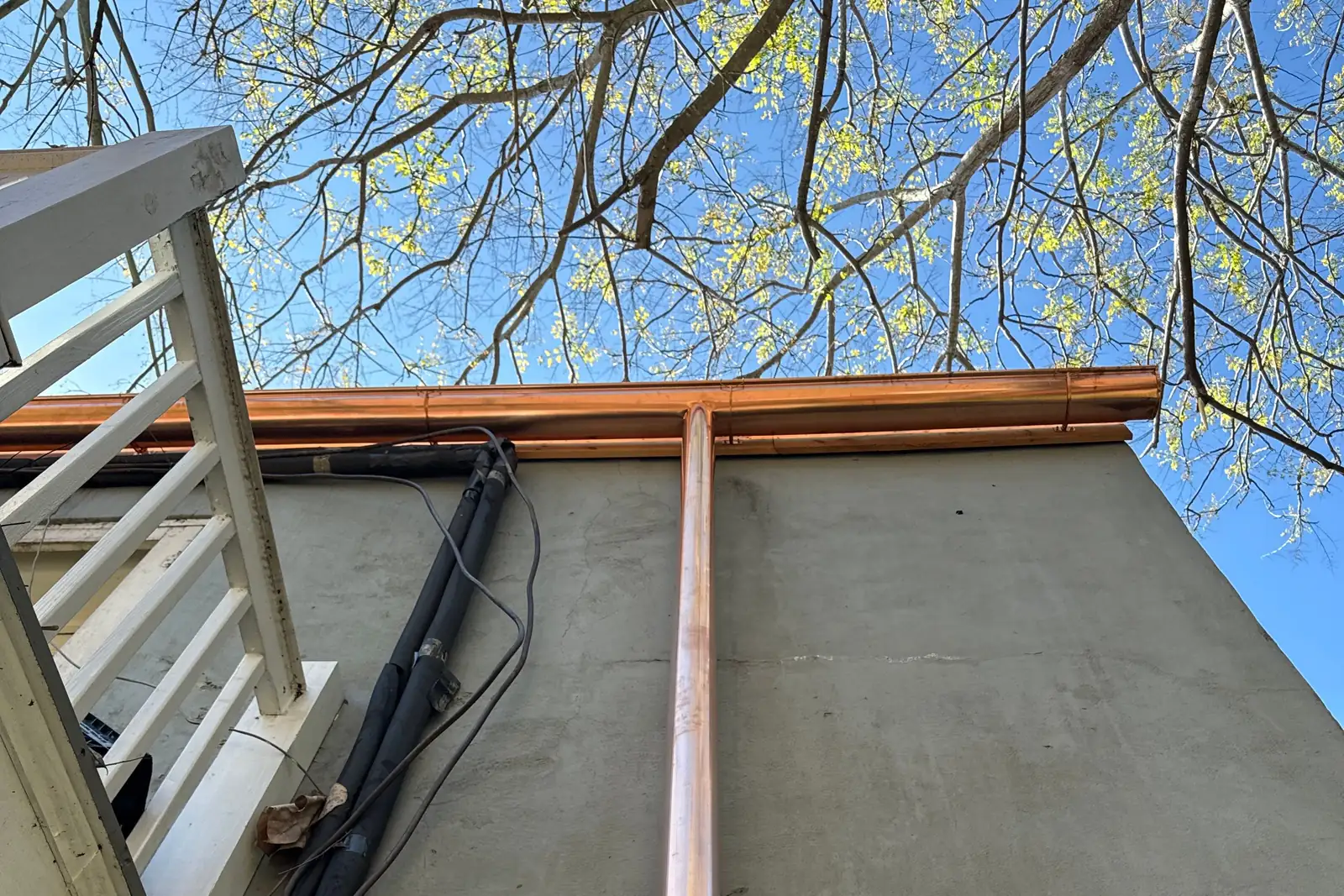
Houston Gutter Installation
6-Inch K-Style Sized for Gulf-Coast Deluge Rain and Hurricane Wind
Houston rainfall intensity is among the highest in the United States. The 100-year, 60-minute rate routinely exceeds the 4 in/hr SMACNA reference benchmark. We default to 6-inch K-style aluminum with 3x4 downspouts on Houston residential, with hurricane-rated hidden hanger spacing and salt-aware fastener selection for coastal-adjacent ZIPs.
Schedule Your FREE
Roof Inspection & Estimate
Request a written estimate
Where is your property?
We serve Texas, Louisiana & Missouri
What do you need?
Almost done!
How can we reach you?
By submitting, you consent to follow-up messages. Reply STOP to opt out.
What size gutters do I need for a Houston home?
For most Houston homes we recommend 6-inch K-style aluminum with 3x4 downspouts. Houston's 100-year, 60-minute rainfall intensity exceeds the SMACNA 4 in/hr reference benchmark, which means a standard 5-inch K-style sized to that benchmark can overflow during gulf-coast deluge events. Going to 6-inch increases capacity by roughly 67% per linear foot, and the 3x4 downspouts handle approximately 75% more cross-sectional area than the 2x3 standard.
- 6-inch K-style standard for Houston homes
- 3x4 downspouts handle deluge events
- Hurricane-rated hidden hanger spacing (24" max)
- .032 gauge aluminum standard
- Stainless or hot-dip galvanized fasteners coastal-adjacent
How Houston Conditions Drive Gutter Specs
Houston Gutter Failures Are Capacity, Wind, and Salt
Houston combines the highest sustained rainfall intensity in our service area with hurricane wind events and (in coastal-adjacent ZIPs) salt-air corrosion. Each driver pushes the spec.
Deluge Rainfall Intensity
Impact: Houston 100-year, 60-minute rainfall intensity exceeds the 4 in/hr SMACNA reference benchmark. A 5-inch K-style sized to the standard benchmark with a single 2x3 downspout can overflow during a gulf-coast deluge.
Our Solution: 6-inch K-style standard, with 3x4 downspouts. Multiple intermediate downspouts on long runs. Sizing per the actual local rainfall intensity, not just the SMACNA reference number.
Hurricane Wind Uplift on Gutters
Impact: Hurricane winds can peel gutters off the fascia at hidden hangers spaced too widely. Tropical storm and hurricane events routinely tear gutters off Houston homes.
Our Solution: Hidden hangers at 24-inch maximum spacing in hurricane wind zones (vs typical 24-32 inch in non-hurricane areas). Screw fastening through fascia into rafter tail or sub-fascia, not just face-screwed.
Salt Air Corrosion (Coastal-Adjacent)
Impact: Standard galvanized fasteners and aluminum gutters in chronic salt exposure (Galveston-adjacent neighborhoods) corrode within years. Inner-loop Houston is far enough inland that salt is a minor factor.
Our Solution: Stainless or hot-dip galvanized fasteners on coastal-adjacent installs. Copper gutters as a premium upgrade for chronic salt exposure — copper develops a verdigris patina but does not corrode like aluminum.
Expansive Clay and Foundation Drainage
Impact: Houston soils include expansive clay zones similar to Austin. Water dumped at the foundation perimeter accelerates differential settling and contributes to slab cracks.
Our Solution: Downspout extensions at least 4-6 feet from foundation, splash blocks at every discharge, underground drain tile where lot grade and access allow.
Subtropical Vegetation Debris
Impact: Live oak, pine, and Spanish moss-bearing trees in older Houston neighborhoods drop fine debris year-round. Pine pollen and oak debris clog reverse-curve guards.
Our Solution: Micromesh guards (200-275 micron stainless steel) handle the local debris pattern better than reverse-curve in pine-canopy areas. We pick based on the actual canopy at the home.
Houston Gutter Considerations by Area
Hurricane exposure, salt air, and tree canopy vary significantly across the metro:
Inner Loop (Heights, Montrose, West U, Bellaire)
Older homes with mature live oak and pine canopy. Hurricane wind a factor; salt air minimal.
6-inch K-style with 3x4 downspouts standard. Micromesh guards for live oak and pine debris. .032 aluminum gauge, hot-dip galvanized fasteners (no salt premium needed).
West Houston (Memorial, Energy Corridor, Katy)
Newer-build subdivisions. Variable tree canopy. Hurricane wind a factor; salt air minimal.
6-inch K-style standard. Foundation drainage particularly important — many west Houston subdivisions are on expansive clay.
Coastal-Adjacent (Galveston, Clear Lake, Seabrook, La Porte)
TDI windstorm-designated. Chronic salt air. Most aggressive hurricane wind exposure.
6-inch K-style copper or .032 aluminum with stainless fasteners. Hidden hangers at 24-inch max. Hurricane-rated install detail throughout.
Southwest Houston (Sugar Land, Pearland, Missouri City)
Newer subdivisions, less salt exposure, similar hurricane wind risk to inner-loop.
6-inch K-style with 3x4 downspouts standard. Hot-dip galvanized fasteners adequate. Foundation drainage attention.
Houston Gutter Installation Cost Ranges
Houston gutter pricing is driven by the upgrade to 6-inch K-style and 3x4 downspouts as the residential default, plus salt-aware fastener and material selection for coastal-adjacent ZIPs:
6" K-style aluminum, .032 gauge, 3x4 downspouts
Standard tier per LF
Our default Houston residential spec. Sized for deluge rain.
6" K-style copper, half-round profile
Premium tier per LF
3-5x aluminum cost. Salt-resistant; ideal for coastal-adjacent and historic homes.
Hurricane-rated hanger spacing add
Modest add per LF
Tighter spacing (24" max) for wind-zone resistance.
Coarse-mesh or perforated screen guards
Modest add per LF
Budget-tier debris management.
Micromesh guards (LeafFilter, MasterShield)
Significant add per LF
Filters fine debris from pine, oak, Spanish moss. Lifetime transferable warranty.
Stainless fastener upgrade (coastal-adjacent)
Modest add per LF
Required for chronic salt exposure.
Factors Affecting Price
- 1Total linear footage and downspout count
- 2TDI windstorm zone status
- 3Salt-air exposure (drives fastener and material spec)
- 4Tree canopy density (drives guard selection)
- 5Foundation drainage configuration (splash block vs extension vs underground drain)
Ranges represent typical Houston contractor pricing for residential gutters as of mid-2026. Coastal-adjacent and TDI windstorm-designated parcels typically run higher than inner-loop Houston due to upgraded fastener and material specs.
Our Houston Gutter Installation Process
Houston install priorities: 6-inch capacity for deluge rain, hurricane-rated hanger spacing, salt-aware fasteners for coastal-adjacent jobs.
Site Walk and Sizing
Drainage area calculation per elevation, downspout discharge planning, fascia condition check.
Local Note: In Houston we size to actual local rainfall intensity, not the SMACNA 4 in/hr default. NOAA Atlas 14 for Harris County is our reference.
Existing Gutter Removal
Old gutters and hangers removed without damaging fascia. Fascia inspected for humidity damage and termite damage.
On-Site Seamless Forming
A coil of color-matched .032 aluminum is fed through a portable forming machine on-site. Continuous gutter formed to exact length per run.
Hurricane-Rated Hanger Layout
Hidden hangers at 24-inch maximum spacing in hurricane wind zones. Screw fastening through fascia into rafter tail or sub-fascia. Closer spacing on corners and long runs.
Slope and Pitch
About 1/4-inch fall per 10 feet of run toward the downspout. On long runs we sometimes split the slope with downspouts at both ends.
End Caps, Miters, Outlets
Inside and outside corners formed and sealed. 3x4 downspout outlets cut and crimped.
Downspouts, Fasteners, Discharge
Downspouts hung plumb, secured every 6-8 feet. Stainless or hot-dip galvanized fasteners per salt-exposure spec. Discharge configured 4-6 feet from foundation minimum.
Gutter Guard Install (If Selected)
Micromesh, reverse-curve, or screen guards per manufacturer instructions.
Water Test and Walk
Hose test at multiple points to verify slope, downspout flow, and discharge. Photo documentation. Manufacturer warranty registration.
Recommended Gutter Specs for Houston
Houston residential default is 6-inch K-style aluminum with 3x4 downspouts and hurricane-rated hangers. Material upgrades for coastal-adjacent and historic premium homes:
6" K-Style Aluminum, .032 Gauge, 3x4 Downspouts
Why for Houston
Sized for deluge rainfall intensity. .032 gauge resists hail dents and wind uplift. 3x4 downspouts handle the deluge volume. Standard Houston residential spec.
Best For
Inner-loop Houston, west Houston, southwest Houston outside coastal salt zones.
Considerations
Visual scale is larger than 5-inch. Not the right call aesthetically for very small homes or specific architectural styles.
6" Half-Round Copper
Why for Houston
Salt-resistant for coastal-adjacent installs. Develops verdigris patina; ages well. 50+ year service life.
Best For
Coastal-adjacent Houston (Galveston, Clear Lake, Seabrook, La Porte), historic and architecturally significant homes.
Considerations
3-5x aluminum cost. Significant project investment.
Micromesh Gutter Guards
Why for Houston
Pine, oak, and Spanish moss debris common in older Houston neighborhoods. Micromesh handles all three; reverse-curve struggles with pine and Spanish moss.
Best For
Homes under pine, oak, or mature deciduous canopy.
Considerations
Higher install cost than coarse-mesh or screen guards. Lifetime transferable warranties offset upfront cost over time.
Why Hire Lapeyre for Houston Gutters
Houston gutters need actual sizing math, hurricane-rated install detail, and salt-aware spec. Coming from roofing, we treat gutters as part of the roof drainage system.
Sized to Actual Houston Rainfall
Most Houston gutter problems are sizing problems. We do the SMACNA math and use NOAA Atlas 14 numbers for Harris County, not the 4 in/hr default benchmark.
Hurricane-Rated Hanger Detail
Hidden hangers at 24-inch max in hurricane wind zones, screw fastening through fascia into rafter tail or sub-fascia.
Salt-Aware Fastener Spec
Stainless or hot-dip galvanized fasteners for coastal-adjacent jobs. Standard galvanized fails fast in chronic salt exposure.
Foundation Drainage Awareness
Houston's expansive clay zones make discharge configuration matter as much as the gutter itself.
Roof Drainage Coordination
When the roof and gutter are one project, drip edge, ice/water shield, and gutter integration get done correctly the first time.
How We Approach Gutters in Houston
Houston rainfall intensity is among the highest in our service area. The standard 5-inch K-style with a single 2x3 downspout that works fine in milder metros routinely overflows in Houston during a gulf-coast deluge. Our default Houston spec is 6-inch K-style with 3x4 downspouts, hidden hangers at tighter hurricane-zone spacing, and stainless or hot-dip galvanized fasteners for coastal-adjacent jobs. We size to actual NOAA Atlas 14 numbers for Harris County rather than the SMACNA 4 in/hr reference benchmark, because the local rainfall data is what actually drives required capacity. For coastal-adjacent neighborhoods (Galveston, Clear Lake, Seabrook, La Porte), copper is a worthwhile upgrade — chronic salt exposure causes aluminum to corrode in years rather than decades. The hurricane-rated install detail (hidden hangers at 24-inch maximum spacing, screw fastening into the rafter rather than face-screwed) is the difference between a gutter system that survives a tropical storm and one that ends up in the yard.
Read more about this roofing decision
Gutter Sizing Guide: SMACNA Examples
Most residential gutter overflow problems are sizing problems, not material problems. Here is how SMACNA actually sizes K-style gutters and downspouts — with worked examples for the four metros we work in.
Gutter Guards Compared: LeafFilter vs LeafGuard
Four major gutter guard categories (micromesh, reverse-curve, screen, foam) handle four different debris patterns. Here is which guard actually works for your trees and climate.
FAQ
Frequently Asked Questions
Why 6-inch gutters in Houston?
Houston rainfall intensity exceeds the SMACNA 4 in/hr reference benchmark. A 5-inch K-style sized to that benchmark with a single 2x3 downspout can overflow during a gulf-coast deluge event. 6-inch K-style with 3x4 downspouts increases capacity by roughly 67% per linear foot of gutter and approximately 75% more downspout cross-sectional area. For most Houston homes, this is the right capacity for actual local rainfall.
Do my Houston gutters need hurricane-rated install?
Yes — hidden hangers at 24-inch maximum spacing and screw fastening through the fascia into the rafter tail or sub-fascia. Hurricane wind events routinely tear gutters off homes when hangers are spaced too widely or face-screwed only. Tighter hanger spacing is one of the cheapest upgrades you can make and provides the largest hurricane-resistance benefit.
When do I need stainless steel fasteners?
For coastal-adjacent Houston neighborhoods (Galveston, Clear Lake, Seabrook, La Porte, and similar areas with chronic salt exposure), stainless steel or hot-dip galvanized fasteners are essential. Standard galvanized fasteners corrode within years in salt air. Inner-loop Houston has minimal salt exposure and standard hot-dip galvanized is typically adequate.
Is copper worth it in Houston?
For coastal-adjacent and historic homes, often yes. Copper has a 50+ year service life, develops a green verdigris patina over time, and resists salt corrosion that accelerates aluminum failure in coastal exposure. The cost premium is significant — typically 3 to 5 times the cost of equivalent aluminum K-style. For inner-loop Houston away from chronic salt exposure, aluminum at .032 gauge is typically adequate and far more cost-effective.
What about expansive clay and foundation drainage?
Houston has expansive clay zones similar to Austin. Water dumped at the foundation accelerates differential settling and contributes to slab cracks and structural movement. Downspout extensions at least 4-6 feet from foundation, splash blocks at every discharge point, and underground drain tile where lot grade and access allow. Foundation drainage is part of our standard scope.
Which gutter guards work best in Houston?
For homes under pine, oak, or mature deciduous canopy — common in inner-loop Houston — micromesh guards with 200-275 micron stainless steel mesh work best. Pine pollen and pine needles defeat reverse-curve guards. Oak debris and Spanish moss settle on top of reverse-curve covers. Micromesh handles all three. For homes with primarily large-leaf debris and minimal pine, reverse-curve guards (Gutter Helmet, LeafGuard) can also work.
How long does Houston gutter installation take?
Most installs complete in 1-2 working days. Seamless forming happens on-site. Existing-gutter tear-off and fascia repair (when needed) are the main schedule variables. Hurricane-season weather windows can add scheduling unpredictability — we plan around tropical-system tracks when conditions warrant.
Will hurricane gutter damage be covered by insurance?
Yes — wind, hurricane wind, and hail damage to gutters are typically covered perils on Houston homeowners policies. We document gutter damage with the same photo-by-elevation approach we use for roofs and include it in the storm scope. Pulled-off gutters, creased downspouts, and hail-dent damage are consistently covered when the storm event is documented for the broader claim.
How does humidity affect gutter selection?
Houston's 90%+ summer humidity does not directly affect aluminum or copper gutter performance — both are corrosion-resistant in humidity alone. The bigger humidity-related issue is fascia and soffit rot behind the gutter when water finds its way past the gutter or when fasteners create water-path issues. We inspect fascia condition during the bid walk and plan fascia replacement when needed before the new gutter goes up.
Do I need heat tape on Houston gutters?
No. Houston sees occasional freezes (notably February 2021), but does not have a chronic ice damming problem. Heat tape is a real consideration in St. Louis where freeze-thaw and ice dams are routine, but it is not standard spec for Houston homes.
Contact information
Thank you for considering us for roofing needs. We will get back to you during normal business hours.


Send us a message