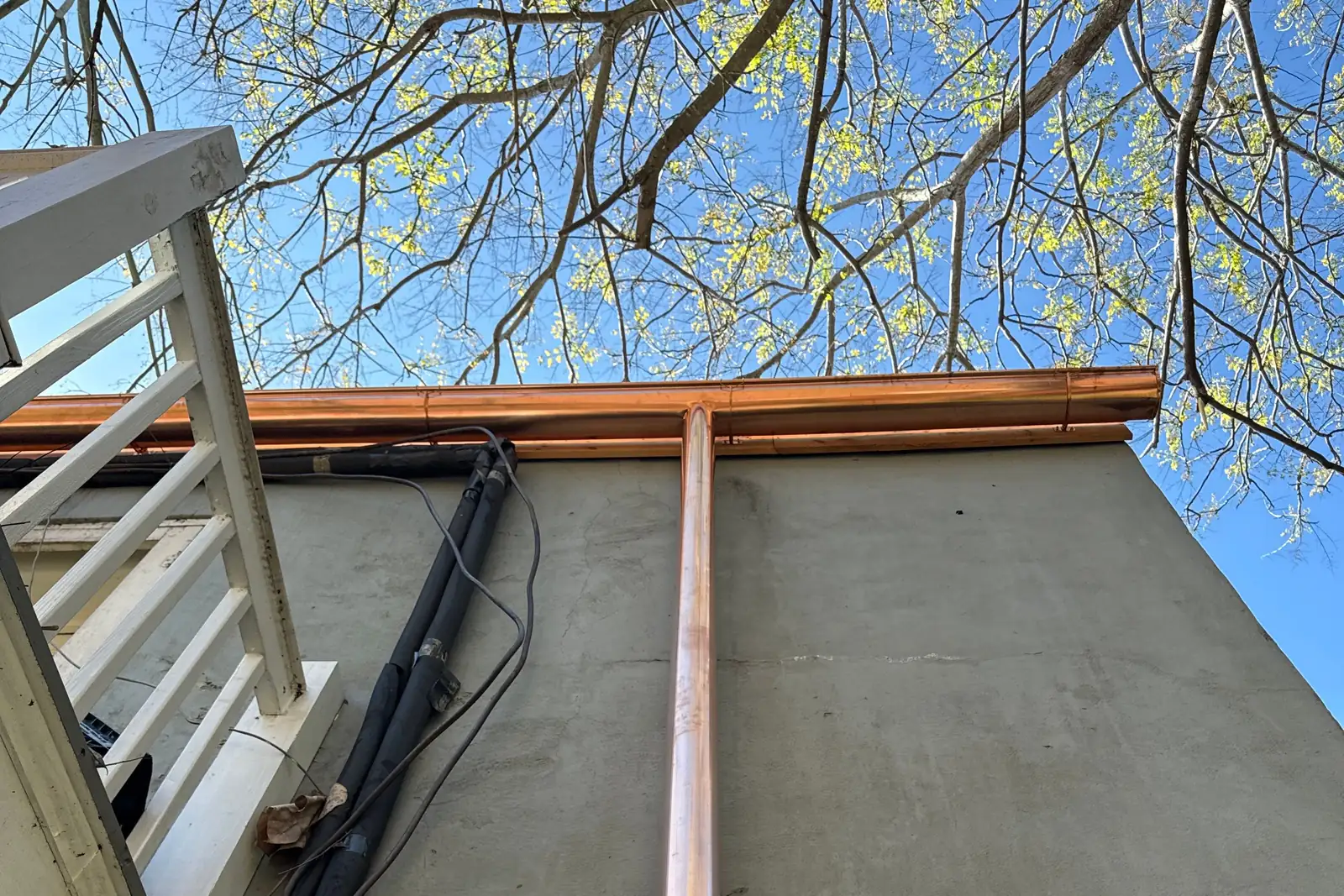
Austin Gutter Installation
Seamless K-Style Sized for Hill Country Storms and Oak Debris
Austin homes need gutters sized for sudden Hill Country thunderstorms and tuned for the local debris pattern — oak pollen and acorns drive most of the maintenance load. We install seamless aluminum K-style sized per SMACNA tables, with 2x3 or 3x4 downspouts based on actual drainage area, and micromesh guards where the tree canopy demands them.
Prefer to book online? Schedule your free Austin estimate
Schedule Your FREE
Roof Inspection & Estimate
Request a written estimate
Where is your property?
We serve Texas, Louisiana & Missouri
What do you need?
Almost done!
How can we reach you?
By submitting, you consent to follow-up messages. Reply STOP to opt out.
Sources we use
Check the scope against current guidance
Official sources reviewed September 7, 2026, plus a planning tool for comparing the decisions in your estimate.
What size gutters do I need for an Austin home?
5-inch K-style aluminum is adequate for most Austin homes. SMACNA reference tables show a 5-inch K-style handles roughly 5,520 square feet of drainage area at 4 inches per hour rainfall, which covers the typical Austin home roof. We step up to 6-inch with 3x4 downspouts on larger drainage areas, complex roofs with multiple valleys feeding one run, and homes with a history of overflow problems. Heavy oak debris pushes us toward micromesh guards regardless of size.
- 5-inch K-style covers most Austin homes
- 6-inch K-style for large drainage areas or complex roofs
- Spring storm intensity is high but short-duration
- Oak pollen and acorns drive guard selection
- Expansive clay soil makes downspout extension critical
How Austin Conditions Drive Gutter Specs
Austin Gutter Failures Are Sizing, Debris, and Foundation Drainage
Austin sees intense but short-duration thunderstorms in spring and early summer, with extended dry periods between. Combined with expansive clay soil and dense oak canopy in many neighborhoods, the dominant gutter problems are undersized capacity, clogged guards, and failed foundation drainage.
Spring Thunderstorm Deluge Intensity
Impact: Hill Country supercells can drop 1-3 inches of rain in 30-60 minutes. Undersized 5-inch K-style with a single 2x3 downspout on a long run can overflow in these events even when the system would handle a typical year.
Our Solution: We size to local rainfall intensity, not to the bare SMACNA 4 in/hr benchmark. For homes with large drainage areas or complex roof geometry, 6-inch K-style with 3x4 downspouts is the right call.
Oak and Cedar Debris Loading
Impact: Live oak shed cycles deposit pollen, leaves, and acorns into open gutters. Cedar elm and other Austin natives add to the debris mix. Twice-yearly cleanouts become every-3-month cleanouts in heavy-canopy yards.
Our Solution: Micromesh gutter guards with 200-275 micron stainless steel mesh handle the fine debris (oak pollen, shingle granules) while still letting water through. Reverse-curve guards struggle with oak seed pods.
Expansive Clay and Foundation Settling
Impact: Austin's expansive clay subsoil moves dramatically with seasonal moisture cycles. Water dumped at the foundation perimeter saturates the clay, accelerates differential movement, and leads to slab cracks and door/window misalignment.
Our Solution: Downspout extensions of at least 4-6 feet beyond the foundation, splash blocks at every discharge point, and where possible, underground drain tile to discharge water well away from the foundation.
Pollen Buildup at Downspout Outlets
Impact: Spring oak pollen is fine enough to slip through coarse-mesh guards but heavy enough to settle and clog at downspout transitions. Outlet blockages cause overflow even with otherwise-clean gutters.
Our Solution: Annual outlet inspection and cleanout is built into our service-call cycle for homes under heavy oak canopy. Larger 3x4 downspouts have more tolerance for pollen accumulation than 2x3.
No Ice Dam Concerns
Impact: Austin sees occasional freezes, but ice damming on residential roofs is rare. Heat tape and freeze-protection systems are not part of our standard Austin spec.
Our Solution: We focus on summer storm capacity and debris management, not winter ice. (Heat-tape considerations belong in our St. Louis spec, not Austin.)
Austin Gutter Considerations by Area
Tree canopy, roof complexity, and soil conditions vary across Austin. Common patterns:
Central Austin (Hyde Park, Travis Heights, Old Enfield, Tarrytown)
Mature live oaks, complex older rooflines, smaller lots with foundation stress.
6-inch K-style upgrade is common given roof complexity. Micromesh guards essential under oak canopy. Foundation drainage is a real concern given clay and lot drainage.
West Austin (West Lake Hills, Westlake, Rob Roy, Davenport Ranch)
Larger lots, premium homes, often complex roof geometry with multiple valleys.
Drainage area calculations frequently push us to 6-inch K-style with multiple 3x4 downspouts. Copper is an option for premium budgets and architectural fit.
South and Southwest Austin (Barton Hills, Travis Heights, South Lamar)
Mix of bungalows and 1990s-2010s subdivisions. Variable canopy.
5-inch K-style adequate for simpler subdivisions; 6-inch for older homes with complex roofs and significant canopy.
North and Northwest Suburbs (Round Rock, Cedar Park, Pflugerville)
Builder-grade subdivisions, often original gutters from build aging out.
Original builder gutters frequently undersized for the actual roof drainage area. 5-inch with adequate downspouts upgrades to 6-inch where the roof complexity demands.
Austin Gutter Installation Cost Ranges
Gutter pricing depends on linear footage, profile, gauge, downspout count and size, and gutter guard selection. We work in installed cost-per-LF tiers:
5" K-style aluminum, .027 gauge, basic install
Budget tier per LF
Adequate for typical Austin homes without heavy canopy or complex roofs.
5" or 6" K-style aluminum, .032 gauge, 3x4 downspouts
Standard tier per LF
Our default residential spec. Better gauge for hail and wind durability.
Coarse-mesh or perforated screen guards
Modest add per LF
Budget-tier debris management. Effective for large leaves only.
Micromesh guards (LeafFilter, MasterShield, Raptor)
Significant add per LF
Filters fine debris including oak pollen and shingle granules. Lifetime transferable warranties.
Half-round copper
Premium tier per LF
3-5x aluminum K-style cost. Reserved for historic and architecturally significant homes.
Factors Affecting Price
- 1Total linear footage and downspout count
- 2Profile (K-style standard, half-round premium)
- 3Material (aluminum standard, copper premium)
- 4Gauge (.027 vs .032)
- 5Downspout size and discharge configuration (splash blocks vs underground drain)
- 6Gutter guard selection
Ranges represent typical Austin contractor pricing for residential gutter installation as of mid-2026. Two-story homes, complex eave geometry, and inaccessible runs increase labor cost.
Our Austin Gutter Installation Process
Seamless gutters are formed on-site from a continuous aluminum coil. Here is the typical install sequence:
Site Walk and Sizing
On-site measurement of linear footage by elevation, drainage area calculation, downspout discharge planning. SMACNA tables applied for 5" vs 6" decision.
Local Note: In Austin we always check tree canopy density during the walk — guard selection is part of the sizing conversation.
Existing Gutter Removal (If Replacing)
Old gutters and hangers removed without damaging fascia. Fascia inspected for rot or termite damage; replaced where needed before new install.
On-Site Seamless Forming
A coil of color-matched .032 aluminum is fed through a portable forming machine staged at the home. Continuous gutter formed to the exact length needed for each run.
Hanger Layout and Slope
Hidden hangers screwed through fascia into rafter tail or sub-fascia, spaced 24-32 inches in standard residential. Gutter hung with about 1/4-inch fall per 10 feet toward the downspout.
End Caps, Miters, Outlets
Inside and outside corners formed and sealed. Strip miters or boxed miters per profile. Downspout outlets cut and crimped into the gutter at planned discharge points.
Downspouts and Discharge
Downspouts hung plumb, secured to wall with downspout straps every 6-8 feet. Discharge configured: splash blocks, downspout extensions, or underground drain tie-ins.
Local Note: For Austin homes on expansive clay, discharge should land at least 4-6 feet from the foundation. Splash blocks alone are usually inadequate; we recommend downspout extensions or tile.
Gutter Guard Install (If Selected)
Micromesh, reverse-curve, or screen guards installed per manufacturer instructions. Drop-in micromesh systems are the most common Austin upgrade.
Water Test and Walk
Hose test at multiple points to verify slope, downspout flow, and discharge. Photo documentation, manufacturer warranty registration where applicable.
Recommended Gutter Specs for Austin
Most Austin homes work well with a standard residential spec. Premium upgrades are about debris management and material longevity:
5" K-Style Aluminum, .032 Gauge
Why for Austin
Adequate capacity for typical Austin home drainage areas at typical Hill Country rainfall intensity. .032 gauge resists hail dents better than .027 and holds up to wind uplift.
Best For
Standard residential without heavy oak canopy or complex roof geometry.
Considerations
Single 2x3 downspout on a long run can overflow in spring deluge. Add intermediate downspouts on runs over 35-40 feet.
6" K-Style Aluminum, .032 Gauge, 3x4 Downspouts
Why for Austin
Significant capacity upgrade (~67% more volume per LF, plus larger downspout). Right call for complex roofs, large drainage areas, or chronic-overflow homes.
Best For
West Austin and Hill Country premium homes, central Austin homes with complex older rooflines, any home with multiple valleys feeding one gutter run.
Considerations
Visual scale is larger. Some 1920s-1940s homes look out of proportion with 6-inch; we discuss aesthetic on a per-home basis.
Micromesh Gutter Guards
Why for Austin
Oak pollen, fine debris, and shingle granules are the dominant clog drivers in Austin. Micromesh (200-275 micron stainless steel) filters all three while still letting water through.
Best For
Homes under live oak, cedar elm, or pecan canopy. Pine is less common in Austin but micromesh handles it well.
Considerations
Higher install cost than coarse-mesh or screen guards. Lifetime transferable warranties from major brands offset the upfront cost over time.
Why Hire Lapeyre for Austin Gutters
Gutters are part of the roof drainage system. Coming from roofing, we approach gutter sizing and installation with the math that matters and the integration details that prevent water from going where it should not.
SMACNA-Sized, Not Eyeballed
We do the actual drainage area calculation. Most Austin gutter problems are sizing problems, and the math is not hard if you bother to do it.
Roof Drainage Path Coordination
When valleys, kickout flashings, and roof penetrations all feed into one gutter, we plan downspout placement to handle the actual peak flow, not the average.
Foundation Drainage Awareness
Austin's expansive clay makes downspout discharge location more important than the gutter itself. We extend or tile-in discharge as part of the standard scope.
Climate-Appropriate Guard Selection
Micromesh for fine oak debris. We do not push reverse-curve where the debris pattern will defeat it.
Coordinated With Roof Work
When roof and gutter are part of one project, drip edge, ice/water shield, and gutter integration get done correctly the first time.
Design the outlet before selecting the gutter size
Map where each Austin roof section drains before selecting a gutter profile. A long run fed by several valleys behaves differently from an isolated porch eave. Ask for the contributing roof area, outlet locations, and the proposed overflow path; gutter width alone does not describe the drainage system.
For a home that collects rainwater, Austin Watershed Protection describes rainwater harvesting and rain gardens as stormwater-management options. Confirm storage, overflow routing, and maintenance access with the collection-system design. Do not route the gutter into a tank without establishing where water goes when that tank is full.
Compare a gutter replacement with a gutter-and-fascia repair as separate scopes. The hanger needs a suitable supporting surface, and gutter work should not conceal deteriorated fascia. Use the estimate tool to separate the roofing portion and explicit drainage allowances when part of a reroof; obtain a measured gutter quote rather than treating roof area as gutter length.
Compare your options before signing
Compare a written roof estimate
Use measured roof area, installed prices, and separate allowances to compare scope. Planning output is not a project quote.
Read more about this roofing decision
Gutter Sizing Guide: SMACNA Examples
Most residential gutter overflow problems are sizing problems, not material problems. Here is how SMACNA actually sizes K-style gutters and downspouts — with worked examples for the four metros we work in.
Gutter Guards Compared: LeafFilter vs LeafGuard
Four major gutter guard categories (micromesh, reverse-curve, screen, foam) handle four different debris patterns. Here is which guard actually works for your trees and climate.
FAQ
Frequently Asked Questions
What should an Austin gutter estimate show besides gutter width?
Ask for contributing roof areas, run lengths, downspout and outlet locations, fascia repairs, and overflow routing. Include cleaning access and any connection to rainwater storage.
Can a rain barrel replace a safe overflow route?
No. Establish where runoff goes when storage is full or an inlet is blocked. Austin provides stormwater-management guidance, but the routing needs to fit the actual property and collection system.
Do I need 5-inch or 6-inch gutters in Austin?
5-inch K-style is adequate for most Austin homes. SMACNA reference tables show 5-inch handles roughly 5,520 square feet of drainage area at 4 inches per hour rainfall. We step up to 6-inch with 3x4 downspouts on larger drainage areas (over ~5,000 sq ft of roof draining to one gutter), complex roofs with multiple valleys, and homes with chronic overflow history. The actual decision is based on drainage area, not house size.
How often do Austin gutters need cleaning?
Without guards: twice a year minimum, once after spring oak pollen and seed drop, once after fall leaf drop. Homes under heavy live oak canopy may need quarterly cleanouts. With micromesh guards: typically annual inspection plus quick checks after major storms. Reverse-curve guards work well against larger leaves but can struggle with oak seed pods and pine needles.
What about expansive clay and foundation issues?
Austin's expansive clay soil moves dramatically with seasonal moisture. Water dumped at the foundation perimeter accelerates differential movement and contributes to slab cracks and structural movement. We recommend downspout extensions of at least 4-6 feet from the foundation, splash blocks at every discharge, and where lot grade allows, underground drain tile to carry water well away from the house. Foundation drainage is a meaningful part of our gutter scope.
Are seamless gutters worth it over sectional?
Yes. Seamless gutters are formed on-site from continuous aluminum coil to match your exact roof length. Fewer joints means fewer failure points. Sectional gutters have a seam every 10 feet, and most leaks develop at those seams over time. Seamless also offers a cleaner appearance and typically lasts longer with less maintenance.
Which gutter guards work best for Austin?
For homes under live oak, cedar elm, or pecan canopy — which is most of central and west Austin — micromesh guards handle the local debris pattern best. Oak pollen, shingle granules, and seed pods all slip through coarse-mesh and reverse-curve guards but get filtered by 200-275 micron stainless steel mesh. LeafFilter, MasterShield, and several aftermarket micromesh systems work well. For homes with low canopy and primarily large-leaf debris, reverse-curve guards (Gutter Helmet, LeafGuard) can also work.
Do you replace fascia and soffit?
When tear-off reveals rotted fascia, yes — fascia replacement is part of the standard scope on a re-gutter where damage is found. Soffit work is included on a case-by-case basis. We document any fascia or soffit findings during the bid walk and provide a clear scope before work starts.
Is hail damage to gutters covered by insurance?
Hail dents on gutters are typically covered when the underlying storm event is documented for the roof claim. Cosmetic-only dents on aluminum are sometimes contested by carriers, but functional damage (creased gutters, separated hangers, downspout damage) is consistently covered. We include gutter damage in the documentation when we walk a roof claim.
How long does a gutter install take?
Typical Austin home: most installs complete in one working day, sometimes two days for larger homes or complex configurations. Seamless forming happens on-site, so there is no long lead time. Existing-gutter tear-off and fascia repair (when needed) are the main schedule variables.
Do I need heat tape on my gutters?
Not in Austin. Austin sees occasional freezes but does not have a chronic ice damming problem. Heat tape (heating cable) is a real consideration in St. Louis where freeze-thaw and ice dams are routine, but it is not standard spec for Austin homes.
Can you match my house color?
Most aluminum gutter coil is available in 20+ stocked colors. We can match almost any standard residential exterior. For unusual color matches, custom-color coil is available with longer lead times. Copper is unfinished and develops a verdigris patina; not a color-match material.
Contact information
Thank you for considering us for roofing needs. We will get back to you during normal business hours.


Send us a message