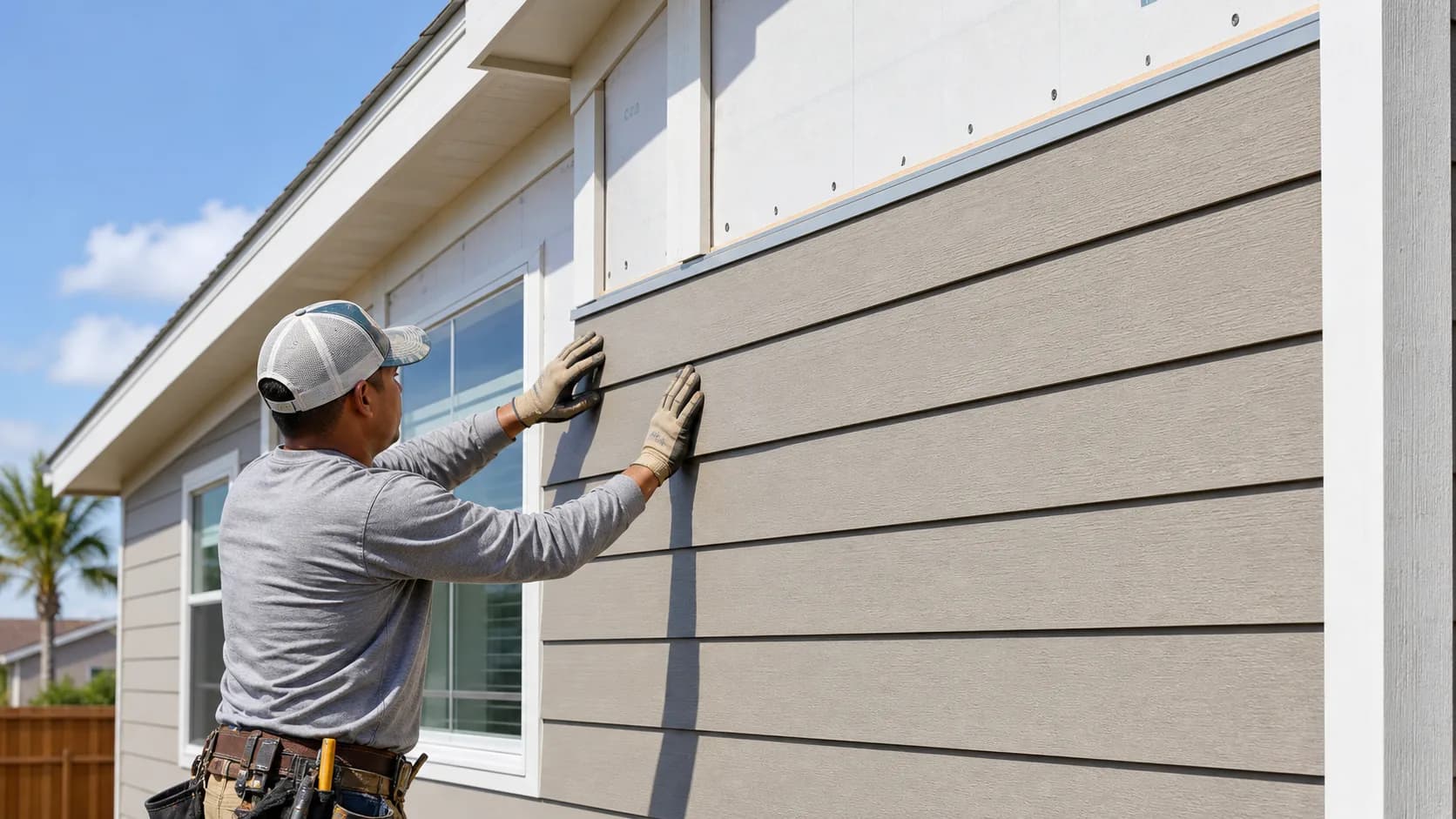
Houston Siding Installation
Hardie HZ10 and Hurricane-Rated Cladding for Gulf Coast Texas
Houston siding has to survive hurricane wind uplift, deluge rain at fastener penetrations, salt air in coastal-adjacent ZIPs, and chronic 90%+ humidity in the WRB layer. We default to James Hardie HZ10 fiber cement, the formulation engineered specifically for hot, humid, hurricane-exposed zones. For TDI windstorm-designated ZIPs, the entire wall assembly may be subject to WPI-8 inspection — we install to that spec.
Schedule Your FREE
Roof Inspection & Estimate
Request a written estimate
Where is your property?
We serve Texas, Louisiana & Missouri
What do you need?
Almost done!
How can we reach you?
By submitting, you consent to follow-up messages. Reply STOP to opt out.
What siding is best for Houston homes?
James Hardie HZ10 fiber cement is the right product line for Houston. Hardie engineers HZ10 specifically for zones 6-10 — hot, humid, and hurricane-exposed. It resists cracking, splitting, rotting, and swelling through gulf coast hurricane and tropical storm seasons. LP SmartSide engineered wood is a strong alternative with its 5/50/15 warranty and explicit hail damage coverage. We do not recommend uninsulated standard-grade vinyl in coastal-adjacent Houston ZIPs because of long-term durability issues with driven rain at fastener penetrations.
- Hardie HZ10 is the climate-matched product for Houston
- TDI windstorm program covers specific Houston-area ZIPs
- Salt air is a factor in coastal-adjacent neighborhoods
- Deluge rain creates fastener-penetration water intrusion risk
- IBHS FORTIFIED Wall principles apply even without a TX state grant
How Houston Conditions Drive Siding Selection
Hurricane, Deluge, and Salt Air All Hit Houston Walls
Houston layers hurricane wind on top of deluge rainfall, gulf-coast humidity, and (in coastal-adjacent ZIPs) salt air corrosion. Each driver demands a different siding response.
Hurricane Wind Uplift on Cladding
Impact: Hurricane wind pulls siding off walls when fastener density is inadequate. Vinyl is most at-risk in this scenario; fiber cement and engineered wood, properly fastened, hold up better.
Our Solution: We install Hardie per technical bulletin fastening density (which gets tighter in coastal high-wind zones) and use ring-shank or screw-shank fasteners for additional pull-out resistance. For TDI windstorm-designated ZIPs, fastening matches WPI-8 inspection requirements.
Deluge Rain at Fastener Penetrations
Impact: Houston routinely sees 100-year, 60-minute rainfall intensities exceeding the 4 in/hr SMACNA benchmark. Driven rain finds tiny gaps at every fastener and butt joint. WRB and flashing details are the actual waterproofing.
Our Solution: We use cap-nailing or stapling on housewrap WRB, lap shingled-style at every horizontal seam, and pay extra attention to head and sill flashing details. Hardie expansion gaps and butt-joint sealant per spec.
Salt Air Corrosion (Coastal-Adjacent ZIPs)
Impact: Inner-loop Houston is far enough from the coast that salt air is a minor factor. Galveston-adjacent neighborhoods see real salt corrosion on standard galvanized fasteners and aluminum trim.
Our Solution: For coastal-adjacent installs we spec stainless steel or hot-dip galvanized fasteners, copper trim accents where appropriate, and avoid aluminum where the salt exposure is chronic.
Chronic Humidity in the WRB Layer
Impact: Houston RH routinely exceeds 90% during summer. Trapped moisture in the wall cavity behind impermeable siding can drive substrate rot and mold growth.
Our Solution: We use vapor-permeable WRBs (housewrap rather than rigid sheet membrane in most installs) and avoid over-caulking on the exterior, which traps moisture inside the wall.
Termite Pressure in Older Neighborhoods
Impact: Houston is in heavy termite country. Wood-substrate siding without integral preservative treatment is at risk; LP SmartSide's SmartGuard zinc-borate process provides termite resistance.
Our Solution: Fiber cement (Hardie) is termite-inedible. LP SmartSide is treated. Solid wood siding is rarely the right call in Houston for this reason alone.
Houston Siding Considerations by Area
Houston is a sprawling metro with varied exposure to hurricane wind, salt air, and rainfall. Common patterns:
Inner Loop (Heights, Montrose, Rice Village, West U)
Older homes, frequent partial replacements after storm events, mature trees, complex original architecture.
Restoration vs replacement is real for historic-character homes. Hardie HZ10 with custom trim profiles can match older proportions. Termite history is common in older bungalows.
West Houston (Memorial, Energy Corridor, Katy)
Larger newer-build homes from 1990s-2010s, often with original builder-grade vinyl or hardboard composite siding aging out.
Replacement projects frequently reveal sheathing damage from years of failed flashing details. Hardie or LP upgrade with better flashing detailing is the typical scope.
Coastal-Adjacent (Galveston, La Porte, Seabrook, Clear Lake)
TDI windstorm-designated areas, salt air exposure, more aggressive hurricane wind history.
WPI-8 inspection requirements drive fastening density. Stainless or hot-dip galvanized fasteners. Salt-resistant trim materials. Hardie HZ10 with hurricane-rated install detail.
Southwest Houston (Sugar Land, Pearland, Missouri City)
Newer subdivisions, less salt exposure, similar hurricane wind risk to inner-loop Houston.
Hardie HZ10 standard install. Hurricane wind a factor but not at coastal-adjacent levels. LP SmartSide a strong alternative for hail-priority homeowners.
Houston Siding Cost Ranges
Houston siding pricing depends on material, house size, prep, trim complexity, and whether the home falls in a TDI windstorm-designated ZIP requiring upgraded fastening. We work in installed-cost ranges:
Premium vinyl, whole-house
Budget tier
VSI-certified premium grade only. Not recommended for coastal-adjacent homes due to long-term durability concerns.
Insulated vinyl
Modest premium over standard
Adds R-value and impact resistance; better hail performance.
LP SmartSide
Mid tier
Engineered wood with SmartGuard termite/decay treatment; 5/50/15 warranty plus 1.75-inch hail damage coverage.
Hardie ColorPlus HZ10
Premium tier
Climate-matched fiber cement; 30-year non-prorated substrate warranty.
TDI windstorm-designated ZIP upgrade
Add to base
WPI-8-spec fastening, stainless or hot-dip galvanized fasteners, additional inspection costs.
Factors Affecting Price
- 1Wall area and story count (multi-story coastal homes more involved)
- 2Sheathing condition revealed at tear-off (humidity damage common)
- 3TDI windstorm zone status (drives fastener spec)
- 4Salt-exposure trim and fastener material upgrades
- 5Removal and disposal of existing siding
Ranges represent typical Houston contractor pricing for residential siding as of mid-2026. Coastal-adjacent and TDI windstorm-designated ZIPs typically run higher than inner-loop Houston due to upgraded specs.
Our Houston Siding Install Process
Houston install priorities: hurricane fastening density, deluge-rated WRB and flashing detail, humidity-aware vapor permeability decisions.
Site Walk and TDI Status Check
On-site measurement, photo documentation, and check of whether the property falls in a TDI windstorm-designated ZIP. Different specs apply.
Local Note: TDI windstorm coverage is parcel-specific within Harris County. We confirm before bidding so the spec matches the inspection requirements.
Tear-Off and Sheathing Inspection
Existing siding removed. Sheathing inspected for humidity damage, termite damage, and rot. Damaged sheathing replaced before the new wall goes back on.
Vapor-Permeable WRB Installation
Housewrap-style WRB installed shingled with cap-nail or staple fastening per manufacturer instructions. Lap dimensions per spec, no shortcuts at joints.
Hurricane-Detailed Flashing
Pan flashing at every window sill, head flashing above, kickout flashing at every roof-to-wall transition, drip caps over horizontal trim. Sealed transitions to WRB.
Trim Installation
Corner boards, frieze boards, window/door surrounds — typically Hardie or LP trim profiles. Trim complete before siding install begins.
Siding Installation Per Hardie/LP Specs
Hardie HZ10: blind-nailed at higher fastener density per technical bulletin for wind-zone application. LP SmartSide: standard wood-style fastening per LP install instructions.
Local Note: For coastal-adjacent homes, we use stainless or hot-dip galvanized fasteners only. Standard galvanized fails fast in chronic salt exposure.
Sealant Per Spec, Not Beyond
Sealant only where the manufacturer spec calls for it. Over-caulking on exterior siding traps moisture in chronic high-humidity climate.
WPI-8 Inspection Coordination (If Applicable)
For TDI windstorm-designated ZIPs, we coordinate the inspection at the appropriate stages. Documentation kept for the warranty file.
Punch-List, Walk, Warranty Registration
Final walk-through with the homeowner, photo documentation, manufacturer warranty registration.
Climate-Matched Siding for Houston
Houston falls in Hardie's HZ10 zone — the formulation engineered for hot, humid, hurricane-exposed climates. We install only HZ10 in Houston (not HZ5).
James Hardie HardiePlank HZ10 (ColorPlus)
Why for Houston
Engineered specifically for zones 6-10. Resists cracking, splitting, rotting, and swelling through hurricane and tropical storm seasons. Salt-tolerant when properly fastened. ColorPlus baked-on finish holds pigment under sustained UV.
Best For
Premium budgets, hurricane-exposed homes, TDI windstorm-designated parcels.
Considerations
Heavier than vinyl or engineered wood. Specialty cutting blades and dust collection. Fastener density tighter in wind zones — non-negotiable for warranty.
LP SmartSide (ExpertFinish)
Why for Houston
Engineered wood with SmartGuard zinc-borate treatment for termite and decay resistance — important in Houston's heavy termite pressure. 5/50/15 warranty plus explicit 1.75-inch hail damage coverage.
Best For
Hail-priority homeowners, faster install, lighter weight for upper-story access on multi-story homes.
Considerations
Slightly lower long-term substrate warranty than Hardie (50 years prorated vs Hardie 30 years non-prorated). Standard wood-style fastening.
Insulated Vinyl (Premium Grade Only)
Why for Houston
Foam-backed panels improve impact resistance and add modest R-value. ASTM D3679 / VSI-certified premium grade required for hurricane-zone applications.
Best For
Budget tier, inner-loop Houston without coastal salt exposure, smaller homes with simple geometry.
Considerations
Not recommended for coastal-adjacent Houston ZIPs due to long-term fastener-penetration durability concerns. Heat distortion risk on dark colors.
Why Hire Lapeyre for Houston Siding
Houston siding work has technical depth: TDI windstorm spec, salt-aware fastener selection, hurricane-rated install detail, deluge-rated flashing. Coming from roofing, the flashing and integration details are second nature.
TDI Windstorm-Aware Install
For parcels in TDI windstorm-designated ZIPs, we install to WPI-8 inspection spec. Documentation kept clean for the warranty file.
FORTIFIED Wall Principles
Texas does not have a state FORTIFIED grant program (unlike Louisiana), but FORTIFIED Wall and Gold construction practices apply anywhere. We bring those principles into every coastal install.
Roofer's Approach to Wall Flashing
Pan flashing at sills, head flashing at openings, kickout flashing at every roof-to-wall transition. Non-negotiable details we bring from roofing into siding work.
Insurance-Claim Documentation
After hurricane and hail events, we document slope-by-slope, panel-by-panel for storm scope. Same playbook we use for roofs.
Coordinated Exterior Scope
When siding, gutters, windows, and roof all need post-storm work, we coordinate the schedule and the warranty boundaries.
How We Approach Siding in Houston
Houston siding is more technical than most metros. The TDI windstorm program covers specific ZIPs in Harris County, and within those ZIPs the entire wall assembly is subject to WPI-8 inspection — fastener type, fastener spacing, anchor patterns, the whole spec. Outside those ZIPs, hurricane wind and deluge rain still apply, just without the inspection layer. We install Hardie HZ10 (the correct climate formulation for Houston, never HZ5) with fastener density that matches the wind zone, vapor-permeable WRBs because chronic 90%+ humidity demands the wall cavity can dry, and stainless or hot-dip galvanized fasteners on coastal-adjacent jobs because standard galvanized fails fast in salt air. The flashing details we bring from roofing — pan flashing at sills, head flashing at openings, kickout flashing where roofs meet walls — matter even more in deluge-rain country than they do inland. After hurricane and tropical storm events, we document storm damage the same way we document roof claims: slope by slope, panel by panel, with the same supplement strategy when initial adjuster estimates miss damage.
Read more about this roofing decision
Siding Cost in Houston, TX: 2026 Guide
Houston siding cost reflects the technical reality of hurricane country: TDI windstorm-zone fastening upgrades, salt-aware fasteners for coastal-adjacent ZIPs, and Hardie HZ10 formulation as the climate-matched product. Here is what homeowners actually pay in 2026.
Best Siding for Texas Heat: 2026 Guide
Texas heat is an underrated siding stressor. Surface temperatures on south-facing dark walls regularly exceed 165°F in summer — enough to soften lower-grade vinyl. Here is which siding actually survives Texas heat, hail, and Hill Country UV.
James Hardie vs LP SmartSide: Installer Guide
Hardie and LP both make excellent siding. The right choice depends on hail-warranty priority, install logistics, warranty structure, and a few specific climate considerations. Honest comparison from installers.
Siding Insurance Claims: Storm Damage Guide
Siding storm damage is one of the most under-claimed line items on residential policies. Here is the documentation playbook that gets adjusters to scope what is actually damaged — adapted from years of roofing-claim work.
FAQ
Frequently Asked Questions
Is Hardie HZ5 or HZ10 right for Houston?
HZ10. Houston sits in zones 6-10 by James Hardie's HardieZone System, which means HZ10 is the climate-matched formulation. Hardie engineers HZ10 specifically for hot, humid, hurricane-exposed climates. HZ5 is the cold-climate formulation for zones 1-5 (think St. Louis or Chicago). Installing HZ5 in Houston would be a climate mismatch.
Does my Houston home need impact-rated siding?
Code requirements vary by ZIP. Specific Harris County ZIPs in the Texas Department of Insurance windstorm program may require WPI-8 inspection of the wall assembly, which dictates fastener density and installation detail. Outside those ZIPs, impact rating is not code-required but still a meaningful consideration for hurricane-exposed homes. We confirm TDI status during the bid walk.
What is the TDI windstorm program?
The Texas Department of Insurance Windstorm Inspection Program (commonly called WPI-8) covers specific coastal counties and ZIPs along the Texas gulf coast. For homes in covered areas, building inspections at specific construction stages verify wind-resistant construction practices including roof, wall, and opening details. The certification can affect insurance availability and rates. Houston has both covered and uncovered ZIPs within Harris County.
Will my insurance cover siding hurricane damage?
Wind, hail, wind-driven debris, and hurricane wind are typically named perils on Houston homeowners policies. The challenge is documentation. Hidden vinyl bruising, wind-creased fiber cement, and back-side water intrusion are routinely missed by adjusters. We document slope-by-slope and panel-by-panel and supplement when initial estimates miss damage — same playbook we use for roof claims.
Can I use vinyl siding in Houston?
In inner-loop Houston, premium-grade vinyl (0.046 inches or thicker, ASTM D3679 / VSI-certified) can work for budget-driven projects on simpler homes. In coastal-adjacent ZIPs and on hurricane-exposed elevations, we typically steer toward fiber cement or engineered wood for long-term durability. Standard-grade vinyl is not appropriate for coastal Texas applications regardless of price.
How long does a Houston re-side take?
For a typical 2,500 square foot Houston home with no major sheathing damage, 5 to 10 working days. TDI windstorm-designated parcels add inspection coordination time. Hurricane-season weather windows can add scheduling unpredictability — we plan around tropical-system tracks when conditions warrant.
Does FORTIFIED apply in Texas?
FORTIFIED is a national IBHS standard, so the construction practices apply anywhere. The question is whether your state has an active grant program or insurance-discount program. Texas does NOT have a state FORTIFIED grant program (unlike Louisiana, which runs the Louisiana Fortify Homes Program with up to $10,000 grants). However, IBHS FORTIFIED Wall and Gold construction practices are still the right framework for hurricane-exposed Texas homes, even without a state grant.
How does humidity affect siding choice in Houston?
Houston runs 90%+ relative humidity for much of the year. Vapor-permeable WRBs (housewrap rather than rigid sheet membrane) help the wall cavity dry. Over-caulking on exterior siding traps moisture inside the wall and accelerates substrate damage. Hardie fiber cement is dimensionally stable across humidity cycles; LP SmartSide's SmartGuard treatment provides moisture and decay resistance. Solid wood siding is generally not the right call in Houston because of humidity-driven movement and termite pressure.
Do I need stainless steel fasteners?
For coastal-adjacent Houston ZIPs (Galveston, La Porte, Seabrook, Clear Lake area), yes — chronic salt air exposure causes standard galvanized fasteners to fail within years. Hot-dip galvanized is acceptable for moderate exposure; stainless steel for severe exposure. Inner-loop Houston has minimal salt exposure and standard hot-dip galvanized fasteners are typically adequate.
What about historic Heights and Montrose homes?
Many older Houston homes have original wood siding that may be partly salvageable. We discuss restoration vs replacement before bidding. For homes outside historic-protected districts, full replacement to Hardie HZ10 yields the biggest long-term durability gain. For historic-protected homes, we coordinate with appropriate restoration approaches and discuss matching profiles when partial replacement makes sense.
Contact information
Thank you for considering us for roofing needs. We will get back to you during normal business hours.


Send us a message