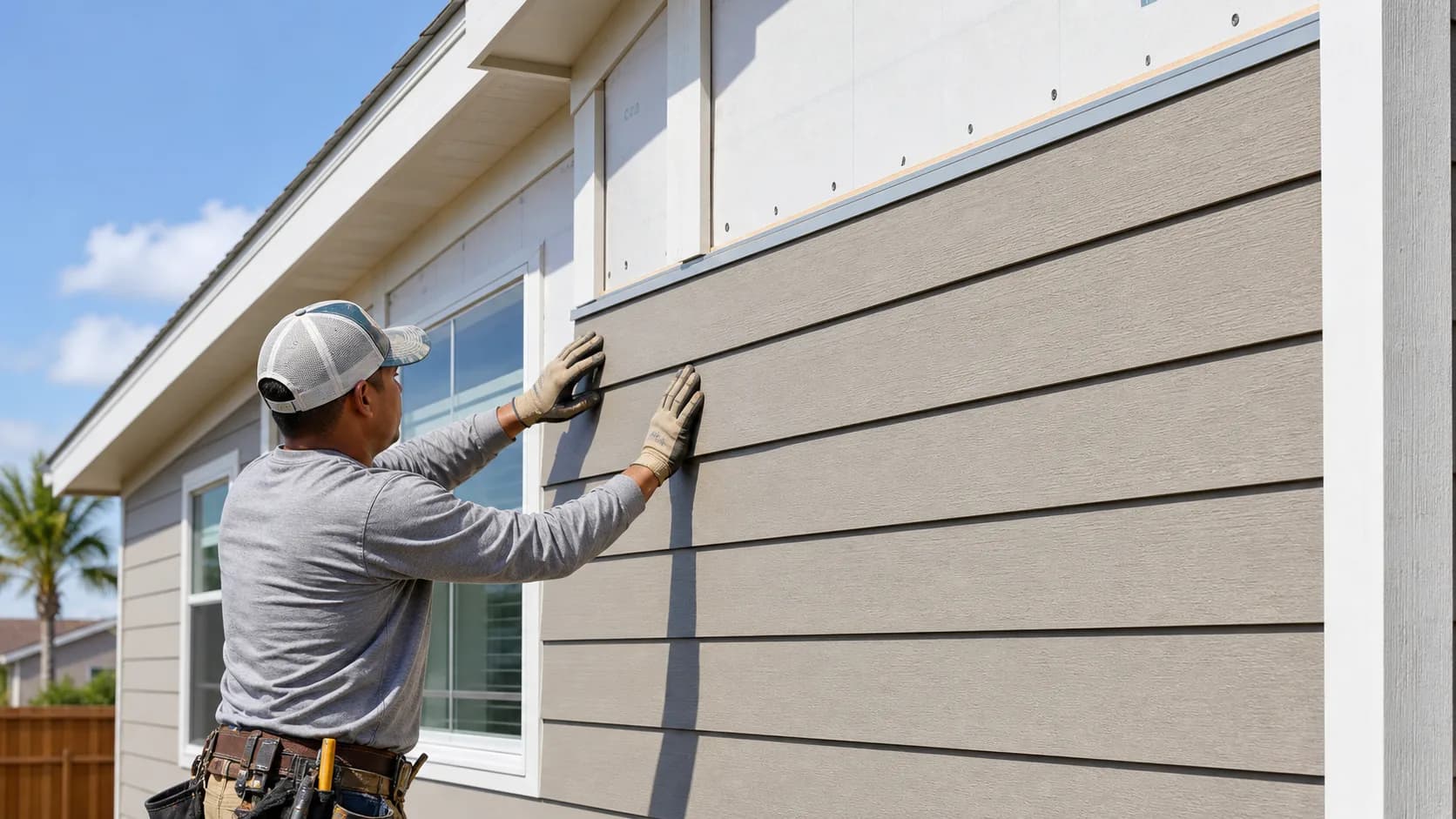
Austin Siding Installation
Hardie HZ10 and LP SmartSide for Hill Country Heat, UV, and Hail
Austin siding is mostly about UV, thermal cycling, and the occasional hail event — not hurricanes. We install James Hardie HZ10 fiber cement (engineered for hot, humid zones), LP SmartSide engineered wood with its 1.75-inch hail damage warranty, and certified premium vinyl when budget rules the upgrades out. Same storm-documentation approach we bring to roofs.
Prefer to book online? Schedule your free Austin estimate
Schedule Your FREE
Roof Inspection & Estimate
Request a written estimate
Where is your property?
We serve Texas, Louisiana & Missouri
What do you need?
Almost done!
How can we reach you?
By submitting, you consent to follow-up messages. Reply STOP to opt out.
What siding is best for Austin homes?
For most Austin homes we recommend James Hardie HZ10 fiber cement, the formulation engineered specifically for hot, humid, hurricane-exposed zones 6 through 10. LP SmartSide engineered wood is a strong alternative, particularly because it carries an explicit hail-damage warranty up to 1.75 inches in diameter when properly installed. Premium vinyl (0.046 inches or thicker, certified to ASTM D3679 by the VSI program) works as a budget tier, with the caveat that dark colors can heat-distort on south- and west-facing walls in Texas summers.
- Hardie HZ10 is the climate-matched fiber cement product for Austin
- LP SmartSide carries a hail-damage warranty up to 1.75 inches
- Premium vinyl works in moderate climates; risky on south/west elevations
- Travis County is NOT a TDI windstorm-designated county — no WPI-8
- Austin does not require impact-rated cladding by code
How Austin Weather Drives Siding Selection
Austin Siding Failures Are UV, Heat, and Hail — Not Hurricane
Austin sits at roughly 30° N latitude and routinely sees triple-digit summer surface temperatures on south- and west-facing walls. The dominant siding failure modes are UV degradation, thermal cycling at fasteners and caulk joints, and hail impact during spring storm season.
UV Degradation on Dark Colors
Impact: Sustained UV exposure fades pigmented siding unevenly across elevations. Field-painted fiber cement and lower-grade vinyl show this fastest. Repair patches rarely color-match years-old siding.
Our Solution: We default to ColorPlus or ExpertFinish factory-applied finishes for pigment longevity and recommend lighter color families on south and west elevations whenever the homeowner is open to it.
Thermal Cycling at Caulk Joints
Impact: Austin can swing 40°F+ in a 24-hour window during seasonal transitions. Standard acrylic latex caulks fail at expansion-prone joints (window heads, butt joints, transition trim). Once the caulk fails, water finds the WRB and works inward.
Our Solution: We use elastomeric, manufacturer-approved sealants only where the spec calls for them, install proper expansion gaps per Hardie technical bulletins, and avoid over-caulking (which traps moisture).
Hail Impact (Spring and Early Summer)
Impact: Travis County has a documented hail history. Hail bruises vinyl, can crack lower-grade fiber cement, and dents soft-metal trim and fascia. Adjusters routinely miss hidden bruising on vinyl panels.
Our Solution: For hail-priority homeowners we recommend LP SmartSide (with its named hail warranty) or Class 4-rated systems where applicable. We document slope-by-slope after any storm event for insurance.
Expansive Clay Soil and Grade Clearance
Impact: Austin's expansive clay subsoil moves with seasonal moisture. Siding installed too close to grade splash-soaks during storms and wicks moisture into the substrate.
Our Solution: We hold siding 6 inches from earth and 2 inches from hard surfaces per Hardie technical specs, install proper kickout flashing where roofs meet walls, and inspect grade conditions during the bid walk.
Driving Rain at Window and Door Penetrations
Impact: Sudden Hill Country downpours can drive rain horizontally against west-facing walls. Failed sill pans and missing head flashings let water bypass the siding entirely.
Our Solution: We approach the wall the way we approach a roof — pan flashing at every sill, head flashing at every opening, sealed WRB transitions. The siding is the cover, not the system.
Austin Siding Considerations by Area
Architecture, sun exposure, and tree canopy vary significantly across Austin neighborhoods. Common patterns we plan for:
Central and East Austin
Older homes with original wood siding, frequent partial replacements after storm damage, mature tree canopy.
Color-match challenges on partial replacements are real. We discuss matching limitations before work starts and document for insurance "matching" coverage when applicable.
West Austin and Hill Country
Larger homes, often stucco-and-stone with limited siding sections, premium budgets and architectural priorities.
Hardie ColorPlus in factory-applied finishes for color longevity. Stone and stucco transitions need disciplined flashing details to prevent water intrusion.
South and Southwest Austin
Mix of older bungalows and newer-build subdivisions, generally lower tree canopy and higher UV exposure.
High-UV elevations benefit most from ColorPlus over field-painted finishes. South- and west-facing walls show fade fastest.
North and Northwest Austin Suburbs
Builder-grade homes from the 1990s-2010s with original siding aging out, often vinyl or hardboard composites being replaced.
Many of these homes had hardboard composite siding (e.g., LP InnerSeal) that has reached end-of-life. Tear-off reveals OSB sheathing condition that often needs partial replacement.
Austin Siding Cost Ranges
Siding cost depends on material, house size, prep work, trim complexity, and access. Rather than quote a point estimate that ages quickly, we work in installed-cost ranges sourced from current Austin contractor pricing. For your specific home, we provide a written estimate after a measure-up.
Premium vinyl, whole-house
Budget tier
Rated to ASTM D3679; 0.046+ inch panel grade for wind durability. Risk: heat distortion on dark colors south/west.
Insulated vinyl
Modest premium over standard vinyl
Adds ~R-2 to R-3 continuous insulation; better impact resistance for hail.
LP SmartSide
Mid tier
Engineered wood with SmartGuard; 5/50/15 warranty, 1.75-inch hail damage coverage.
Hardie ColorPlus HZ10
Premium tier
Factory-finished fiber cement; 30-year non-prorated substrate warranty. Premium driven by trim complexity and color selection.
Factors Affecting Price
- 1Wall area, story count, and access difficulty
- 2Sheathing replacement quantity revealed at tear-off
- 3Trim profile complexity (corner boards, frieze, window/door surrounds)
- 4Removal and disposal of existing siding
- 5Color selection (ColorPlus standard vs custom)
Ranges represent typical Austin contractor pricing for residential whole-house re-sides as of mid-2026. Your specific home may fall outside these ranges depending on access, structure repair scope, and premium material selections.
Our Austin Siding Install Process
Siding done right starts at the WRB and flashing layer, not the cladding. Here is how we approach a typical Austin re-side:
Site Walk and Bid
On-site measurement, photo documentation of every elevation, review of existing siding condition, sheathing access where possible.
Local Note: In Austin we always check grade clearance on the south and west elevations — many homes show siding installed too close to expansive clay grade.
Tear-Off and Sheathing Inspection
Existing siding removed in panels, debris contained. OSB or plywood sheathing inspected for rot and termite damage. Damaged sheathing replaced before anything new goes back on.
Weather-Resistive Barrier (WRB)
Continuous housewrap or self-adhered membrane installed shingled correctly so water sheds outward at every horizontal lap.
Flashing Details
Pan flashing at every window sill, head flashing above every opening, kickout flashing at roof-to-wall transitions, drip caps over horizontal trim.
Local Note: Driving rain on west elevations during summer storms is the single most common water-intrusion path on Austin homes. We pay extra attention to west-facing pan and head flashings.
Trim Installation
Corner boards, frieze boards, window and door surrounds installed first. Trim sets the rhythm for siding course layout.
Siding Installation
For Hardie: blind-nailed per technical bulletin, 3/4-inch from butts, expansion gaps maintained. For LP SmartSide: standard wood-style fastening per LP install instructions. For vinyl: middle-third of nail-slot, panels free to expand laterally.
Sealant and Punch-List
Sealant only where the manufacturer spec calls for it. Final walk-through, photo documentation for the file, manufacturer warranty registration.
Climate-Matched Siding for Austin
Austin falls in James Hardie's HZ10 zone — the formulation engineered for hot, humid, and hurricane-exposed zones. We do not install HZ5 in Austin (that is the cold-climate formulation for St. Louis-type markets).
James Hardie HardiePlank HZ10 (ColorPlus)
Why for Austin
Engineered specifically for hot, humid zones 6-10. Resists cracking, splitting, rotting, and swelling through Texas heat and storm seasons. ColorPlus baked-on finish holds pigment under sustained UV exposure.
Best For
Premium budgets, long service life, factory-finished color longevity, Class A fire rating.
Considerations
Heavier than vinyl or engineered wood. Specialty cutting blades and dust collection during install. Fastener spec is non-negotiable for warranty.
LP SmartSide (ExpertFinish)
Why for Austin
Engineered wood with SmartGuard zinc-borate treatment for termite and decay resistance. Carries a 5/50/15 warranty plus an explicit hail damage warranty up to 1.75 inches in diameter when properly installed.
Best For
Hail-priority homeowners, faster install schedules, cleaner cuts than fiber cement, similar paintability.
Considerations
Slightly lower long-term substrate warranty than Hardie (50 years prorated vs Hardie 30 years non-prorated). Standard wood-style fastening.
Premium Insulated Vinyl
Why for Austin
Insulated panels (foam-backed) reduce oil-canning, improve impact resistance against hail, and add modest R-value. Certified to ASTM D3679 with VSI Product Certification Program backing.
Best For
Budget tier, moderate climate exposure, homeowners prioritizing low maintenance and zero painting.
Considerations
Heat distortion risk on dark colors at south and west elevations. Color-fade unevenness complicates partial replacements. Hail performance below fiber cement at cold temps.
Why Austin Homeowners Hire a Roofer for Siding
Most siding failures begin at flashings — the wall-to-roof transitions, window heads, and sill pans where water finds its way past the cladding. We have spent years inspecting those failures from the roof side. Now we install the wall side too.
Roofer's Approach to Wall Flashing
Pan flashing at sills, head flashing at openings, kickout flashing at every roof-to-wall transition. Non-negotiable details we bring from roofing into siding work.
Climate-Specific Product Selection
We install Hardie HZ10 in Austin (the correct climate formulation) and discuss climate-zone-mismatched products honestly when homeowners ask about HZ5 or other lines.
Insurance-Claim Documentation
After hail and wind events, we document slope-by-slope, panel-by-panel, the same way we do for roof claims. Hidden vinyl bruising and wind-creased fiber cement frequently get missed by adjusters.
Coordinated Exterior Scope
When siding, gutters, and roof all need work, we coordinate the schedule so trim, flashing, and gutters all integrate cleanly instead of creating warranty boundary disputes.
Local Austin Office
Real local presence, not a storm-chase pop-up. We are still here next year for warranty claims and follow-up inspections.
How We Approach Siding in Austin
We are upfront about being roofers expanding into exterior services rather than a 20-year siding company. What we bring to siding installation is the same systematic approach we bring to roofing: get the WRB and flashing details right, match the product to the climate (HZ10 for Austin, not HZ5), follow manufacturer technical bulletins to the letter, and document everything for the file. After hundreds of roof claims, we know how adjusters look at storm damage and how to write a scope that survives review. That experience extends directly to siding hail and wind claims, which are routinely under-scoped in initial estimates. For homeowners who want a single contractor to handle the full exterior — roof, siding, gutters, windows — we keep the warranty boundaries clean and the schedule coordinated so each trade transitions properly into the next.
Read more about this roofing decision
Siding Cost in Austin, TX: 2026 Guide
Austin siding cost depends on material, house size, and a few Texas-specific factors that quotes often skip over. Here is what homeowners actually pay in 2026, sourced from current market pricing and broken down by material family.
Best Siding for Texas Heat: 2026 Guide
Texas heat is an underrated siding stressor. Surface temperatures on south-facing dark walls regularly exceed 165°F in summer — enough to soften lower-grade vinyl. Here is which siding actually survives Texas heat, hail, and Hill Country UV.
James Hardie vs LP SmartSide: Installer Guide
Hardie and LP both make excellent siding. The right choice depends on hail-warranty priority, install logistics, warranty structure, and a few specific climate considerations. Honest comparison from installers.
Siding Insurance Claims: Storm Damage Guide
Siding storm damage is one of the most under-claimed line items on residential policies. Here is the documentation playbook that gets adjusters to scope what is actually damaged — adapted from years of roofing-claim work.
FAQ
Frequently Asked Questions
Is Hardie HZ5 or HZ10 right for Austin?
HZ10. James Hardie engineers HZ10 for hot, humid, hurricane-exposed zones 6 through 10, which includes Austin. HZ5 is the cold-climate formulation for zones 1 through 5 (think St. Louis or Chicago). Installing HZ5 in Austin would be a climate mismatch — the product is not engineered for sustained heat and humidity exposure.
Do Austin homes need impact-rated siding?
Code does not require it. Travis County is not a Texas Department of Insurance windstorm-designated county, and Austin's building code does not mandate impact-rated cladding. That said, hail is a real factor in spring storms. LP SmartSide carries an explicit hail damage warranty up to 1.75 inches in diameter when properly installed, which makes it a strong choice for hail-priority homeowners. We discuss hail-rated upgrades on a per-home basis.
Will my insurance cover siding storm damage?
Wind, hail, and wind-driven debris are typically named perils on Austin homeowners policies. The challenge is documentation. Hidden hail bruising on vinyl, wind-creased fiber cement, and back-side water intrusion are routinely missed by adjusters. We document slope-by-slope and panel-by-panel and supplement when initial estimates miss damage — the same playbook we use for roof claims.
How long does an Austin re-side take?
For a typical 2,500 square foot Austin home with no major sheathing damage, 5 to 10 working days from tear-off to punch-list. Multi-story homes, complex trim, and homes needing significant sheathing repair run longer. Spring hail-season weather windows can add scheduling unpredictability.
Can I get partial siding replacement after hail damage?
Yes, but we are honest about color-match limitations before we start. UV fade on Texas walls is uneven, especially on south and west elevations. A new panel rarely blends perfectly with siding that has been in service for several years. In most hail and wind insurance claims, this is a covered "matching" issue under standard policy language, and we present it that way to the adjuster as part of the scope.
Do you install vinyl siding in Austin?
Yes, when the budget rules out fiber cement or engineered wood and the homeowner understands the trade-offs. We use VSI-certified premium-grade panels at 0.046 inches thick or heavier, certified to ASTM D3679 for wind, weatherability, and impact resistance. We avoid dark vinyl colors on south and west elevations because of heat-distortion risk in 100°F+ surface temperatures.
What about stucco and stone — do you do those?
We coordinate with masonry and stucco partners on whole-exterior projects but do not self-perform stucco or stone work. Where a home has mixed cladding (Hardie at upper elevations and stone at the base, for example), we handle the siding scope and integrate flashing and weather barrier details cleanly with the masonry partner.
How does Hardie's warranty work?
James Hardie's standard substrate warranty is 30 years, non-prorated, and transferable. The ColorPlus baked-on factory finish has its own separate warranty. Both warranties assume installation per Hardie's technical bulletins, which include specific fastener types, blind-nailing patterns, expansion gaps, and clearance from grade. We follow those bulletins to the letter so the warranty applies.
What is the difference between primed Hardie and ColorPlus?
Primed Hardie ships with a factory primer and is field-painted on site, typically with 100% acrylic paint. ColorPlus Hardie ships with a baked-on factory finish in a defined color palette. ColorPlus carries its own warranty separate from the substrate warranty, holds color noticeably longer in UV exposure, and skips the labor cost and weather-window risk of field painting. The trade-off is a more limited color selection.
Can you match my home's existing trim and architectural details?
Most of the time, yes. Hardie and LP both make a wide range of trim profiles — corner boards, frieze, window and door surrounds, lap profile widths matching common existing siding. For unusual historic profiles, we discuss custom trim options or alternative matching strategies up front.
Contact information
Thank you for considering us for roofing needs. We will get back to you during normal business hours.


Send us a message