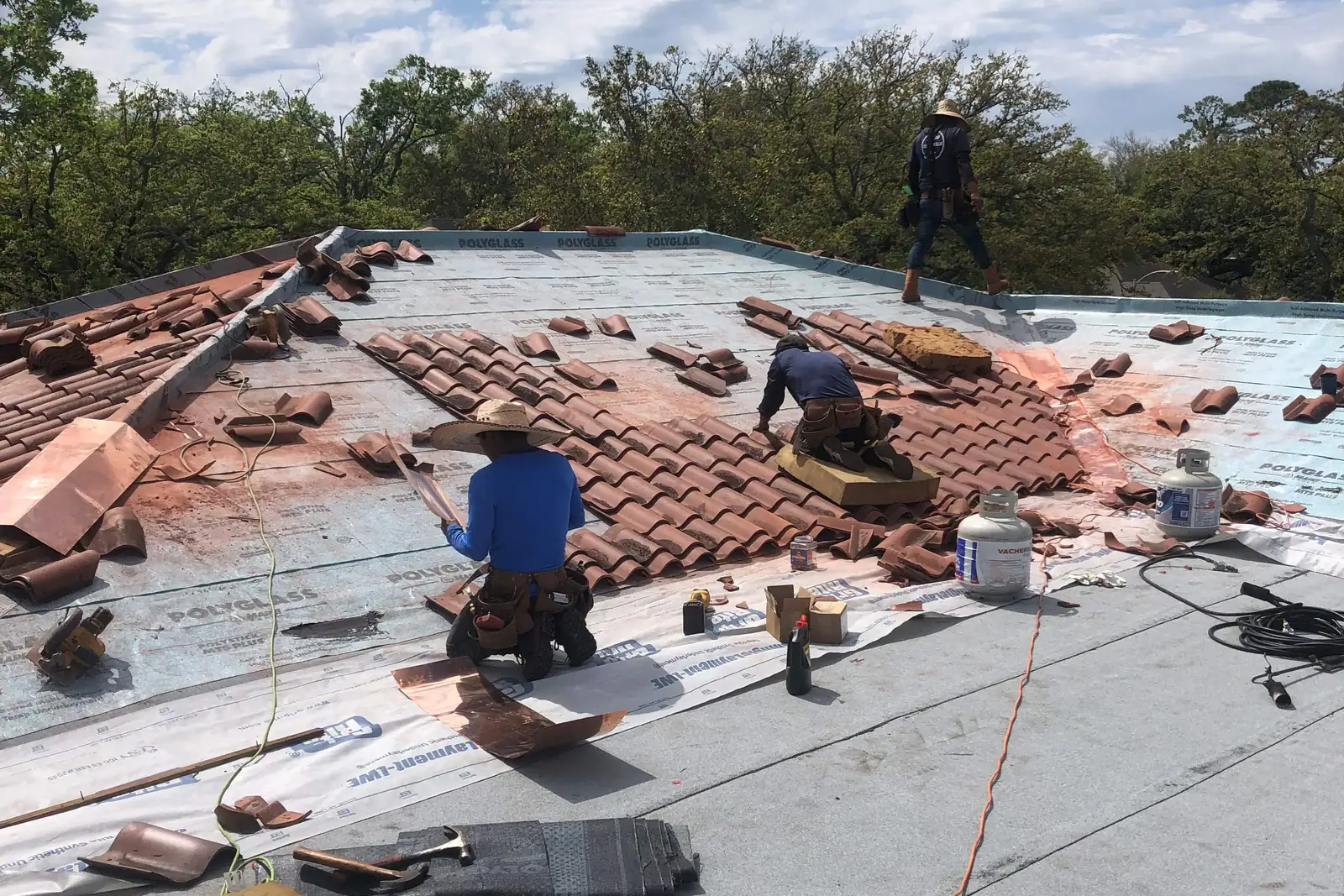
Tile Roof Repair
Cracked tiles, slipped tiles, failed flashings, ridge mortar, worn-out underlayment — we repair clay, concrete, and slate roofs without replacing what still has decades of life left.
Tile Roof Repair Financing Options
We partner with multiple lenders to offer financing for all credit levels. A soft credit pull checks your options without affecting your score.
Pay off your project within 18 months with zero interest.
Spread your project cost over up to 20 years for the lowest monthly payment.
Our multi-lender platform finds options where single-bank programs turn people away.
Subject to credit approval. Terms and conditions apply. Contact us for details.
The Five Ways Tile Roofs Fail
- Cracked tiles: hail, foot traffic, or falling limbs — replaced individually
- Slipped tiles: corroded fasteners, broken lugs, or rotted battens let tiles slide out of course
- Underlayment failure: the waterproofing membrane wears out at 25-35 years, long before the tile
- Flashing failure: valleys, chimneys, and wall flashings corrode and open up
- Ridge and hip mortar: rigid mortar cracks as the roof moves, loosening cap tiles
- Nearly every tile "roof failure" is one of these five — and all five are repairs, not replacements
The Walking-On-Tile Warning
- Foot traffic is a leading cause of tile damage — one wrong step cracks clay and concrete alike
- Satellite installers, painters, and pressure washers break tiles on roofs constantly
- Our crews walk the load-bearing head laps and hips, use foam pads and walk boards, and still budget for breakage
- If anyone needs roof access, have a tile-experienced crew do the walking
- Post-trade inspections available after other contractors have been on your roof
What Tile Repairs Cost
- Individual tile replacement: quote the tile count, matching availability, access, and handling work after inspection
- Flashing repairs: define the affected valleys, chimneys, or penetrations and specify the metal and removal scope
- Underlayment-only re-felt: quote lifting tiles, replacing the membrane, and reinstalling reusable tiles, including a breakage allowance
- Ridge and hip re-bedding or dry-ridge conversion, priced by the linear foot
- Written scope and pricing after inspection — no phone-quote guesswork
Repair vs. Replace — and the Insurance Angle
- If the tile field is sound, repair wins: tiles are reusable assets, not consumables
- Hail-cracked tile is a well-established insurance claim, especially in Texas hail country
- We document cracked tiles slope by slope, dated to the storm, with matching-tile availability addressed
- Salvage networks supply weathered, discontinued tiles so repairs blend in
- Replacement only makes sense when the tiles themselves have broadly failed or cannot be matched
- GAF Master Elite, BBB A+, licensed in Texas, Louisiana, and Missouri
Frequently Asked Questions
Get answers to common questions about our tile roof repair services.
How much does tile roof repair cost?
We quote tile repairs after inspection. The estimate should identify the damaged tile count, matching availability, roof access, and any flashing or underlayment work. For a re-felt, separate tile removal and handling, new underlayment and flashing, tile reinstallation, and an allowance for tiles that cannot be reused. Compare that scope with replacement only after confirming the condition of the remaining tile field.
Can a cracked roof tile be repaired, or does it need replacement?
Replace it. Sealants and adhesives on a cracked clay or concrete tile are a temporary patch at best — moisture keeps working through, and heat cycling reopens the crack. Individual tiles are designed to be swapped: the surrounding tiles are lifted, the broken tile comes out, and a matching tile goes in. The trick is matching color and profile, which is where salvaged, weathered tile earns its keep.
Why do tiles slip out of place?
Fastener or batten failure, usually. Nails corrode, hanging lugs break, or the wood battens the tiles hook onto rot — and gravity does the rest. A slipped tile exposes underlayment to UV and concentrated water flow, so it should be re-hung promptly even if the roof is not leaking yet. Widespread slipping across a slope usually signals batten or fastener failure and calls for more than spot fixes.
My tile roof leaks but the tiles look fine. What is wrong?
Almost certainly the underlayment or flashings. Tiles are the armor; the waterproofing is the membrane underneath, and it wears out decades before the tile does — typically at 25-35 years. Flashings at valleys, chimneys, and walls are the other usual suspects. Both fail invisibly from above. The fix ranges from targeted flashing work to a full re-felt, and in either case your existing tiles are reused.
What is ridge mortar failure?
On many older tile roofs, ridge and hip caps are bedded in mortar. Mortar is rigid; roofs move with heat and wind, so the mortar cracks, chunks fall away, and cap tiles loosen — a leak path and a falling-debris hazard. The modern fix is re-bedding or, better, converting to a mechanically fastened dry-ridge system that flexes with the roof and ventilates the ridge. This is one of the most common tile repairs we see.
Can I walk on my tile roof?
Please don't. Foot traffic is one of the leading causes of tile damage — clay and concrete tiles crack under a wrong step, and slate can shear. We regularly repair damage caused by satellite installers, painters, and pressure washers who walked the roof. Tile crews walk the load-bearing parts of the tile (the head lap and hips), use foam pads and walk boards, and still budget for a few breakages.
When does repair beat replacement?
When the failure is localized and the tile field is sound. Cracked tiles, slipped tiles, flashing failures, and ridge mortar are all repairs, even in quantity. Underlayment failure with healthy tile calls for a re-felt, not a new roof — your tiles are reused. Replacement only wins when a large share of the tiles themselves have failed, matching tile cannot be sourced, or the structure needs work anyway.
Does insurance cover tile roof damage?
Frequently, when the cause is a covered peril — hail and wind-borne debris crack tiles, and those claims are well established, especially in Texas hail country. The key is documentation: cracked tiles photographed slope by slope, dated to the storm, with matching-tile availability addressed. We document tile damage the same way we document shingle claims and can meet your adjuster on site. Wear-and-tear underlayment failure is generally not covered.
Can you match discontinued tiles for a repair?
Usually, yes. We identify the manufacturer — clay tile often carries a back-stamp on the underside — then source matches through salvage networks that reclaim tile from demolished roofs. Salvaged tile comes pre-weathered, so it blends into a 40-year-old roof far better than new production. For slate, we match thickness, color behavior, and texture from quarry and salvage stock. Bring us one sample tile and we can work from there.
Do you repair slate roofs too?
Yes — slate, clay, and concrete are all in-house work. Our slate and tile crews are led by a master craftsman whose portfolio includes university landmarks like SMU and Tulane and hundreds of specialty slate and Ludowici roofs across the country. Lapeyre's slate restoration portfolio includes the historic Sylvain building and multiple other French Quarter roofs in New Orleans, so historic and luxury repairs are familiar ground.
Ready to Get Started?
Contact us today for a free inspection and estimate for your tile roof repair project.