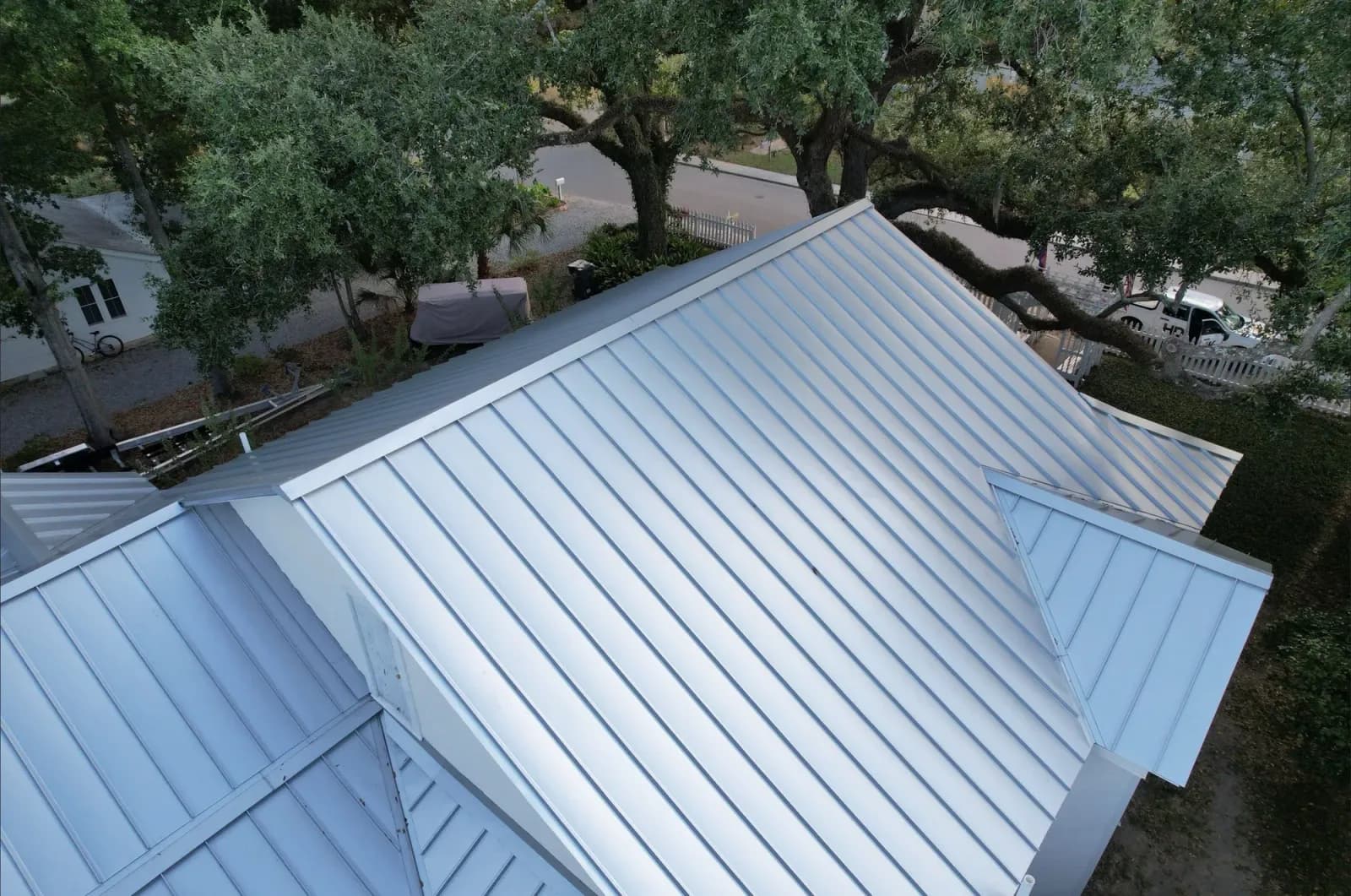
Metal Roofing in New Orleans: Built for Wind, Heat, and Historic Homes
Clear roofing decisions for New Orleans homeowners
The calls we get usually start the same way. A homeowner noticed a stain. Or they heard something during a hard rain and couldn't place it. Nine times out of ten, the roof had been sending signals for a year or more before anybody looked up.
Prefer to book online? Schedule your free New Orleans estimate
Schedule Your FREE
Roof Inspection & Estimate
Request a written estimate
Where is your property?
We serve Texas, Louisiana & Missouri
What do you need?
Almost done!
How can we reach you?
By submitting, you consent to follow-up messages. Reply STOP to opt out.
Sources we use
Check the scope against current guidance
Official sources reviewed September 7, 2026, plus a planning tool for comparing the decisions in your estimate.
City of New Orleans
Residential re-roofing permit
Reviewed September 7, 2026. Covers qualifying residential replacement, construction photo stages, and historic review.
Read the official guidance →New Orleans HDLC
Historic exterior-work application process
Reviewed September 7, 2026. Identify the district and itemize existing and proposed exterior materials with photos before work.
Read the official guidance →Signs Your Roof Needs a Metal Roofing Evaluation
The calls we get usually start the same way. A homeowner noticed a stain. Or they heard something during a hard rain and couldn't place it. Nine times out of ten, the roof had been sending signals for a year or more before anybody looked up. Here's what matters. A single leak isn't a verdict. But a leak in the same spot for the third time is different, that pattern usually means the problem is under the panel, not on it. We pull the fasteners, check the decking, and photograph what we find before anybody talks about scope.
- Standing seam metal: about $10-$16 per sq ft installed
- Exposed-fastener / 5V crimp: about $6-$9 per sq ft installed
- Typical New Orleans home total: $20,000-$35,000
- Aluminum resists salt-air corrosion better than steel near the lake and river
- Properly installed standing seam is rated for 140+ mph winds
- Lifespan of 40-70 years vs. 15-25 for shingles in Gulf Coast conditions
Why Metal Makes Sense on a New Orleans Roof
What a Metal Roof Has to Survive Here
Homeowners ask us about FORTIFIED almost every time metal comes up. Fair question. The short answer is that metal panels alone don't make a roof FORTIFIED. The standard is about the whole assembly, not the top layer you can see from the street.
Hurricane-Force Winds
Impact: Category 3+ hurricanes bring sustained winds of 111-157+ mph. Metal roofs fail at the edges and seams, not in the field—wind grabs the perimeter first and peels panels back if the attachment is weak.
Our Solution: We install standing seam with concealed clips engineered for our wind zone, reinforced edge and eave metal, and correct clip spacing for the roof geometry. Properly installed standing seam is tested to 140+ mph—well beyond what most shingle roofs can claim.
Wind-Driven Rain
Impact: During a hurricane, rain travels horizontally and finds every seam, lap, and penetration. This is where exposed-fastener roofs get in trouble—thousands of screw penetrations are thousands of potential entry points.
Our Solution: Standing seam eliminates face penetrations entirely, and we back panels with a high-temperature peel-and-stick underlayment as a sealed secondary barrier. If wind ever compromises the surface, the underlayment keeps the interior dry.
Salt Air & Coastal Corrosion
Impact: Homes near Lake Pontchartrain, the river, and the Intracoastal breathe salt-laden air year-round. Standard galvanized steel and cheap fasteners corrode quickly, starting at cut edges, scratches, and screw heads.
Our Solution: For coastal-adjacent homes we specify aluminum panels (which don't rust) or Galvalume steel with a Kynar 500 / PVDF finish, paired with stainless or coated fasteners and sealed cut edges. Material selection here matters as much as installation.
Heat & Humidity
Impact: Dark shingles push New Orleans attic temperatures past 150°F in summer, driving up cooling bills and cooking the underside of the roof deck. Year-round 75% humidity accelerates corrosion and mold on the wrong materials.
Our Solution: Reflective PVDF finishes and cool-roof color options bounce solar heat instead of absorbing it. Paired with proper intake and exhaust ventilation, a metal roof runs a cooler, drier attic than dark asphalt ever will.
Thermal Expansion
Impact: Metal expands and contracts through our daily heat swings. Screw-down panels fight this movement with rigid fasteners, which slowly elongate the holes and loosen washers over years of cycling.
Our Solution: Standing seam is designed to move—the panels float on clips that let metal expand and contract without stressing the fasteners. It's why standing seam outlasts screw-down in a climate that never stops moving.
Metal Roofing by New Orleans Neighborhood
Metal roofing decisions in New Orleans depend heavily on where you are—salt exposure, historic review, and architecture all shift the right answer. Here is what we typically encounter.
French Quarter & Marigny
The historic core, where standing seam and flat-lock metal have topped buildings for well over a century. Metal is not just allowed here—it's the historically correct material on many structures.
Vieux Carré Commission (VCC) approval is required for visible work, but VCC generally welcomes appropriate metal because it fits the district's heritage. We handle the submission, match historically accurate profiles and finishes, and use flat-lock or standing seam where the architecture calls for it.
Lakeview & Lakefront
Post-Katrina rebuilds close to Lake Pontchartrain, where salt air is a genuine corrosion factor and many homeowners want a roof that ends the replacement cycle for good.
This is aluminum country. The salt exposure off the lake makes aluminum standing seam the safest long-term specification. Many Lakeview homes were rebuilt with simple, metal-friendly rooflines that make standing seam efficient to install.
Garden District & Uptown
Grand 1800s homes with complex rooflines, dormers, and historic-district oversight through the HDLC. Aesthetics and approvals both matter here.
Standing seam works beautifully on these homes and is often historically appropriate, but HDLC review governs visible changes. We match period profiles and finishes and manage the approval paperwork. Complex rooflines mean more custom flashing and a longer install.
Bywater & Holy Cross
Creole cottages, shotguns, and camelbacks—many with original standing seam or 5V crimp roofs that are part of the neighborhood character.
5V crimp is authentic to this housing stock and remains a cost-effective exposed-fastener option for simple gable roofs. For homeowners wanting maximum longevity we upgrade to standing seam. Either way we respect the original profile the block expects.
Mid-City & Bayou St. John
A mix of Creole cottages, doubles, and early-1900s homes with mostly simple gable rooflines—well suited to metal.
Straightforward rooflines keep standing seam installation efficient here. Fewer historic restrictions than the Quarter or Garden District give homeowners more freedom on profile and color while staying neighborhood-appropriate.
Metairie & Kenner (Jefferson Parish)
Suburban ranch and two-story homes from the 1960s-1990s, generally without historic review and with easier lot access for staging.
No historic-district hurdles and simpler permitting make Jefferson Parish metal projects move faster. Simple rooflines suit both standing seam and 5V crimp. We still specify corrosion-resistant materials given the regional humidity and salt exposure.
New Orleans Metal Roofing Costs in 2026
Here's the part most homeowners never see. The panels get all the attention, but the wood underneath is what decides how the job goes. A metal roof needs a flat, solid deck to fasten to. If the boards are soft, cupped, or spaced with gaps, the panels telegraph every flaw and the fasteners don't hold the way they should.
Exposed-Fastener / 5V Crimp (Steel)
$14,000 - $24,000
Screw-down panels like 5V crimp and R-panel. The budget-friendly metal option, authentic on many older New Orleans homes. Requires periodic fastener maintenance and is best on simple gable roofs.
Standing Seam (Galvalume Steel)
$20,000 - $32,000
Concealed-fastener standing seam in Galvalume steel with a Kynar 500 / PVDF finish. The mainstream premium choice—hurricane-rated, low-maintenance, and long-lived for homes not directly on the water.
Standing Seam (Aluminum)
$26,000 - $40,000
The best specification for lakefront and river-adjacent homes. Aluminum doesn't rust, so it shrugs off salt air that corrodes steel. Higher material cost, but the corrosion resistance is worth it near the water.
Historic-Profile Metal (VCC / HDLC)
$28,000 - $50,000+
Flat-lock or custom standing seam matched to historic-district requirements in the French Quarter, Marigny, or Garden District. Custom fabrication, period-correct finishes, and commission approvals add to the scope.
Factors Affecting Price
- 1Panel profile (5V crimp and R-panel cost less than standing seam)
- 2Material (aluminum costs more than Galvalume steel but resists salt-air corrosion)
- 3Metal gauge (heavier 24-gauge resists denting better than 26-gauge)
- 4Roof pitch and complexity (dormers, valleys, and hips add custom flashing labor)
- 5Coating (Kynar 500 / PVDF finishes cost more than standard but hold color and resist chalk)
- 6Historic review (VCC / HDLC approval and custom profiles add cost and time)
- 7Decking and wood repair uncovered at tear-off (termite and rot damage is common here)
These ranges reflect 2026 pricing for typical Greater New Orleans homes (1,600-2,200 sq ft). Metal prices move with the commodities market—we honor written quotes for 30 days. We provide an exact price after inspecting your roof.
How We Install Metal Roofing in New Orleans
Nobody should quote a metal roof from the curb. We get on the roof, in the attic, and into the details before we write anything down. Photos of every problem area. Measurements of the actual planes, valleys, and penetrations. That's what turns a guess into a written scope you can compare.
Inspection & System Consultation
We measure the roof, assess pitch and complexity, and talk through what you want from the roof—longevity, storm performance, aesthetics, budget. We recommend a specific panel profile, material, and gauge for your home.
Local Note: For homes near the lake or river, we lead with aluminum because of salt exposure. For historic properties, we start by identifying what the VCC or HDLC will approve before we design the system.
Material & Finish Selection
We show you panel profiles (standing seam vs. 5V crimp vs. R-panel), gauges, and Kynar 500 / PVDF color options with real samples. You see exactly what will go on your home before anything is ordered.
Local Note: Reflective cool-roof colors are worth serious consideration here—they measurably reduce attic temperatures during Louisiana summers.
Permits & Historic Review
We handle City of New Orleans or Jefferson Parish re-roofing permits. For historic properties we prepare and submit VCC or HDLC applications with the panel profile and finish documentation they require.
Local Note: Orleans Parish requires a residential re-roofing permit when replacement affects 50% or more of the roof. VCC approval in the Quarter/Marigny can take 4-6 weeks—we build that into the timeline.
Tear-Off & Deck Inspection
We remove the existing roof to the deck and inspect every board for rot or termite damage. Metal needs a sound, flat substrate—we replace any compromised decking before panels go down.
Local Note: We find decking damage on roughly 40% of New Orleans tear-offs, usually termites or old leaks. We document it, show you, and price the repair before proceeding.
Sealed Underlayment
We install a high-temperature peel-and-stick underlayment as a sealed secondary water barrier—critical under metal in a wind-driven-rain climate. This is your backup if the surface is ever compromised in a storm.
Local Note: High-temp underlayment matters under metal specifically: standard synthetic underlayment can break down against the heat metal panels transmit in Louisiana summers.
Edge Metal & Flashing Detailing
We fabricate and install reinforced eave, rake, and drip-edge metal and detail every valley, wall transition, chimney, and penetration for sideways rain. This is where hurricane performance is won or lost.
Local Note: On the Gulf Coast we over-build the perimeter. Wind attacks edges first, so we use enhanced edge metal and fastening well beyond code minimum.
Panel Installation
Standing seam panels are set on concealed clips that allow thermal movement and mechanically seamed or snap-locked per the system. Exposed-fastener panels are fastened in the correct pattern with gasketed, corrosion-resistant screws.
Local Note: Clip spacing is tightened for our wind zone. We use stainless or coated fasteners on every coastal-adjacent job to prevent corrosion bleed.
Trim, Ridge & Ventilation
We finish with matching ridge caps, hip and rake trim, and a ventilated ridge where the design allows, tying the roof into a balanced attic ventilation system.
Local Note: Proper intake and exhaust ventilation keeps the attic cooler and drier—important in our humidity and it protects the decking under the metal.
Cleanup & Documentation
We do multiple magnetic sweeps for dropped fasteners and metal shavings, then hand you a documentation package: panel and finish specs, warranty registration, and photos of every phase.
Local Note: You get material labels and installation photos you can keep for insurance and for any future FORTIFIED or carrier review.
Metal Roofing Materials for New Orleans Homes
Homeowners ask us about FORTIFIED almost every time metal comes up. Fair question. The short answer is that metal panels alone don't make a roof FORTIFIED. The standard is about the whole assembly, not the top layer you can see from the street.
Aluminum Standing Seam
Why for New Orleans
Aluminum simply doesn't rust, which makes it the gold standard for homes breathing salt air off Lake Pontchartrain, the river, or the Intracoastal. Concealed fasteners eliminate the leak points that fail in hurricanes.
Best For
Lakefront, riverfront, and coastal-adjacent homes; homeowners who want the longest-lasting, lowest-maintenance roof available
Considerations
Highest upfront cost of the common options and slightly softer than steel (marginally more prone to cosmetic denting). The corrosion resistance is worth it near the water.
Galvalume Steel Standing Seam
Why for New Orleans
Galvalume (aluminum-zinc coated steel) with a Kynar 500 / PVDF finish balances cost and durability. Strong, hurricane-rated, and holds color well in our sun—a great choice for homes not directly on the water.
Best For
Most Orleans and Jefferson Parish homes away from direct salt exposure; homeowners wanting premium performance at a lower cost than aluminum
Considerations
Cut edges, scratches, and fasteners are the corrosion initiation points—detailing and corrosion-resistant fasteners matter. Not the first choice for homes right on the lakefront.
5V Crimp (Exposed Fastener)
Why for New Orleans
5V crimp is historically authentic to New Orleans—it's what topped countless Creole cottages and shotguns. As an exposed-fastener system it's the budget-friendly path into metal for simple gable roofs.
Best For
Historic-appropriate homes in Bywater, Holy Cross, and Mid-City; outbuildings; budget-conscious homeowners with simple rooflines
Considerations
Exposed fasteners need periodic review—gasketed washers age and screws can back out over years of thermal cycling. More maintenance than standing seam, but authentic and affordable.
Kynar 500 / PVDF Finish
Why for New Orleans
The finish is not a footnote in Louisiana. Kynar 500 / PVDF resin coatings resist UV fade, chalking, and salt better than economy polyester finishes, and reflective cool-roof colors cut summer attic heat.
Best For
Any New Orleans metal roof where color retention and heat reflection matter—which is essentially all of them
Considerations
Costs more than standard finishes, but the color and reflectivity hold for decades. Skimping on the coating is a false economy in our sun and humidity.
24-Gauge Panels
Why for New Orleans
Heavier 24-gauge steel resists denting from windborne debris and hail better than lighter 26-gauge, and it holds its form under hurricane wind loads.
Best For
Homeowners prioritizing storm resilience and a debris-tough surface; higher-value homes
Considerations
Costs more than 26-gauge. On tight budgets 26-gauge is acceptable on protected roofs, but we recommend 24-gauge where debris and hail exposure is a real concern.
Why New Orleans Homeowners Choose Lapeyre for Metal
Metal roofing is unforgiving of shortcuts—a single mis-detailed flashing or the wrong fastener near salt air undoes the whole investment. Here's why homeowners trust us with it:
We Started Here
New Orleans is home. We learned roofing on Creole cottages in the Marigny and raised homes in Lakeview, and we've stood on roofs the day after hurricanes to see what survived. That firsthand storm experience shapes how we detail every metal roof.
We Match Material to Salt Exposure
Not every roofer thinks about where your home sits relative to the water. We do. Near the lake or river we specify aluminum and corrosion-resistant fasteners as a default, because we've seen what salt air does to the wrong steel.
Historic-District Fluency
We work with the VCC and HDLC regularly. Metal is often historically correct in New Orleans, and we know how to match period profiles and finishes and shepherd the approval so your project doesn't stall.
Hurricane Detailing Is Our Baseline
We over-build the edges, use sealed high-temp underlayment, and tighten clip spacing for our wind zone on every metal roof. The panel is the easy part—the details are what keep the roof on in a Category 3.
Documentation You Can Use
You get panel specs, finish and gauge documentation, warranty registration, and photos of every phase—useful for insurance, resale, and any future carrier or FORTIFIED review.
When Metal Roofing Isn't the Right Fit
Metal isn't right for every house. We'd rather say that up front than talk you into a panel system you'll regret.
Start with the deck. Metal panels and standing seam systems fasten to the wood underneath, and if that wood is soft, rotted, or patched with three generations of repairs, the panels won't fix it. They'll just hide it. On older New Orleans homes with plank decking and wide gaps between boards, the deck usually needs sheathing before anything goes on top. That's not a reason to skip metal. It's a reason to know about it before you sign anything.
Then there's your roof shape. A simple gable or hip takes panels beautifully. A roof with six dormers, two chimneys, a skylight, and a curved bay is a different animal. Every penetration is a flashing detail, and flashing details are where roofs leak. Some cut-up roofs are still great candidates. Others are better served by a different material,.
Here's when we tell folks to slow down:
Your current roof is under ten years old and has one or two isolated leaks. That's a repair, not a replacement.
You're in a historic district where the exterior appearance may be reviewed. Check the requirements for your specific address first.
You're planning to sell within a year or two and just need the roof to be sound and documented.
There's active water damage inside. Stop the water first, then talk about the long-term plan.
Structural framing is sagging or questionable. That's a different trade's problem before it's ours.
And sometimes the answer is just timing. If your shingle roof has five good years left, spending them is not a loss - it's five years to plan the project properly. We'll tell you that during an inspection, with photos, even when it means we don't sell a roof that week.
Compare your options before signing
Compare roofing material priorities
Organize budget, maintenance, and material tradeoffs before a property-specific specification.
Read more about this roofing decision
Metal Roofing in New Orleans (2026)
Compare New Orleans metal-roof panels, coastal-exposure exclusions, separate warranty types, itemized quotes, and permit or FORTIFIED coordination.
FAQ
Frequently Asked Questions
How do I know if my roof needs a repair or a full metal roofing replacement?
A single leak usually points to a repair, but a leak in the same spot for the third time means something deeper is wrong. That pattern often means the decking underneath is damaged, not just the surface. We check fasteners, seams, and decking before recommending anything. If your current roof is under ten years old with one isolated leak, that's usually a repair, not a full replacement.
Does a metal roof automatically meet the FORTIFIED standard?
No, metal panels alone don't make a roof FORTIFIED. The standard covers the whole roof assembly, including sealed decking, strengthened edges, and upgraded flashing, not just the visible panels. Older New Orleans homes often have plank decking with gaps, which changes the scope before installation starts. Ask for the full roof assembly in writing, not just the panel name, so you know exactly what you're getting.
Why does humidity cause problems for roofs in New Orleans?
Humidity rots roof decking from underneath while the surface still looks fine. Many older New Orleans homes have minimal attic venting, which traps moisture against the wood over time. We've opened roofs that looked solid from the street and found decking soft enough to push a screwdriver through. That's why an inspection after any named storm, or after paying for the same repair twice, matters so much here.
When is metal roofing not the right choice for my home?
Metal isn't ideal if your decking is soft, rotted, or heavily patched, since panels will only hide the problem instead of fixing it. It's also a tougher fit for roofs with many dormers, chimneys, or skylights, since each penetration adds a flashing detail that can leak. If you're in a historic district, check your address for exterior review requirements first. We'll tell you during an inspection if a different plan makes more sense.
What should I expect when your team inspects my roof?
We photograph fasteners, seams, and decking condition before discussing any scope of work. You'll get a written estimate based on what we find, not a guess from the ground. We check for rust rings, lifted seams, soft decking near valleys, and attic moisture along the ridge. This documentation is especially useful if you're planning to sell or refinance soon.
What decking issues affect metal roofing on older New Orleans homes?
Older New Orleans homes often have plank decking with wide gaps between boards, which usually needs sheathing before metal panels go on. Skipping this step means panels fasten to unstable wood that can shift or fail. We check the decking during inspection and explain what repairs are needed before any installation begins. Knowing this upfront helps you plan the project scope and timeline accurately.
Does a metal roof qualify for a FORTIFIED designation in New Orleans?
Metal roof systems can be compatible with the IBHS FORTIFIED program when installed to its standards—sealed roof deck, enhanced edge metal, and correct attachment. FORTIFIED is about installation method and performance, not a single material. Whether that translates into any insurance benefit depends entirely on your carrier, policy, and documentation, so verify treatment with your insurer before counting on a credit. We provide the installation records and product documentation you'd need for review.
Are metal roofs noisier than shingles in New Orleans rain?
No, not on a home. Metal panels are installed over solid decking and underlayment, which dampens rain noise to about the same level as any other roof. The loud-metal-roof memory comes from panels over open framing—barns and unlined patio covers with no attic or insulation. Over a finished New Orleans home with a proper attic assembly, you won't notice a meaningful difference during our afternoon downpours.
How long does a metal roof last in New Orleans?
Properly specified and installed, a metal roof lasts 40-70 years here—versus 15-25 years for asphalt shingles in Gulf Coast heat, humidity, and storms. The key words are 'properly specified': aluminum or Galvalume near salt air, a quality Kynar 500 / PVDF finish, corrosion-resistant fasteners, and correct detailing. Get those right and metal is very often the last roof you'll buy for that home.
Do I need a permit to install a metal roof in New Orleans?
Yes. The City of New Orleans requires a residential re-roofing permit when replacement affects 50% or more of the roof, and the process includes geotagged photo documentation during installation. Jefferson Parish (Metairie, Kenner) also requires permits and is typically faster. Properties in historic districts require additional VCC or HDLC review before permits issue. We handle the entire permit and historic-review process for you.
Want the complete picture?
Compare metal, shingle, tile, and slate systems—lifespans, costs, and which material fits your home and climate.
Read our Roofing Materials GuideContact information
Thank you for considering us for roofing needs. We will get back to you during normal business hours.


Send us a message