Austin Metal Roofing
Standing Seam Built for Central Texas Hail and Heat
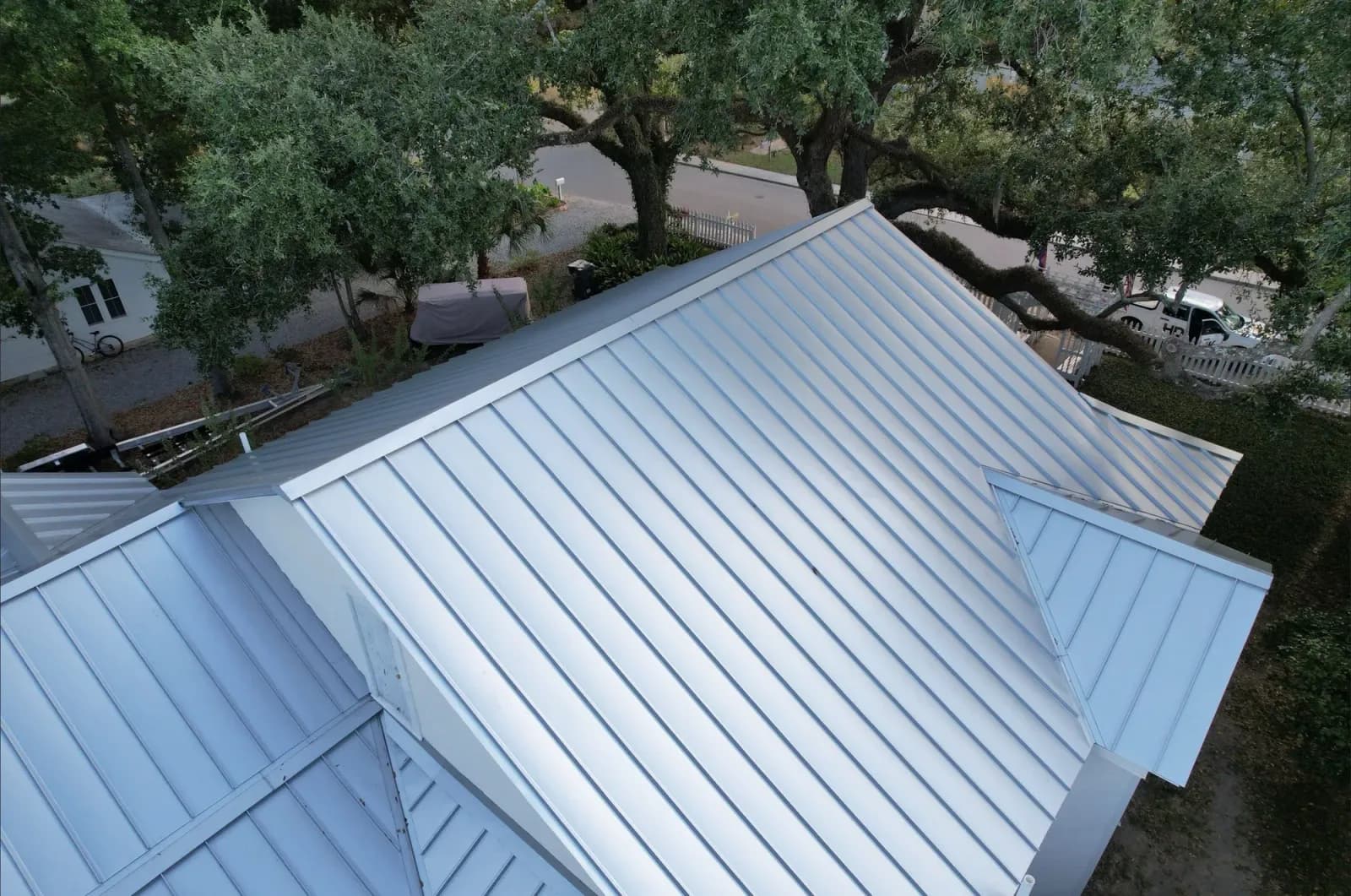
Metal roofing is having a moment in Austin, and for good reason: it handles hail better than any shingle, reflects the brutal summer sun instead of soaking it up, and gives modern and Hill Country homes the clean lines homeowners want. We install Class 4 impact-rated standing seam and exposed-fastener systems—and we'll be straight with you about what metal does and doesn't do, including the honest truth about hail dents versus punctures.
Prefer to book online? Schedule your free Austin estimate
Schedule Your FREE
Roof Inspection & Estimate
Request a written estimate
Where is your property?
We serve Texas, Louisiana & Missouri
What do you need?
Almost done!
How can we reach you?
By submitting, you consent to follow-up messages. Reply STOP to opt out.
Sources we use
Check the scope against current guidance
Official sources reviewed September 7, 2026, plus a planning tool for comparing the decisions in your estimate.
City of Austin
Austin work exempt from building permits
Reviewed September 7, 2026. Check roof-cover exemptions, structural effects, and the Wildland-Urban Interface exception for the actual address.
Read the official guidance →Metal Construction Association via Metal Roofing Alliance
Metal roof installation manual
Reviewed September 7, 2026. Covers panel systems, fastening, and installation details; use the selected manufacturer specification for the actual project.
Read the official guidance →How much does metal roofing cost in Austin, TX?
Most Austin metal roofs cost between $18,000 and $34,000 installed for a typical 1,800-2,400 sq ft home. Standing seam runs about $10-$16 per square foot installed; exposed-fastener (screw-down) systems like R-panel run about $6-$9 per square foot. Class 4 impact-rated panels and premium Kynar 500 / PVDF cool-roof finishes add cost but pay back in hail resilience and lower cooling bills. Final price depends on roof pitch, panel profile, gauge, coating, and roof complexity.
- Standing seam metal: about $10-$16 per sq ft installed
- Exposed-fastener / R-panel: about $6-$9 per sq ft installed
- Typical Austin home total: $18,000-$34,000
- Class 4 impact-rated metal resists hail punctures better than any shingle
- Reflective cool-roof finishes can drop attic temperatures 20-40°F versus dark shingles
- Lifespan of 40-70 years vs. 15-25 for shingles in Central Texas hail country
Why Austin Homeowners Are Choosing Metal
What Central Texas Does to a Roof
Austin's climate is a specific kind of punishing: violent hail, relentless UV, and daily heat swings that cook a roof from above and below. Metal answers most of these well—but you have to understand the tradeoffs, especially on hail. Here's the honest breakdown.
Hail Impact
Impact: Central Texas averages 3-5 significant hailstorms a year, and the 2021-2023 seasons were brutal. Hail cracks, bruises, and punctures asphalt shingles, stripping granules and shortening roof life dramatically.
Our Solution: Class 4 impact-rated metal is the most puncture-resistant roof surface you can buy—it doesn't crack or lose granules because it has none. Here's our honesty policy: large hail can still leave cosmetic dents in metal (especially thinner gauge), but a dented metal roof stays fully watertight, where a hailed shingle roof leaks and fails early.
Extreme Heat & UV
Impact: Austin roof surfaces hit 160°F+ in summer, pushing attic temperatures past 140°F with dark shingles. That heat drives cooling bills up and bakes the roof deck and shingles from below, accelerating aging.
Our Solution: Reflective Kynar 500 / PVDF cool-roof finishes bounce solar radiation instead of absorbing it. Homeowners commonly see attic temperatures drop 20-40°F and a real dent in summer cooling costs—metal is one of the few roofing choices that pays you back monthly.
Thermal Cycling
Impact: Austin's daily swing—160°F roof surface to overnight ambient—stresses roofing through constant expansion and contraction. Shingles crack along stress lines; screw-down metal slowly loosens its fasteners.
Our Solution: Standing seam is engineered to move—panels float on concealed clips that let metal expand and contract without stressing fasteners. It handles Central Texas thermal cycling far better than screw-down or asphalt.
Straight-Line Wind
Impact: Severe thunderstorms bring 60-80 mph gusts that lift shingle edges and break seal strips. Once a shingle lifts, it invites water and further wind damage.
Our Solution: Standing seam mechanically locks to concealed clips with no exposed edges for wind to grab, and many systems are rated well beyond typical Austin thunderstorm winds. We reinforce edge and eave metal on every install.
Wildfire-Adjacent Risk
Impact: Hill Country and west-side Austin neighborhoods carry real wildfire exposure. Embers landing on a combustible roof are a genuine ignition risk during dry seasons.
Our Solution: Metal is non-combustible and carries a Class A fire rating—it will not ignite from embers. For Hill Country and wildland-interface homes, that fire performance is a meaningful safety upgrade over some other materials.
Metal Roofing Across the Austin Area
The right metal roof in Austin shifts with architecture, HOA rules, and hail exposure. Here is what we typically see across the metro.
Central Austin (Clarksville, Tarrytown, Old Enfield)
Established neighborhoods with a mix of historic bungalows and high-end modern rebuilds. Strong design sensibilities and, in places, historic oversight.
Standing seam is popular on the modern rebuilds for its clean lines. On historic bungalows we match appropriate profiles and colors. Some pockets have historic review—we confirm requirements before finalizing a profile.
West Austin & Hill Country (Westlake, Rob Roy, Barton Creek)
Custom and luxury homes on hillside lots, many with contemporary architecture and wildfire exposure. Aesthetics and fire performance both matter.
This is prime standing seam territory—the look suits contemporary Hill Country design and the Class A fire rating is a genuine benefit in the wildland interface. Complex custom rooflines mean more custom flashing and a longer install.
Dripping Springs & Western Hays County
Hill Country ranch properties, barndominiums, and rural custom homes where metal is often the default expectation.
Both standing seam and exposed-fastener metal are at home here. Barndominiums and outbuildings suit R-panel; primary residences typically get standing seam. Wide-open exposure makes wind and hail detailing important.
Suburban Northwest (Cedar Park, Leander, Steiner Ranch)
Master-planned subdivisions, many with HOAs, hit hard by recent hail seasons. Homeowners here are actively rethinking materials after repeated claims.
Strong candidates for Class 4 metal after multiple hail hits. HOA approval is the gatekeeper—we prepare submissions with color and profile documentation. Simpler tract rooflines make standing seam efficient to install.
East & Southeast Austin (Mueller, Del Valle)
Modern infill and newer construction, much of it designed with contemporary rooflines that pair naturally with metal.
Modern architecture and standing seam are a perfect match here. Newer, simpler rooflines keep installation clean and let reflective cool-roof finishes deliver maximum summer energy savings.
Austin Metal Roofing Costs in 2026
Metal costs more than shingles upfront, but between hail resilience, lower cooling bills, and a 40-70 year lifespan, the long-run math often favors metal in Austin. Here's what systems run in the metro:
Exposed-Fastener / R-Panel (Steel)
$13,000 - $23,000
Screw-down panels like R-panel and PBR. The budget metal option, common on Hill Country outbuildings, barndominiums, and simple roofs. Requires periodic fastener maintenance.
Standing Seam (Galvalume Steel)
$20,000 - $32,000
Concealed-fastener standing seam in Galvalume steel with a Kynar 500 / PVDF finish. The mainstream premium choice for Austin homes—clean lines, low maintenance, and long life.
Class 4 Standing Seam (24-Gauge)
$24,000 - $38,000
Heavier 24-gauge, Class 4 impact-rated standing seam. The most hail- and debris-resistant option for Central Texas, and the version most likely to support an insurance impact-resistance credit.
Aluminum Standing Seam
$26,000 - $40,000
Corrosion-proof aluminum, worth considering on homes near water features or for homeowners wanting the absolute longest-lived panel. Softer than steel, so slightly more prone to cosmetic hail dents.
Factors Affecting Price
- 1Panel profile (R-panel costs less than standing seam)
- 2Metal gauge (24-gauge resists hail dents better than 26-gauge, at higher cost)
- 3Impact rating (Class 4 panels cost more but resist hail and may earn insurance credits)
- 4Coating (Kynar 500 / PVDF cool-roof finishes cost more but cut attic heat and hold color)
- 5Roof pitch and complexity (Hill Country custom rooflines add flashing labor)
- 6HOA requirements (approved colors and profiles can narrow options)
- 7Decking condition uncovered at tear-off
These ranges reflect 2026 pricing for typical Austin-area homes (1,800-2,400 sq ft). Metal prices track the commodities market—we honor written quotes for 30 days. We provide an exact price after inspecting your roof.
How We Install Metal Roofing in Austin
A metal roof's value comes from the details—the panels are the easy part. Here's how we approach a Central Texas metal install:
Inspection & System Consultation
We measure the roof, assess pitch and complexity, and talk through your priorities—hail resilience, energy savings, aesthetics, budget. We recommend a specific profile, gauge, and impact rating for your home.
Local Note: For hail-battered northwest suburbs we lead with Class 4 24-gauge. For contemporary and Hill Country homes we focus on standing seam profiles and reflective cool-roof colors.
Material & Finish Selection
We show you standing seam and exposed-fastener profiles, gauges, and Kynar 500 / PVDF color options with real samples—including cool-roof colors that reflect Austin heat.
Local Note: Reflective finishes are a real energy play here, not a gimmick. We'll show you the color options that cut attic temperature the most.
HOA & Permits
We prepare HOA submissions with color and profile documentation where required and pull the City of Austin or applicable jurisdiction roofing permit.
Local Note: HOAs are the most common hold-up on Austin metal projects. We package the submission so approval moves quickly and you don't lose weeks.
Tear-Off & Deck Inspection
We remove the existing roof to the deck and inspect for damage. Metal needs a flat, sound substrate—we replace any compromised decking before panels go on.
Local Note: We also document any hail damage we find during tear-off, which can matter for a pending or future insurance claim.
High-Temp Underlayment
We install a high-temperature underlayment rated for the heat metal panels transmit—critical in Austin summers, where standard synthetic underlayment can degrade under metal.
Local Note: This is a detail cheaper installers skip. Under metal in Central Texas heat, the wrong underlayment breaks down years early.
Edge Metal & Flashing
We fabricate and install reinforced edge, rake, and drip-edge metal and detail valleys, wall transitions, chimneys, and penetrations for wind and water tightness.
Local Note: Edges are where thunderstorm winds attack first. We reinforce the perimeter beyond code minimum on every install.
Panel Installation
Standing seam panels set on concealed clips that allow thermal movement and are mechanically seamed or snap-locked per the system. Exposed-fastener panels are screwed in the correct pattern with gasketed fasteners.
Local Note: Concealed-clip attachment lets the metal expand and contract through Austin's daily temperature swings without loosening a single fastener.
Trim, Ridge & Ventilation
We finish with matching ridge caps, hip and rake trim, and ventilated ridge where the design allows, tying into a balanced attic ventilation system.
Local Note: Good ventilation plus a reflective roof compounds the energy savings—a cooler attic means a lower cooling bill all summer.
Cleanup & Documentation
We run multiple magnetic sweeps for fasteners and metal shavings, then provide a documentation package: panel and finish specs, impact rating, warranty registration, and phase photos.
Local Note: The impact-rating documentation is what you'll hand your insurer if you pursue a Class 4 premium credit.
Metal Roofing Materials for Austin Homes
For Central Texas, hail resistance, heat reflection, and thermal stability drive the material decision. Here's what we recommend and why:
Class 4 Galvalume Standing Seam (24-Gauge)
Why for Austin
Heavier 24-gauge, Class 4 impact-rated standing seam is the most hail-resistant roof we install—the best answer to Central Texas hail seasons, and the version most likely to earn an insurance impact-resistance credit.
Best For
Hail-prone northwest suburbs, homeowners tired of repeat claims, and anyone prioritizing storm resilience
Considerations
Highest steel option cost. Honest note: severe hail can still leave cosmetic dents, but the roof stays watertight—no cracks, no granule loss, no leaks.
Galvalume Standing Seam (26-Gauge)
Why for Austin
Galvalume with a Kynar 500 / PVDF finish balances cost and performance—clean modern lines, strong heat reflection, and long life for homes where budget matters more than maximum hail gauge.
Best For
Contemporary and Hill Country homes, and homeowners wanting premium standing seam without the 24-gauge premium
Considerations
Lighter gauge is marginally more prone to cosmetic denting than 24-gauge. Still far more impact-resistant than any shingle.
Kynar 500 / PVDF Cool-Roof Finish
Why for Austin
In Austin the finish is an energy decision. Reflective Kynar 500 / PVDF cool-roof colors bounce solar heat, commonly dropping attic temperatures 20-40°F and cutting summer cooling costs.
Best For
Every Austin metal roof where summer energy bills matter—which is essentially all of them
Considerations
Costs more than economy polyester finishes, but the reflectivity and fade resistance hold for decades. Skimping here forfeits the energy payback.
R-Panel / Exposed Fastener (Steel)
Why for Austin
R-panel is the practical, budget-friendly metal for Hill Country outbuildings, barndominiums, and simple primary roofs where cost is the priority.
Best For
Barndominiums, workshops, ranch outbuildings, and budget-conscious simple rooflines
Considerations
Exposed fasteners need periodic review—gasketed washers age and screws can loosen over years of Austin thermal cycling. More maintenance than standing seam.
Aluminum Standing Seam
Why for Austin
Aluminum never rusts, making it the longest-lived panel for homes near water features or for homeowners who want to eliminate corrosion entirely.
Best For
Lakeside Austin properties and homeowners prioritizing maximum longevity
Considerations
Highest material cost and softer than steel, so slightly more prone to cosmetic hail dents. Corrosion immunity is the tradeoff.
Why Austin Homeowners Choose Lapeyre for Metal
Metal roofing punishes shortcuts—the wrong underlayment or a sloppy flashing detail wastes a premium investment. Here's why Austin homeowners trust us with it:
We're Honest About Hail
Some installers oversell metal as hail-proof. We won't. Class 4 metal resists the punctures that destroy shingles, but severe hail can dent it cosmetically—we tell you that upfront so you buy metal for the right reasons: it stays watertight and keeps working when a shingle roof would be leaking.
We Treat the Finish as an Energy Choice
In Austin's heat, a reflective cool-roof finish isn't cosmetic—it's a measurable cut to your summer cooling bill. We help you pick colors that reflect the most heat while still matching your home and HOA.
We Handle the HOA
The most common Austin metal roadblock is HOA approval. We package submissions with color and profile documentation so approval moves fast and your project doesn't stall for weeks in a review queue.
We Use Materials That Survive the Heat
High-temp underlayment under metal, Kynar 500 / PVDF finishes, and corrosion-resistant fasteners—we spec for 160°F roof surfaces and daily thermal cycling because that's what Central Texas actually does to a roof.
Documentation for Your Insurer
If you go Class 4 for an impact-resistance credit, you need the right paperwork. We provide the impact rating, product specs, and installation records to support that conversation with your carrier.
Decide how the Austin metal roof will move, drain, and be serviced
Ask for the exact panel profile and attachment system rather than a generic metal-roof line. The proposal should identify the base metal, finish, seam, clips or fasteners, substrate, and applicable manufacturer details. Compare roof sections and slopes before assuming a panel used on the main house is suitable for a porch or addition. A materials-only price cannot explain the installed performance at edges, transitions, valleys, and penetrations.
Discuss expansion, later access, and rooftop additions while the details can still be designed. Ask how the system accommodates movement, how pipes and walls are flashed, and which methods may be used for future equipment. Require a written maintenance plan for the chosen roof, including inspection of sealants or exposed attachment points where applicable. Keep paint or finish coverage distinct from installation workmanship and ask about exclusions before relying on a warranty headline.
A change to metal should also trigger a check of the property's approval requirements and supporting roof conditions. Austin's roof-cover exemption has limits; verify jurisdiction, structural effects, and WUI status for the actual address. Use the material selector to rank maintenance, appearance, and budget priorities. Then compare complete written metal and shingle scopes in the cost estimator, including the same removal and flashing work, rather than treating the visible covering as the whole decision.
Compare your options before signing
Compare roofing material priorities
Organize budget, maintenance, and material tradeoffs before a property-specific specification.
FAQ
Frequently Asked Questions
What information should a metal roofing bid identify?
Request panel profile, metal and finish, attachment method, substrate, roof sections, underlayment, penetrations, flashings, and manufacturer details. These establish what the installed price actually includes.
Can solar or other equipment be added after metal roofing is installed?
Plan for it early. Ask the roofer and equipment installer to agree on compatible attachment, access, flashing, and warranty responsibilities for the specified panel system before work is performed.
Does a metal roof really survive Austin hail?
Here's the honest answer: Class 4 impact-rated metal resists the punctures and cracks that destroy asphalt shingles, and it never loses granules because it has none. But severe hail can leave cosmetic dents in metal, especially thinner 26-gauge panels. The critical distinction is that a dented metal roof stays fully watertight and keeps performing, while a hailed shingle roof leaks and fails early. Heavier 24-gauge panels resist denting better if surface appearance is a priority.
Can a metal roof lower my energy bills in Austin?
Yes, meaningfully. Austin roof surfaces hit 160°F+ in summer, and a dark shingle roof pushes attic temperatures past 140°F. A reflective Kynar 500 / PVDF cool-roof metal finish bounces solar radiation instead of absorbing it, commonly dropping attic temperatures 20-40°F. Homeowners routinely report lower summer cooling bills and a more comfortable second floor. Paired with proper attic ventilation, metal is one of the few roofing choices that pays you back every month.
Will my HOA approve a metal roof in Austin?
Many Austin HOAs do approve metal, particularly standing seam in muted, architecturally appropriate colors—but you almost always need approval first, and some HOAs restrict profiles or colors. We prepare the submission with color chips, profile documentation, and product specs so your architectural committee has everything it needs. HOA review is usually the longest part of an Austin metal project, so we package it to move quickly.
Are metal roofs too loud during Austin thunderstorms?
No, not on a home. Metal panels are installed over solid decking and underlayment, which dampens rain and hail noise to about the same level as any other roof. The loud-metal-roof reputation comes from panels over open framing—barns and unlined patio covers with no attic or insulation. Over a finished Austin home with a proper attic assembly, you won't notice a meaningful difference during a storm.
Is standing seam or exposed-fastener metal better for Austin?
For a primary residence, standing seam is usually the better choice—concealed fasteners mean fewer leak points, better handling of Austin's daily thermal cycling, and a cleaner modern look. Exposed-fastener systems like R-panel cost less and make sense for barndominiums, workshops, and Hill Country outbuildings, but the gasketed screws age and can loosen over years of heat cycling, requiring periodic maintenance. Standing seam is the premium, low-maintenance option; R-panel is the budget path.
Does metal roofing help with wildfire risk in the Hill Country?
Yes. Metal is non-combustible and carries a Class A fire rating—the highest available—so it won't ignite from windborne embers during dry seasons. For homes in west Austin, the Hill Country, and the wildland-urban interface, that fire performance is a genuine safety upgrade over combustible roofing. It's one reason standing seam is so popular on custom homes in those areas.
How long does a metal roof last in Austin?
Properly installed, a metal roof lasts 40-70 years in Central Texas—versus 15-25 years for asphalt shingles that get chewed up by hail and UV. The keys are a quality Kynar 500 / PVDF finish, correct gauge for your hail exposure, high-temp underlayment for our heat, and proper flashing details. Get those right and metal is very often the last roof you'll put on that home.
Want the complete picture?
Compare metal, shingle, tile, and slate systems—lifespans, costs, and which material fits your home and climate.
Read our Roofing Materials GuideContact information
Thank you for considering us for roofing needs. We will get back to you during normal business hours.


Send us a message