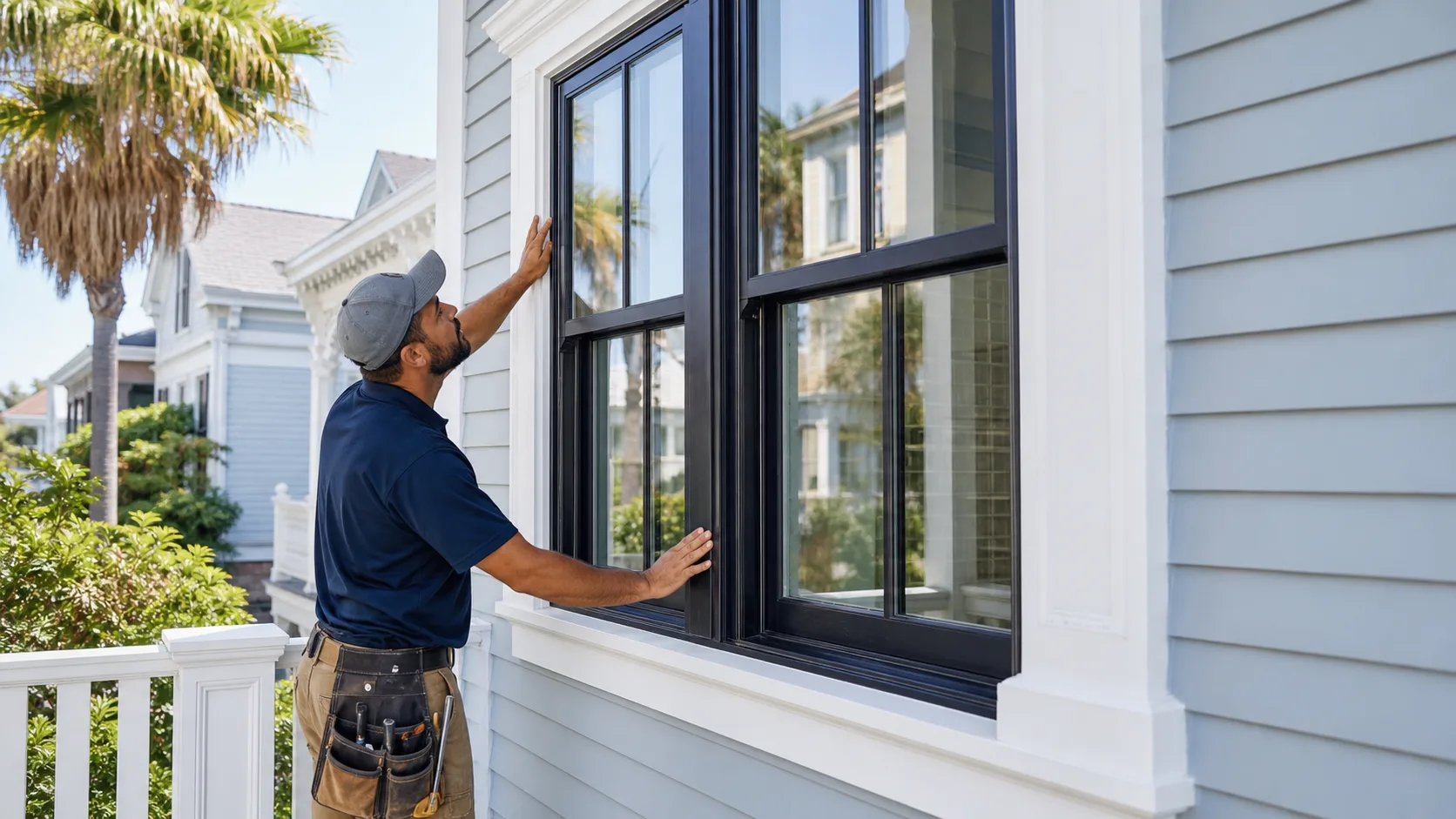
Louisiana homes in wind-borne debris regions need approved opening protection, which can mean impact-rated windows or qualifying shutters. Before buying, verify the product label, pressure ratings, water-test pressure, installation details, permit requirements, and insurer documentation.
Hurricane impact windows are one way to protect glazed openings in Louisiana, but they are not automatically required for every home or every replacement project. The rule depends on the property's wind-borne debris classification, the adopted code, and the local building official. Where protection is required, an approved shutter system may be an alternative to impact-rated glazing.
The short answer
Do not buy on the phrase "hurricane window" alone. Ask for the exact product label and test report, the positive and negative design pressures for your opening, the water penetration resistance test pressure, installation instructions, permit responsibility, and warranty. Then confirm the required values with the local building department or project design professional.
When does Louisiana require protected windows?
Louisiana's 2021 International Residential Code with state amendments, effective March 1, 2024, says exterior glazing in wind-borne debris regions must be protected from wind-borne debris. For the covered residential openings, the code identifies the large-missile provisions of ASTM E1886 and ASTM E1996. An impact-rated window can meet that opening-protection role, but an approved impact-resistant covering can also qualify.
Requirements are address-specific. The applicable design wind speed, exposure, building geometry, opening size, opening height, and local amendments can change the required assembly. Existing buildings and replacement work may also be reviewed differently from new construction. Confirm the current requirement with the authority having jurisdiction before ordering windows.
For a New Orleans project, start with the local permit office or design professional and make the contractor identify the code path in writing. Our New Orleans service-area page explains how to reach our local team, while the window replacement service overview covers the broader planning process.
What ratings and labels should you verify?
Impact resistance and pressure resistance answer different questions. Impact testing checks how the assembly responds to wind-borne debris and the pressure cycling that follows. Design pressure addresses the inward and outward loads acting on the installed opening. A product family can have different approved sizes, configurations, glass packages, and anchor schedules, so a brochure for the family is not enough.
A useful submittal identifies the exact window model, operator type, frame material, glass package, maximum tested size, impact standard, and approved installation method. It should also show the positive design pressure, negative design pressure, and water penetration resistance test pressure. These values need to fit the specific opening and project conditions.
The label format is getting clearer. In a June 1, 2026 announcement, the Fenestration and Glazing Industry Alliance said NAFS-26 makes the secondary product designator mandatory on test reports and labels. That designator includes positive pressure, negative pressure, and water-test pressure. FGIA also says NAFS-26 is expected in the 2027 model codes, so its publication does not mean Louisiana's currently adopted code has already switched to the 2026 edition.
| Document or value | Question it answers | What to match |
|---|---|---|
| Product label and test report | Was this exact assembly tested and listed? | Model, size, configuration, glass, and standards |
| Positive and negative design pressure | Can the assembly resist inward push and outward suction? | The required pressure for this opening and exposure |
| Water-test pressure | At what laboratory pressure was water penetration evaluated? | Project expectations and the cited test method |
| Installation instructions | How must the tested product be anchored and sealed? | Substrate, fasteners, spacing, edge distance, and flashing |
Do impact windows stop wind-driven rain?
No window should be sold as a guarantee against hurricane water intrusion. Impact resistance protects against a particular debris-and-pressure test sequence. Water penetration is evaluated separately, and field performance also depends on the rough opening, sill pan, flashing, sealant joints, drainage path, wall assembly, and installation quality.
FEMA's August 9, 2023 recovery advisory gives recommendations for reducing wind-driven rain through and around windows and doors. The IBHS Hazard 101 guidance, accessed July 29, 2026, also notes that wind-driven rain can enter through openings and small gaps around windows, doors, siding, and roofs.
Ask the bidder to explain the water-management detail from the inside and outside. You should be able to see where water lands, how it drains, how the sill is protected, and how the window connects to the water-resistive barrier. A high product rating cannot repair a weak wall detail.
Are impact windows better than hurricane shutters?
Impact windows provide passive protection and need no storm-time deployment after correct installation. Shutters can cost less and may add a layer in front of the glass, but removable or operable systems require storage, access, working hardware, and enough time to close or install them.
Code review focuses on whether the selected system is approved for the opening. Advertising category claims do not establish approval. An impact window can crack and still perform its tested containment role. A shutter can protect the opening only when it is the approved product, correctly anchored, maintained, and deployed.
Choose based on the home's required pressures, who will prepare the property, upper-story access, appearance, storage, maintenance, and the complete installed price. Some owners use shutters over impact glazing for additional protection, but that is a project choice rather than proof that either system is universally required.
What should a Louisiana impact-window bid include?
A complete proposal should identify the product and the installation. A brand and window count are incomplete. Require these items before signing:
- The exact manufacturer, series, model, operator type, glass package, color, and opening dimensions.
- The applicable impact standard and the positive, negative, and water-test pressures shown in the product documentation.
- The approved substrate, anchor type, spacing, embedment, edge distance, and any limits that apply to the tested size.
- The sill pan, flashing, sealant, water-resistive-barrier tie-in, trim replacement, and interior finish work included in the price.
- The party responsible for permit applications, inspections, product submittals, engineering, disposal, and protecting the occupied home.
- The product warranty and the contractor's labor warranty, including exclusions for leaks, glass breakage, finish work, and storm damage.
- The records you will receive at completion: labels, invoices, photos, inspection approvals, and warranty registration.
Do not let the label disappear before documentation is complete. Photograph it, keep the approved submittal, and save the installation instructions used for the job. Those records are useful for future repairs, resale questions, FORTIFIED evaluation, and insurer review.
Will impact windows lower Louisiana insurance premiums?
Louisiana law recognizes opening protection and window strength as wind-mitigation measures, but it does not promise a particular owner a particular dollar savings. Louisiana Revised Statute 22:1483, current when reviewed July 29, 2026, requires qualifying insurers to provide actuarially justified adjustments for eligible code-compliant, FORTIFIED, or demonstrated mitigation work. The insurer's filed plan, the policy's wind coverage, the completed scope, and the required records determine how that applies.
Ask the insurer what documentation it requires before construction and what portion of the premium can change. Lapeyre can document observed conditions, the contracted construction scope, product information, and completed work. The insurer decides coverage, eligibility, premium treatment, and settlement. We do not interpret the policy or act as a public adjuster or attorney.
The 2025 FORTIFIED Home Standard treats opening protection as part of the broader Hurricane designation requirements for FORTIFIED Silver and Gold. The standard allows impact-rated assemblies or qualified opening-protection systems in the applicable sections, with additional pressure requirements for Gold. If a designation matters to the project, involve a FORTIFIED evaluator before ordering and keep the evaluation separate from the sales promise.
Our Louisiana FORTIFIED program guide explains the roof-focused state grant, and the FORTIFIED certification guide covers the evaluation and documentation process. A roof grant should not be represented as payment for replacement windows.
What should a Louisiana homeowner do next?
Start with the address and the opening schedule. Brand selection comes later. Confirm the adopted code and permit path, identify the required pressures, then compare impact windows and approved shutter systems against the same criteria. The most useful proposal ties the exact product, exact opening, exact installation detail, and exact documentation together.
If you are planning replacement windows, review our hot-climate window guide for glass and frame questions that also affect Gulf Coast comfort. Then ask a qualified local contractor or design professional to verify the Louisiana wind and water requirements for your home before materials are ordered.
Common questions
Frequently asked
Not for every home or every replacement project. Louisiana requires protected exterior glazing in designated wind-borne debris regions, but the accepted protection can be an impact-rated window or an approved impact-resistant covering. The address, opening, adopted code, project scope, and local review determine the requirement. Confirm it with the permit office or project design professional before ordering.

Founder of Lapeyre Roofing, continuing a family legacy in Louisiana since 1699. Licensed in Louisiana, GAF Certified, and FORTIFIED Roofing specialist serving Texas and Louisiana.