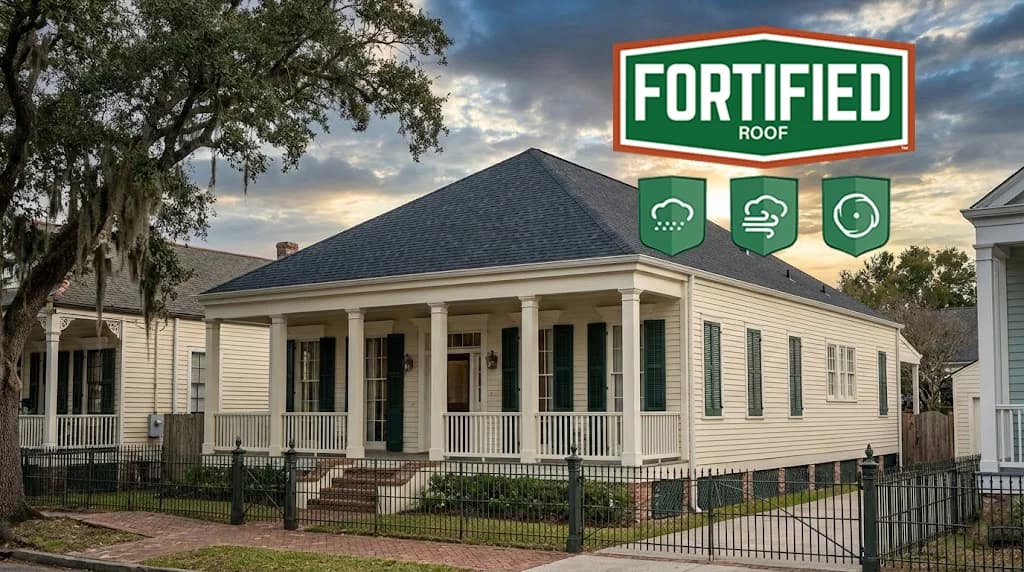
A FORTIFIED roof is a roof built to the IBHS FORTIFIED standard, an engineered system designed to stay on your house in a hurricane. Here is what it actually requires physically, the three levels, the real cost difference, and the storm data that proves it works.
Ask ten homeowners what a FORTIFIED roof is and you will get ten different guesses. Some think it is a shingle brand. Some think it is a marketing sticker. A few think it is just "a really good roof." None of those are right.
FORTIFIED is a specific engineering standard, and a roof either meets it and gets a certificate or it does not. This guide explains exactly what that means, what the roof physically requires, and why it is the default we install across our hurricane-exposed Louisiana market.
The direct answer: A FORTIFIED roof is a roof built to the FORTIFIED standard developed by the Insurance Institute for Business & Home Safety (IBHS), a nonprofit research organization funded by insurers. It is not a brand or a product. It is a set of construction requirements, verified by an independent evaluator, that target the specific failures that destroy roofs in hurricanes, high winds, and hail: a sealed roof deck, an enhanced nailing pattern, and locked-down edges. Meeting the standard earns an official FORTIFIED designation.
Louisiana homeowner? Once you understand the standard, see how the money side works in our Louisiana FORTIFIED roof program guide and how the roof earns its designation in our certification walkthrough.
What FORTIFIED Means
FORTIFIED grew out of decades of IBHS research, including full-scale hurricane simulations at their South Carolina research center where they subject real houses to hurricane-force wind and wind-driven rain. What they learned is that most roof failures are not random. They start at predictable weak points: the edges, the deck attachment, and the seams where water sneaks under the shingles once the wind lifts them.
The FORTIFIED standard is engineered to close those weak points. Crucially, it is verified by a third party. A roof is not FORTIFIED because a contractor says so; it is FORTIFIED because an IBHS-credentialed evaluator confirms the specific requirements were met and IBHS issues a designation. That independent verification is what makes the certificate meaningful to insurers and grant programs.
The Three FORTIFIED Levels
FORTIFIED comes in three levels, each building on the one below it. For an existing home getting a new roof, the entry level is the practical starting point.
| Level | What it adds | Best for |
|---|---|---|
| FORTIFIED Roof (formerly Bronze) | Sealed roof deck, enhanced fastening, locked-down edges, better ridge and vent detailing | Almost every re-roof; delivers the majority of the storm benefit |
| FORTIFIED Silver | Everything in Roof, plus protection for windows, doors, and other openings, and attached-structure anchoring | Homeowners hardening the whole envelope, not just the roof |
| FORTIFIED Gold | Everything in Silver, plus an engineered continuous load path tying roof to walls to foundation | New builds and major renovations pursuing maximum resilience |
For most homeowners replacing a roof, FORTIFIED Roof is the level that matters. It is the one that creates the certificate insurers and Louisiana grant programs review, and it is achievable during a normal re-roof without structural remodeling. Silver and Gold layer on window, door, and structural requirements that make sense during a larger project.
What a FORTIFIED Roof Actually Requires
This is where FORTIFIED stops being abstract. To earn a FORTIFIED Roof designation, the physical roof has to meet requirements that go well past a standard replacement:
1. A Sealed Roof Deck
This is the single most important difference. The seams of the plywood or OSB deck are sealed, typically with a self-adhering (peel-and-stick) membrane or taped seams under the underlayment. The result is a secondary water barrier: even if the wind tears every shingle off, wind-driven rain still cannot pour through the deck into your attic and ceilings. In our experience this is what prevents the interior-damage nightmare after a storm.
2. An Enhanced Nailing Pattern With Ring-Shank Nails
FORTIFIED requires more nails, spaced closer together, and specifically ring-shank nails rather than smooth-shank. The rings grip the wood and roughly double the wind-uplift resistance of a standard nail. The roof deck itself is re-nailed to the rafters or trusses to the enhanced schedule, so the plywood stays attached to the house when the pressure spikes.
3. Locked-Down Edges and Drip Edge
Roof edges are where wind gets its grip. FORTIFIED requires a properly installed metal drip edge, sealed and fastened on a tighter schedule, plus a correctly installed starter strip along the eaves and rakes. Ridge caps get enhanced fastening too. These edge and perimeter details are exactly the spots that peel first on a code-minimum roof.
4. Impact-Rated and Wind-Rated Components Where Applicable
The shingles and accessories have to be rated for the wind zone, and in hail-prone markets many homeowners pair FORTIFIED with impact-rated (Class 4) shingles. Every penetration, vent, and flashing is properly sealed, and attic ventilation must meet the standard so the system behaves as designed during a storm.
FORTIFIED Roof Requirements Checklist
Here is the short version to keep in front of you when you compare bids:
- ☐ Sealed roof deck (self-adhering membrane or sealed/taped seams)
- ☐ Roof deck re-nailed to the enhanced schedule with ring-shank nails
- ☐ Enhanced shingle nailing pattern (more nails, closer spacing)
- ☐ Metal drip edge installed and sealed at eaves and rakes
- ☐ Correct starter strip along all edges
- ☐ Ridge cap and hip shingles with enhanced fastening
- ☐ Wind-rated (and, where chosen, impact-rated) components
- ☐ All penetrations and flashing properly sealed
- ☐ Attic ventilation meeting the standard
- ☐ Independent IBHS evaluator verification and designation
The last box is not optional paperwork; without an evaluator's verification the roof is not FORTIFIED no matter how well it was built. That is why our certification guide walks through the evaluator's role step by step.
How FORTIFIED Differs From Code-Minimum
People assume a roof "up to code" is a safe roof. Building codes set the floor, not the target. Code is designed to keep a house from catastrophically failing; FORTIFIED is designed to keep it from being damaged in the first place. The gaps show up in the details:
| Feature | Typical code-minimum | FORTIFIED Roof |
|---|---|---|
| Deck seams | Underlayment only, seams unsealed | Sealed deck as a secondary water barrier |
| Deck nails | Standard schedule, often smooth-shank | Enhanced schedule, ring-shank |
| Edges | Basic drip edge | Sealed, tightly fastened edges and starter |
| Verification | Municipal inspection of code items | Independent IBHS evaluator + designation |
None of these differences are visible from the street once the shingles are on, which is exactly why the third-party evaluation and documentation matter so much.
One common mix-up worth clearing up: FORTIFIED is not the same thing as an impact-resistant (Class 4) shingle. Class 4 is a hail rating for the shingle product; FORTIFIED is a whole-system wind-and-water standard for how the roof is built and fastened. They are complementary, not interchangeable. In hail-and-hurricane markets many homeowners choose a Class 4 shingle installed to the FORTIFIED standard, which is the strongest combination, but a Class 4 shingle alone does not make a roof FORTIFIED, and a FORTIFIED roof does not automatically carry a Class 4 shingle unless you specify one.
What a FORTIFIED Roof Costs Extra
The good news for homeowners is that the FORTIFIED upgrade is a modest percentage on top of a re-roof, not a separate roof. In our New Orleans market, going FORTIFIED typically adds roughly 10-15% to a standard asphalt-shingle replacement. On a common project that works out to about $1,000 to $3,000 in additional material and labor, mostly for the sealed deck, the extra ring-shank fasteners, the enhanced edge work, and the evaluator's fee.
That delta is small next to what it can offset. In Louisiana, a FORTIFIED certificate can open the door to a state tax credit and mandatory hurricane-portion insurance discounts, and it is designed to prevent the far larger cost of storm damage and a deductible. For the full pricing breakdown by roof size, see our New Orleans FORTIFIED cost guide.
Program details last reviewed: July 5, 2026 — verify current status with the program before making decisions. Grant, tax-credit, and insurance treatment depend on official rules and your policy, and nothing here is an eligibility determination. Confirm current status at ldi.la.gov and fortifiedhome.org.
The Evidence That FORTIFIED Works
This is not a theory that looks good on paper. It has been tested by real hurricanes and by IBHS in controlled research:
- Hurricane Michael (2018): FORTIFIED homes in Mexico Beach, Florida came through Category 5 winds while conventional homes nearby were destroyed.
- Hurricane Laura (2020): Post-storm assessments found FORTIFIED homes sustained markedly less damage than standard construction.
- Hurricane Ida (2021): In our own Louisiana market, FORTIFIED roofs consistently outperformed conventional roofs on the same streets.
Our perspective: After every major storm we go back to neighborhoods where we installed both FORTIFIED and conventional roofs. The pattern does not change. The FORTIFIED roofs lose fewer shingles, keep water out of the attic, and generate far fewer callbacks. The sealed deck alone is the difference between a homeowner losing some shingles and a homeowner losing their ceilings.
The insurance industry funds IBHS precisely because the data holds up. Fewer claims and smaller claims are why Louisiana built mandatory FORTIFIED discounts into its insurance rules.
Why It Matters So Much in Louisiana
Nowhere is the case for FORTIFIED clearer than the Gulf Coast. Between the hurricane record and an insurance market that has pushed premiums to painful levels, a roof that demonstrably reduces claims is worth real money to both the homeowner and the carrier. Louisiana leaned into that with a grant program, a tax credit, and mandatory wind-mitigation discounts, all of which run off the FORTIFIED certificate.
In other words, in Louisiana the standard is not just about storm survival; it is the key that unlocks the state's whole resilience-incentive system. Understand the roof first, then work the programs. Our Louisiana FORTIFIED roof program guide maps out exactly how.
Get a Free FORTIFIED Roof Estimate →
Want the complete picture?
Read our FORTIFIED Roofing guide for certification levels, evaluator expectations, and the engineering behind each requirement.
Common questions
Frequently asked
A FORTIFIED roof is a roof built to the FORTIFIED standard developed by the Insurance Institute for Business & Home Safety (IBHS). It is not a shingle brand or a product. It is a set of engineered construction requirements, verified by an independent evaluator, that target the failures that destroy roofs in hurricanes and high winds: a sealed roof deck, an enhanced nailing pattern with ring-shank nails, and locked-down edges. Meeting the standard earns an official FORTIFIED designation.

Founder of Lapeyre Roofing, continuing a family legacy in Louisiana since 1699. Licensed in Louisiana, GAF Certified, and FORTIFIED Roofing specialist serving Texas and Louisiana.
Found this helpful? Choose Lapeyre Roofing as a source you want to see on Google.
Add Lapeyre Roofing as a preferred source on Google (opens a Google window)