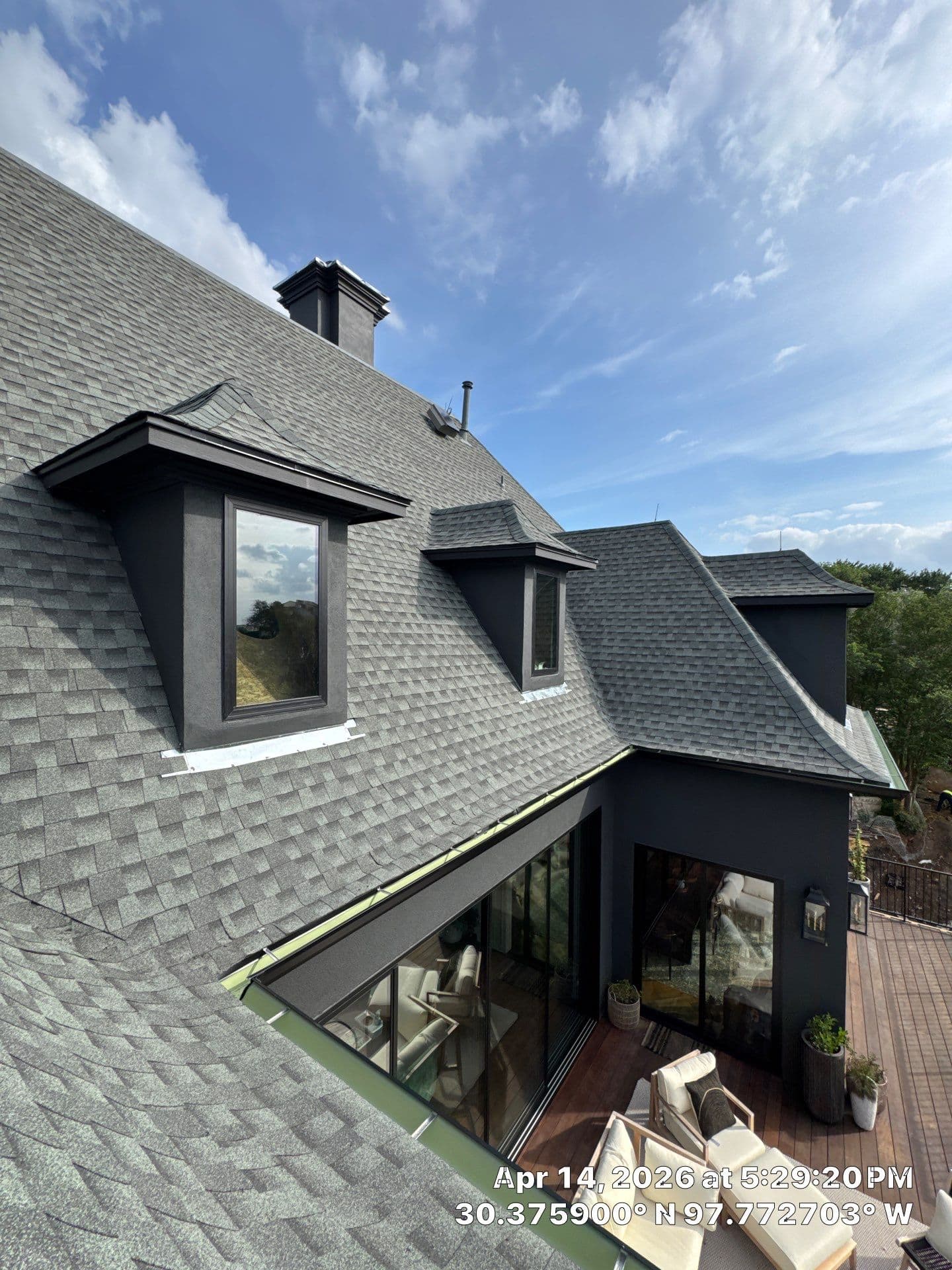
Learn how to document roof damage, review your policy, work with the carrier’s adjuster, and keep the contractor’s role clear under Texas law.
A roof insurance claim has three separate parts: the policyholder reports the loss, the insurer investigates coverage and estimates the covered damage, and the contractor documents construction conditions and prices the proposed work. Keeping those roles separate makes the process easier to understand and helps Texas homeowners avoid promises a contractor cannot legally make.
This guide is educational, not a coverage opinion. Your declarations page, endorsements, deductible, exclusions, deadlines, and carrier decisions control your claim. For current consumer guidance, start with the Texas Department of Insurance home insurance guide.
First Steps After Roof Damage
- Protect people first. Stay off a wet, steep, or storm-damaged roof and keep clear of electrical hazards.
- Photograph visible conditions. Capture exterior damage, interior water, and the surrounding area before it changes.
- Prevent additional damage. TDI advises temporary protection such as tarping when needed, while preserving evidence and receipts.
- Tell the insurer promptly. Policies have notice and filing requirements that vary, so use the number or portal listed by your carrier.
- Keep a claim file. Save the claim number, policy, photographs, emails, estimates, receipts, and a dated call log.
Do not assume a universal filing window. TDI says most companies have deadlines and some policies use a one-year deadline unless good cause exists. TWIA wind and hail policies use a one-year filing deadline. Read your policy and ask the carrier which deadline applies to your loss.
Review Your Policy Before Making Decisions
The declarations page summarizes key limits and deductibles, but endorsements can materially change roof coverage. Ask your agent or carrier to explain terms you do not understand.
- Covered cause of loss: Wind, hail, hurricane, cosmetic damage, and wear can be treated differently.
- Deductible: The policy may use a flat amount or a percentage for wind, hail, or named storms.
- Valuation: Determine whether the roof is settled at replacement cost or actual cash value and whether a roof-specific schedule applies.
- Code coverage: Ordinance or law coverage may affect costs required by current building rules.
- Deadlines: Confirm notice, proof-of-loss, filing, repair, and recoverable-depreciation requirements.
Document the Roof and the Proposed Construction
A contractor can help create a factual construction record. The record should distinguish observed damage from normal wear and should not claim that a policy covers a condition.
A useful contractor report can include:
- Roof measurements, slopes, and material identification
- Labeled photographs tied to specific locations and components
- Observed covering, flashing, vent, gutter, skylight, and interior conditions
- A repair or replacement scope with quantities and line-item pricing
- Product, manufacturer, permit, or code information relevant to the proposed work
- Unknown conditions that can be confirmed only after material is removed
Texas does not require a contractor doing the work to become the policyholder’s representative. The contractor’s value is the accuracy of the construction evidence and estimate.
File and Track the Claim
Use the carrier’s published reporting process. Provide the policy number, date and description of the event, visible damage, contact information, and any emergency protection already completed. Record the claim number and assigned contact.
Respond promptly when the company requests a proof-of-loss form or additional information. Keep copies of what you submit and note the date. If a permanent repair is urgent, ask the carrier in writing how it wants the damage preserved and documented before the work proceeds.
The Carrier’s Adjuster Inspection
TDI advises policyholders to try to be present when the company’s adjuster inspects the damage and says it can be helpful to have the contractor present. The contractor can discuss measurements, the estimate, materials, access, and other technical construction issues.
- Provide the adjuster with the contractor’s photographs and written construction scope.
- Ask what additional information the carrier needs and when its estimate will be available.
- Keep the carrier estimate separate from the contractor proposal so differences can be compared line by line.
- Ask the insurer—not the contractor—to explain coverage, depreciation, exclusions, and payment decisions.

Documenting Scope Differences
The carrier estimate and contractor proposal may differ without either document automatically proving the other is wrong. Compare the quantities, materials, labor operations, access, permit items, flashing, ventilation, decking allowances, and code-related work.
If damage or required work becomes visible after tear-off, the contractor can photograph it, explain the construction consequence, price the additional work, and provide that information to the policyholder and carrier. TDI says a contractor may talk with the adjuster about estimates and other technical issues. The contractor should not interpret policy coverage or negotiate the policyholder’s settlement.
Texas Deductible Rules
A deductible is the portion of a covered claim the policyholder must pay. Check the declarations page for the applicable amount; different causes of loss can have different deductibles.
Texas law prohibits a contractor from waiving, rebating, crediting, or otherwise helping a policyholder avoid the deductible. TDI also notes that an insurer can ask for proof that the deductible was paid. See TDI’s current guidance: Is it OK for a contractor to waive my deductible?
Replacement Cost and Actual Cash Value
TDI describes replacement cost coverage as paying current repair or replacement prices, subject to the policy and deductible. Actual cash value subtracts depreciation for age and wear. Roof-specific endorsements can change how these general terms apply, so confirm the exact policy language with the carrier.
| Question | Replacement cost coverage | Actual cash value coverage |
|---|---|---|
| How is age treated? | Depreciation may be withheld initially and released under the policy after documented completion. | Depreciation reduces the payment and is generally not recoverable. |
| What should you verify? | Completion deadline, invoice requirements, equivalent-material terms, deductible, and endorsements. | Depreciation method, deductible, roof schedule, limits, and the remaining owner-paid amount. |
Texas Claim Deadlines and Timing
The current TDI home insurance guide describes these general Texas deadlines, while also identifying exceptions:
- The company generally must acknowledge receiving the claim within 15 days.
- It generally must accept or deny the claim within 15 business days after receiving all information it needs.
- A company that needs more time can take 45 days to decide if it tells the policyholder why.
- Deadlines can be longer after major disasters, and TWIA, surplus-lines, or other circumstances can follow different rules.
- After agreeing to pay, the company generally must send payment within five business days, subject to the applicable exceptions.
These are not promises about a specific claim. Use the insurer’s written communications and the current TDI guide to track what applies.
What a Texas Roofing Contractor Can—and Cannot—Do
According to TDI’s roofing and insurance guidance, a roofer or contractor cannot act or advertise as the public adjuster on a claim when the company is also doing the work.
A contractor can
- Inspect and photograph roof conditions
- Measure the roof and prepare a construction estimate
- Explain materials, labor, access, permits, and code-related scope
- Discuss its estimate and technical issues with the carrier’s adjuster
- Document changed conditions discovered during construction
A contractor doing the work cannot
- Act as the policyholder’s public adjuster
- Interpret policy coverage for the homeowner
- Negotiate the policyholder’s settlement
- Promise a claim amount or that every item will be covered
- Waive, rebate, or absorb the deductible
Keep the source material handy
The Texas Department of Insurance home insurance guide explains claims, deductibles, RCV/ACV, deadlines, payment, complaints, appraisal, and public adjusters in plain language.
Common questions
Frequently asked
There is no safe universal answer. TDI says most companies have deadlines, some policies use a one-year deadline unless good cause exists, and TWIA wind and hail policies use a one-year deadline. Read your policy and ask the carrier to confirm the applicable deadline in writing.

Founder of Lapeyre Roofing, continuing a family legacy in Louisiana since 1699. Licensed in Louisiana, GAF Certified, and FORTIFIED Roofing specialist serving Texas and Louisiana.