Austin roofs face a unique triple threat: extreme thermal cycling, intense UV radiation, and acidic debris from Live Oak trees. Understanding the science helps you choose materials that actually last.
TL;DR: Austin roofs fail 5-7 years earlier than manufacturer ratings suggest. The culprits are thermal shock (rapid temperature swings that fatigue materials), intense UV radiation (220+ sunny days accelerating oxidation), and—for homes under Live Oaks—acidic leaf debris that corrodes flashing and creates moisture dams in valleys. SBS-modified shingles, proper ventilation, and regular debris clearing extend roof life significantly.
Why Austin Shortens Roof Lifespan
A shingle rated for 30 years in Ohio often lasts only 20-22 years in Austin. This isn't a warranty issue or defect—it's physics. Central Texas combines three roof-killing factors that most manufacturers don't test for simultaneously:
- Thermal shock: Daily temperature swings of 50-70°F during storm season
- UV intensity: 220+ sunny days per year with UV Index regularly hitting 10-11 (extreme)
- Organic acid exposure: Live Oak leaves contain tannic acid that accelerates corrosion
We've inspected hundreds of Austin roofs that "shouldn't" need replacement yet—15-year-old roofs with cracked shingles, granule loss, and failed seals. The pattern is consistent: roofs that would be fine in moderate climates are breaking down here because they weren't built for our specific conditions.
Thermal Shock: The Silent Roof Killer
Thermal shock occurs when materials experience rapid temperature changes that cause uneven expansion and contraction. In Austin, this happens in two specific scenarios:
The Summer Storm Pattern
On a typical July afternoon in Austin:
- 2:00 PM: Roof surface temperature reaches 155-165°F (measured with infrared thermometer)
- 2:45 PM: Thunderstorm rolls in with cold rain and 50°F temperature drop in 20 minutes
- 3:15 PM: Roof surface temperature has dropped to 95-105°F
That's a 60°F swing in less than an hour. When this happens repeatedly—and Austin averages 80+ thunderstorm days per year—shingle materials fatigue. The asphalt matrix develops micro-cracks. Adhesive seals break. Nails work loose as the deck expands and contracts around them.
The Daily Thermal Cycle
Even without storms, Austin roofs experience 40-50°F temperature swings daily during summer. A roof that's 160°F at 4 PM cools to 80°F by midnight. This daily expansion/contraction cycle accumulates over thousands of repetitions.
The Texas A&M Engineering Extension Service documented this effect: standard asphalt shingles in Central Texas show measurable adhesive degradation after just 5 years—half the degradation timeline of the same products in the upper Midwest.
What Thermal Shock Looks Like
If your roof is experiencing thermal shock damage, you'll see:
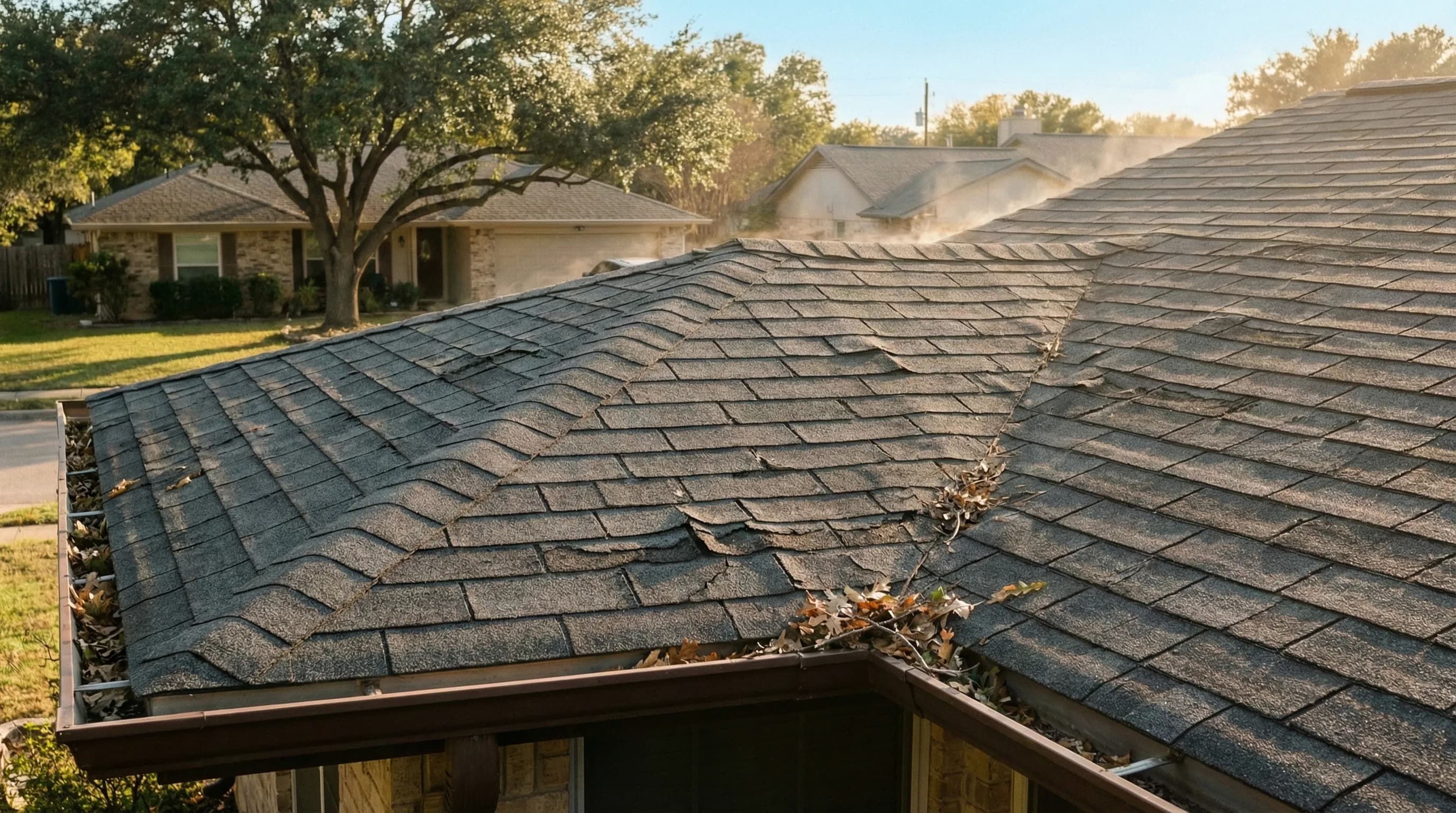
- Curling shingles: Edges curl upward (cupping) or downward (clawing) as materials lose flexibility
- Cracking along horizontal lines: Cracks form perpendicular to the slope, following thermal stress patterns
- Lifted nail heads: Nails "back out" slightly as the deck cycles around them
- Adhesive strip failure: Shingles lift easily at the tabs—the heat-activated seal has broken
UV Degradation: Austin's Relentless Sun
Austin receives approximately 2,650 hours of sunlight annually—among the highest in the continental US. More significantly, our UV Index regularly reaches 10-11 (extreme exposure) from April through September.
How UV Destroys Shingles
Ultraviolet radiation breaks down the chemical bonds in asphalt. This causes:
- Oxidation: Asphalt becomes brittle as volatile compounds evaporate
- Granule loss: The adhesive holding protective granules degrades, causing them to wash off
- Color fading: Pigments break down, though this is cosmetic rather than structural
The granules on your shingles aren't just decorative—they're the UV protection layer. As they shed, the asphalt beneath is exposed to direct UV radiation, accelerating degradation exponentially.
South and West Slopes Fail First
UV damage isn't uniform across your roof. South-facing slopes receive the most direct sunlight year-round. West-facing slopes receive afternoon sun when UV intensity peaks. We consistently see south and west slopes need replacement 3-5 years before north and east slopes on the same roof.
For Austin homes with complex rooflines, this creates a dilemma: do you replace the damaged sections now and create a patchwork appearance, or wait until the protected sections also fail and replace everything at once? Neither answer is perfect, which is why choosing UV-resistant materials from the start matters.
The Live Oak Problem: Acid, Moisture, and Debris Dams
Live Oaks are iconic Austin trees—and one of the most damaging things that can shade your roof. Unlike deciduous trees that drop leaves in fall, Live Oaks shed continuously, creating year-round debris that affects your roof in specific ways.
Tannic Acid Corrosion
Live Oak leaves contain high concentrations of tannic acid (tannins)—the same compounds that give tea and wine their astringent quality. When these leaves sit on your roof, rain extracts the tannins and creates a mildly acidic solution that runs across your roofing materials.
This acidic runoff affects:
- Galvanized flashing: Tannic acid accelerates corrosion of galvanized steel. We've seen 15-year-old flashing fail under Live Oaks that would last 25+ years in open sun.
- Aluminum components: While aluminum resists acid better than galvanized steel, prolonged exposure still causes pitting
- Asphalt shingles: Acid accelerates granule loss and can contribute to moss/algae growth
Debris Dams in Valleys
Live Oak leaves have a waxy, hydrophobic coating that makes them slow to decompose. Unlike maple or oak leaves that break down within weeks, Live Oak leaves can persist for months. When they accumulate in roof valleys, they create debris dams that:
- Hold moisture against shingles: Trapped water accelerates deterioration and can penetrate seams
- Redirect water flow: Water backs up behind debris dams and flows laterally under shingles
- Create organic matter accumulation: Decomposing debris supports moss and algae growth
During inspections, we often find that valley flashing under Live Oaks has corroded through where identical flashing elsewhere on the same roof remains intact.
Shade: The Hidden Factor
Live Oak shade might seem beneficial—cooler roof, less thermal shock. But heavy shade creates its own problems:
- Moss and algae: Shaded, moist areas support biological growth that damages shingles
- Slower drying: Moisture persists longer after rain, extending exposure time
- Branch impact: Overhanging limbs can scrape shingles during wind, removing granules
Materials That Survive Austin Conditions
Knowing the science of Austin roof failure points to specific material solutions:
SBS-Modified Asphalt Shingles
Why they work: SBS (Styrene-Butadiene-Styrene) modified shingles contain rubberized polymers that maintain flexibility through extreme temperature cycles. Where standard oxidized asphalt becomes brittle, SBS-modified asphalt flexes with thermal expansion and contraction.
Top options for Austin:
- GAF Timberline AS II (ArmorShield): SBS-modified, Class 4 impact-resistant. Our primary recommendation for Austin.
- Owens Corning Duration: Modified asphalt with SureNail technology for enhanced wind resistance.
- Malarkey Legacy: Uses proprietary NEX polymer-modified asphalt with excellent flexibility ratings.
Cool Roof Shingles
Why they work: Reflective granules bounce solar radiation instead of absorbing it, reducing surface temperatures by 20-40°F. Lower peak temperatures mean less thermal shock and slower UV degradation.
The Energy Star-rated cool roof shingles we install maintain 25-40% solar reflectance versus 5-15% for standard dark shingles. This translates to surface temperatures of 130-140°F instead of 160-170°F on peak summer days.
Metal Roofing
Why it works: Metal doesn't degrade from thermal cycling or UV exposure the way asphalt does. Expansion and contraction are accommodated by panel design rather than causing material fatigue. Light-colored metal reflects 60-70% of solar radiation.
For Austin homes under Live Oaks, metal has an additional advantage: debris slides off more easily, and the non-porous surface doesn't support moss or algae growth.
Flashing Upgrades for Live Oak Properties
If your home is under Live Oaks, standard galvanized flashing isn't sufficient. We recommend:
- Copper flashing: Naturally resistant to acid corrosion. Develops protective patina over time.
- Aluminum flashing: More acid-resistant than galvanized steel at lower cost than copper.
- Stainless steel: Maximum durability for critical areas like chimney flashing.
The Ventilation Factor
Proper attic ventilation doesn't just affect energy bills—it directly impacts roof lifespan in Austin.
Heat Buildup From Below
An under-ventilated attic in Austin can reach 150-160°F on summer days. This superheated air bakes the underside of your roof deck and shingles. Combined with solar heating from above, shingles are effectively being cooked from both sides.
We calculate ventilation requirements for every Austin installation using the 1:150 or 1:300 rule (depending on vapor barrier presence), ensuring balanced intake at soffits and exhaust at ridge. Homes that fail these calculations get ventilation upgrades as part of the roofing project.
Moisture Accumulation
Austin's humidity averages 65-70% year-round. Poor ventilation traps this moisture in the attic space, where it condenses on cooler surfaces during temperature swings. Over time, this moisture contributes to:
- Decking rot and deterioration
- Mold growth on framing
- Premature deterioration of underlayment
How to Inspect Your Austin Roof for Climate Damage
You can identify many thermal shock and UV damage indicators from the ground with binoculars:
Signs of Thermal Shock Damage
- Curling edges: Shingle corners curling upward or downward
- Horizontal cracking: Cracks running across shingles perpendicular to the slope
- Lifted tabs: Shingle tabs that have separated from the course below
- Nail pops: Small bumps where nail heads have lifted the shingle surface
Signs of UV Degradation
- Color variation by slope: South/west slopes noticeably lighter than north/east
- Granule accumulation: Significant granules in gutters after rain
- Exposed asphalt: Dark patches where granules have completely shed
- Brittle, crumbling edges: Shingles that crack when flexed
Signs of Live Oak Damage
- Rust staining: Orange/brown streaks below flashing indicating corrosion
- Debris accumulation: Leaves and debris in valleys despite recent clearing
- Moss/algae growth: Green or black streaking in shaded areas
- Pitted flashing: Visible corrosion spots on metal components
If you see these signs, a professional inspection can determine whether repair, maintenance, or replacement is the appropriate response.
Free Roof Inspection
We offer free inspections for Austin homeowners concerned about climate damage. We'll document current conditions, identify problem areas, and provide honest recommendations—even if that recommendation is "your roof is fine, check back in a few years."
Common questions
Frequently asked
Austin roofs experience thermal shock (rapid 50-70°F temperature swings during storms), intense UV radiation (220+ sunny days with extreme UV index), and for homes under Live Oaks, acidic debris that accelerates corrosion. These factors combine to shorten roof lifespan by 5-7 years compared to moderate climates. A 30-year shingle often lasts only 20-22 years in Central Texas.

Founder of Lapeyre Roofing, continuing a family legacy in Louisiana since 1699. Licensed in Louisiana, GAF Certified, and FORTIFIED Roofing specialist serving Texas and Louisiana.