Fortified Roof Cost Austin 2026
Fortified roof cost in Austin is typically $8,500-$13,500 for a 2,000 sqft home before incentives. Stacking Class 4 hail-resistant shingles adds $2,000-$4,000 and unlocks 10-28% insurance discounts from most Texas carriers.
Fortified roof cost in Austin is typically $8,500-$13,500 for a 2,000 sqft home before incentives. Stacking Class 4 hail-resistant shingles adds $2,000-$4,000 and unlocks 10-28% insurance discounts from most Texas carriers. Income-eligible homeowners can pull up to $17,000 from the FHLB Dallas FORTIFIED Fund, which for many Austin roofs covers the entire upgrade.
Ready to start? Get a free FORTIFIED + Class 4 estimate for your Austin home. For background on the building standard itself, read our FORTIFIED Roofing guide, and for Texas-specific shingle picks see our IBHS Class 4 shingle rankings.
Austin sits in the middle of Texas Hail Alley. The threat profile here is different from Houston or Mobile: we are 150 miles inland, so hurricanes are a minor factor, but baseball-sized hail and wind-driven thunderstorms are a yearly event. That changes the math on what a FORTIFIED upgrade is actually buying you, and how to stack it with Class 4 shingles and insurance discounts to come out ahead.
This guide walks through every number a Central Texas homeowner needs to make the call: the FORTIFIED + Class 4 stack, the $17,000 FHLB Dallas grant, Texas carrier discounts, real line-item pricing, and the ten-year payback scenarios I run with customers at the kitchen table.
Which Financial Path Is Right For You?
Before the cost breakdown, here is the critical Texas wrinkle most homeowners miss: there is no state FORTIFIED grant in Texas. Louisiana has LFHP; Alabama has the Strengthen Alabama Homes program; Texas has neither. Austin homeowners get there a different way, by stacking a federal FHLB Dallas grant with voluntary insurance discounts.
Your best path depends on income eligibility and whether you have time to wait for a funding window:
| Your Situation | Best Path | Benefit |
|---|---|---|
| Income at or below 120% Austin AMI | FHLB Dallas FORTIFIED Fund + Class 4 | Up to $17,000 grant + 10-28% premium cut |
| Above AMI, high insurance premium | FORTIFIED + Class 4 stack (self-pay) | $5,000-$15,000 in 10-year premium savings |
| Above AMI, price-sensitive | Class 4 shingles only | 10-28% discount for ~$2,000-$4,000 premium |
| New construction in Travis County | FHLB Dallas new-construction track | Up to $7,500 grant |
FORTIFIED and Class 4 are not competing products; they solve different problems. The stack is what wins. More on that next.
What Is FORTIFIED? Why Pair It With Class 4 in Austin?
FORTIFIED is a building standard from the Insurance Institute for Business & Home Safety (IBHS). A third-party evaluator verifies it. A Class 4 shingle is a product rating under UL 2218, tested by dropping a two-inch steel ball from twenty feet and checking for cracks on the back side.
They protect against different failure modes. Here is what that looks like on an Austin roof during a hail event.
What FORTIFIED does
- Sealed roof deck with taped seams or a self-adhering underlayment. If shingles get stripped off, water cannot pour through the bare deck into your attic.
- Ring-shank nails instead of smooth shanks. Roughly double the wind uplift resistance.
- Enhanced drip edge and flashing at eaves, rakes, and penetrations. These are the first places wind-driven rain finds its way in.
- Locked-down starter courses and proper attic ventilation so the system performs as tested.
- Third-party inspection before sign-off. Independent evaluator, not the contractor, confirms the installation.
What Class 4 shingles do
- Resist hail impact without cracking. The granule mat and asphalt layer are engineered to absorb and spread the blow.
- Keep the shingle sealed to the deck instead of lifting or fracturing on impact.
- Qualify for voluntary premium discounts from most Texas insurers when the product appears on the TDI qualifying list.
The Austin stack: why you want both
During the September 2023 hail event, I inspected roofs across North Austin and Pflugerville with two common failure patterns. First, softball-sized hail split open standard three-tab shingles and exposed the deck. Second, sustained thunderstorm winds drove rain sideways for hours while those roofs sat exposed. Homes without FORTIFIED deck sealing saw water run down interior walls within 45 minutes.
Class 4 shingles would have reduced the first problem: fewer strikes, fewer splits, fewer exposed deck sections. FORTIFIED would have contained the second problem: a sealed deck does not leak even if half the shingles are gone. Each layer covers for the other's weakness. That is the stack.
Why Austin Needs This: The Sept 24, 2023 Hail Event
On September 24, 2023, a severe storm system dropped baseball to softball-sized hail across Travis and Williamson counties. North Austin, Round Rock, and Pflugerville took the worst of it. Total damage estimates ran past $300 million, with tens of thousands of insurance claims filed in the following weeks.
The claims I reviewed after that storm shared a pattern. Standard three-tab shingles on homes built between 2005 and 2015, most with no deck sealing, took catastrophic impact damage. A handful of Class 4 roofs on my routes came out with cosmetic granule loss and kept the water out. The FORTIFIED designations in that zone were still rare in 2023; by 2026 they are showing up on more Round Rock and Cedar Park rebuilds, and those homeowners are paying meaningfully less on renewal.
Two specific failure points showed up over and over on my inspections that week. First, the valley liners on older roofs, which had gone brittle from Austin UV, split open under hail impact and let water flow straight down into the attic. Second, plumbing boot flashings that were already cracked from heat cycling opened up another half inch under impact, and every driving rain that followed pushed water in through the gap. FORTIFIED addresses both by requiring enhanced flashing at all penetrations and a fully sealed deck underneath. On retrofits we do in Travis County, I often pull up flashing that should have failed five years earlier but had not seen a real test yet. The 2023 storm tested them.
Central Texas averages one significant hail day per year in a typical cycle, and we have seen back-to-back severe seasons before. The September 2023 event was not a once-in-a-lifetime anomaly. It was a reminder of the risk profile we already live in. North Austin, Pflugerville, Cedar Park, Round Rock, Leander, and Georgetown all sit inside the central hail corridor. Homes in those ZIPs are the ones where the FORTIFIED + Class 4 math moves fastest, and the ones where carriers are most willing to write the bigger end of the discount.
FHLB Dallas FORTIFIED Fund: Up To $17,000
The Federal Home Loan Bank of Dallas runs the FORTIFIED Fund, the single largest pot of grant money available to Austin homeowners doing this upgrade. It is a federal program delivered through FHLB member banks, not a state program.
The numbers
- Existing home roof replacement: up to $17,000
- New construction: up to $7,500
- Income cap: household income at or below 120% of Area Median Income
2026 funding windows
- Offering 1: January 26, 2026
- Offering 2: July 1, 2026
Funds are limited each cycle. Applications are submitted through a participating FHLB Dallas member bank, not directly to FHLB. The bank is your point of contact; they verify eligibility, hold the funds, and disburse after the roof is installed and FORTIFIED designation is issued. A full list of member institutions and current program details is at fhlb.com/community-programs/homeownership-and-homebuyer-programs/fhlb-dallas-fortified-fund.
How the application flow actually works
- Get a FORTIFIED + Class 4 estimate from a certified contractor. You need this in hand before applying.
- Contact a local FHLB Dallas member bank. Frost Bank, Broadway Bank, and a number of Austin-area community banks participate.
- Submit income verification, the estimate, proof of ownership, and homeowners insurance.
- If approved in that cycle, the bank reserves your funds. Work begins.
- FORTIFIED evaluator inspects and issues the designation. The bank releases funds to the contractor or reimburses you per the member bank's specific process.
This is the single biggest lever in the Austin market. If you are within 120% AMI, applying is the first thing to do.
Texas Class 4 Insurance Discounts (10-28%)
Texas is a voluntary-discount state. Carriers are not required to offer a Class 4 discount, but most do, and the amounts vary. That is different from the hurricane coast, where TWIA and wind-pool pricing creates a more uniform structure. In Austin, which sits inland with no TWIA exposure, discounts are set by each carrier individually.
The range you will actually see
Texas Class 4 discounts run from 10% to 28% on the wind and hail portion of the premium. In the Austin market I typically see carriers land on the lower-to-middle end of that range, 10% to 20%, with a handful of regional carriers going higher. On a typical Austin homeowners premium, that works out to $500 to $1,500 per year in savings.
A few patterns worth knowing:
- Shop your renewal. Because the discount is voluntary, the same Class 4 roof can earn 12% with one carrier and 24% with another. If your current insurer is at the low end, a quote from a competitor is worth your time.
- UL 2218 Class 4 certification is mandatory. The shingle manufacturer's spec sheet must show Class 4 impact resistance under UL 2218. Cosmetic "hail resistant" claims do not qualify.
- Documentation matters. Carriers want the installed product's model number, a manufacturer certificate, and in many cases photos of the shingle packaging on the jobsite. We provide all three standard.
Finding qualifying products
The Texas Department of Insurance publishes a qualifying products list at tdi.texas.gov/company/roofing-discounts.html. Before you pick a shingle, confirm the exact model is on that list or on your carrier's approved list. The carrier's list can be narrower than TDI's, so check with your agent if you have a specific product in mind.
Does FORTIFIED itself get a Texas discount?
Rarely, in Austin specifically. FORTIFIED discounts are common on the hurricane coast (Louisiana, Alabama, Mississippi) where the wind-uplift benefit is priced into the tariff. Inland Austin carriers generally reward the Class 4 component, not the FORTIFIED designation itself. Ask your agent directly; a few carriers are starting to recognize FORTIFIED in Texas rate filings, and that list grows each year.
"After the September 2023 supercell tore through Williamson County, the Class 4 roofs on the houses we had already done held up noticeably better than standard architectural. If you live in North Austin, Round Rock, or Pflugerville, this is not a hypothetical exercise. The storm has already proven the math."
-- Hunter Lapeyre, Austin roofing contractor
Actual Cost Breakdown: FORTIFIED vs Class 4 Stack
Asphalt shingle roof pricing in the Austin market in 2026 runs $4.25 to $6.00 per square foot installed for a standard architectural shingle roof. Upgrading to FORTIFIED adds 10 to 20% on top of that, and Class 4 shingles add another $2,000 to $4,000 depending on the product.
| Roof Size | Standard Architectural | FORTIFIED (no Class 4) | FORTIFIED + Class 4 Stack |
|---|---|---|---|
| 1,500 sqft | $6,500-$9,000 | $7,500-$10,500 | $9,500-$13,000 |
| 2,000 sqft | $8,000-$12,000 | $8,500-$13,500 | $10,500-$15,500 |
| 2,500 sqft | $10,000-$15,000 | $11,000-$16,500 | $13,500-$19,500 |
Line-item: FORTIFIED components
On a 2,000 sqft Austin home, the FORTIFIED delta over a standard replacement breaks down roughly as follows:
- Sealed deck (taped seams or peel-and-stick underlayment): $400-$900
- Ring-shank nails upgrade: $75-$150
- Enhanced drip edge, flashing, and starter courses: $200-$400
- Third-party FORTIFIED evaluator fee: $350-$600
- Certified contractor labor premium: $100-$300
Total FORTIFIED premium over standard: $1,000-$3,000, with most Austin jobs landing near $1,500.
Line-item: Class 4 shingle upgrade
The Class 4 material cost varies by brand. Well-performing Class 4 products in Austin from GAF, Owens Corning, Atlas, and Malarkey run a $2,000-$4,000 premium over standard architectural shingles for a 2,000 sqft roof. Our 2025 IBHS hail resistance rankings cover which specific products actually hold up in impact testing, because not every Class 4 shingle performs the same.
Net cost scenarios for a 2,000 sqft Austin home
| Scenario | Gross Cost | Grant/Credit | Net Out-of-Pocket |
|---|---|---|---|
| FORTIFIED + Class 4, income-eligible | $13,000 | $17,000 FHLB | $0 (grant covers full cost) |
| FORTIFIED + Class 4, partial FHLB | $15,500 | $9,000 FHLB (limited cycle) | $6,500 |
| FORTIFIED + Class 4, no grant | $13,000 | None | $13,000 (offset by 10-yr premium savings) |
| Class 4 only, no FORTIFIED | $11,500 | None | $11,500 (discount-only path) |
Get a Free FORTIFIED + Class 4 Estimate in Austin
"A FORTIFIED roof without Class 4 shingles still protects against leaks when shingles go. The real question for an Austin homeowner is whether you want to prevent shingle loss in the first place--and that is what Class 4 does. Together they are a system: Class 4 stops the hail, FORTIFIED stops the water that follows when hail wins."
-- Hunter Lapeyre, IBHS FORTIFIED Evaluator
Installation Process & Timeline
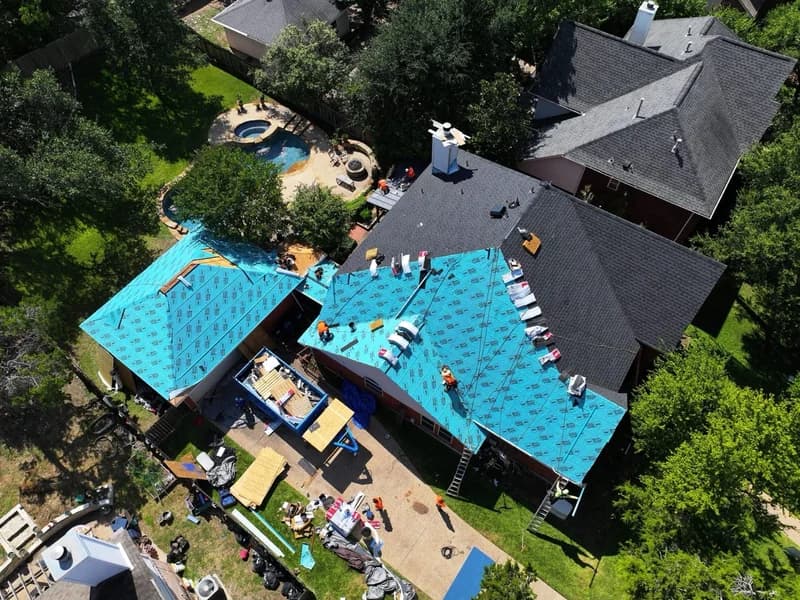
A FORTIFIED + Class 4 replacement on a typical Austin home takes three to five working days. The FORTIFIED evaluation adds one day on the back end, not at the front. Here is how a normal job runs.
Day 1: Tear-off and deck inspection
Strip the old roof down to bare decking. Walk the deck for rotted plywood, improper nailing, and any framing issues. In Austin, we often find soft spots around skylights and at chimneys that get replaced before underlayment goes down. This is the point where cost surprises can come up; we document any decking replacement with photos and a written change order before proceeding.
Day 2: Deck sealing and underlayment
For FORTIFIED, either tape every deck seam with approved tape or cover the entire deck in a self-adhering peel-and-stick membrane. The peel-and-stick option costs more but outperforms in testing. Drip edge goes on. Ring-shank nailing pattern is set for the starter course.
Days 2-4: Class 4 shingle install
Course by course, with attention to proper four-nail (or six-nail on steep pitches) placement. Valleys and flashing details get extra attention because that is where FORTIFIED evaluators focus their inspection.
Day 4-5: Cleanup and final walk
Magnet sweep the lawn, walk the driveway, wash the gutters. We then submit documentation to the third-party FORTIFIED evaluator: photos, product labels, nail shank samples, underlayment product information.
Day 5-7: Third-party inspection and designation
The FORTIFIED evaluator reviews the submission. Most evaluations clear in two to three business days. You receive a FORTIFIED Roof designation certificate that goes to your insurance agent. Designation is good for five years; after that a re-inspection renews it.
From Hunter: The customers I see come out furthest ahead on this are the ones who time the upgrade to a roof that is already due. If you are replacing anyway, the FORTIFIED premium on a 2,000 sqft Austin job is usually around $1,500, and the Class 4 premium is another $2,000-$3,000. Every year that stack sits on your house and no hail hits, you still bank the 10-28% discount. Every year hail does hit, the stack pays for itself in a single event. I have seen both outcomes in Travis County this past cycle.
-- Hunter Lapeyre, Owner
Ten-Year Payback Math
Here is a realistic scenario for a 2,000 sqft Austin home with a current homeowners premium of $4,200 per year. Roughly 60% of that premium is wind and hail exposure in Central Texas, so about $2,500 is the discountable portion.
| Item | Amount |
|---|---|
| FORTIFIED + Class 4 premium over standard roof | $3,500 to $5,500 |
| Annual Class 4 discount (15% of wind/hail portion) | $375 per year |
| 10-year premium savings (no rate growth) | $3,750 |
| 10-year savings (with typical 5% annual premium growth) | $4,700+ |
| Avoided deductible in one average hail event ($2,500-$5,000) | Plus $2,500-$5,000 in avoided replacement exposure |
At the midpoint, the discount alone recovers most of the upgrade premium within ten years. A single significant hail event in that window, which is realistic in Austin, turns the math strongly positive. At a 25% discount (higher end of the Texas range), breakeven comes around year seven.
If you can pull the FHLB Dallas grant, the math is not close. The grant covers most or all of the upgrade, and the discount becomes pure savings from month one.
Ready to map this to your roof?
We walk Austin homeowners through FHLB eligibility, carrier shopping, and the FORTIFIED + Class 4 spec before writing an estimate. See all Austin roofing services or request a free FORTIFIED inspection.
Frequently Asked Questions
A FORTIFIED asphalt shingle roof on a 2,000 sqft Austin home runs $8,500 to $13,500 installed. Adding Class 4 hail-resistant shingles on top of that brings the total to $10,500 to $15,500. Income-eligible homeowners can pull up to $17,000 from the FHLB Dallas FORTIFIED Fund, which covers the full cost of most Austin FORTIFIED + Class 4 projects.
No. They are separate and complementary. FORTIFIED is a whole-roof system standard (sealed deck, ring-shank nails, enhanced edge details, third-party inspection) that protects against wind-driven water intrusion. Class 4 is a UL 2218 impact rating on the shingle itself. A roof can be Class 4 without being FORTIFIED, or FORTIFIED without Class 4 shingles. In Austin I recommend stacking both: Class 4 reduces shingle damage from hail, FORTIFIED prevents leaks if the hail does get through.
Texas Class 4 discounts are voluntary, so the range is wide (10-28%). In the Austin market I most often see 10-20% with major national carriers and occasional higher offers from regional Texas carriers. The same roof can earn 12% with one carrier and 24% with another, so shopping your renewal is worth it. Confirm your shingle is on the Texas Department of Insurance qualifying products list, and ask your agent for the exact discount percentage before you bind.
Yes. A FORTIFIED designation does not waive your coverage or your deductible. If hail cracks Class 4 shingles severely enough to require replacement, you file a claim like any other roof. What FORTIFIED does is dramatically reduce the odds of interior water damage from wind-driven rain during and after the event, which is often the larger claim component. You still get paid for the roof; you just avoid having soaked drywall and ruined flooring added on top.
Usually yes, and here is why. Central Texas averages significant hail events on a roughly annual cadence, and premiums are priced accordingly. The Class 4 discount alone (10-28%) pays for most of the FORTIFIED + Class 4 upgrade within 7-10 years even if no hail ever hits your roof. If a hail event does hit, the stack pays for itself in a single claim cycle. The September 2023 Travis and Williamson County event reminded a lot of homeowners of what the risk actually looks like.
One to three business days after the install is complete, not during the install itself. The roof crew finishes the work and submits documentation (photos, product labels, nailing details) to the third-party FORTIFIED evaluator. Most evaluations clear in 48-72 hours and the designation certificate is issued. Total project time from tear-off to designation is typically 5-7 working days.
Eligibility is based on household income at or below 120% of Area Median Income for your area. For the Austin-Round Rock MSA in 2026, that threshold covers a large share of middle-income households, including many dual-income families. Eligibility also requires that you own and occupy the home and that the work be done by a certified contractor with a third-party FORTIFIED evaluation. Applications go through a participating FHLB Dallas member bank, not directly to FHLB.
FHLB Dallas has announced two 2026 offerings: Offering 1 opens January 26, 2026, and Offering 2 opens July 1, 2026. Funds are limited each cycle and typically allocated quickly, so having your contractor estimate and member bank contact lined up before the window opens is the difference between funded and not funded.
There is no Texas state FORTIFIED grant to stack with. Texas has not created an equivalent to Louisiana's LFHP or Alabama's Strengthen Alabama Homes program. The FHLB Dallas grant and the voluntary carrier Class 4 discount are the two main financial levers in Austin. You keep the insurance discount for the life of the roof regardless of whether you took the grant.
Five years. After that, a FORTIFIED re-inspection renews the designation for another five years. Your insurance discount typically continues as long as your designation is current, which is why re-certification is worth the small fee at year five.
Yes. The installing contractor must be FORTIFIED-trained through IBHS, and a separate third-party evaluator (not the contractor) inspects and signs off on the designation. Certification alone does not guarantee quality; ask how many FORTIFIED roofs the contractor has installed in Central Texas and what their first-time pass rate is with evaluators. A pass rate under 100% means re-inspection fees and schedule slips you did not budget for.

Hunter Lapeyre
Owner & Lead Roofing Consultant, Lapeyre Roofing
Founder of Lapeyre Roofing, continuing a family legacy in Louisiana since 1699. Licensed in Louisiana, GAF Certified, and FORTIFIED Roofing specialist serving Texas and Louisiana.