Fortified roof cost in Houston is typically $9,000-$14,500 before incentives. This guide explains FHLB Dallas member-bank funding, Class 4 discount caveats, and TWIA nuance.
Fortified roof cost in Houston is typically $9,000-$14,500 for a 2,000 sq ft home before incentives. The FHLB Dallas Fortified Fund may provide up to $17,000 for income-qualified households, but homeowners cannot apply directly to FHLB Dallas.
Texas does not currently have an enacted statewide FORTIFIED grant, but Governor Greg Abbott proposed a $400 million roof fortification fund in July 2026 with grants up to $10,000. No application is open and the Legislature must still authorize the program. Houston homeowners can also verify the separate FHLB Dallas member-bank path, carrier-specific Class 4 or FORTIFIED insurance review, and--for certain coastal Harris County properties--TWIA windstorm certification considerations. Read our Texas FORTIFIED roof grant status tracker before budgeting around the proposal.
This is the math, the eligibility rules, and the real Houston pricing--no fluff.
Ready to get a number on your roof? Get a free Fortified roof estimate in Houston →
Which Financial Path Fits You
Before you look at sticker price, figure out which bucket you fall into. Your income and your ZIP code decide your best move.
| Your Situation | Best Path | Potential Benefit |
|---|---|---|
| Household income at or below 120% Area Median Income | FHLB Dallas Fortified Fund through a member financial institution + carrier review | Possible assistance up to $17,000, subject to member-bank application and fund availability |
| Above 120% AMI, pay out of pocket | Class 4 + FORTIFIED documentation review | Possible carrier-specific premium credit if the product and documentation qualify |
| Coastal ZIP in TWIA-designated Harris County area | TWIA windstorm certification review + standard carrier review | Potential credit only if TWIA and product documentation requirements are met |
| New construction (building now) | FHLB Dallas Fortified Fund (new construction track) | Possible assistance up to $7,500 through participating member institutions |
The important piece most homeowners miss: the FHLB Dallas fund runs through member financial institutions, not a state portal or contractor portal. You cannot apply directly to FHLB Dallas or through Lapeyre Roofing.
What Is a Fortified Roof
FORTIFIED is a construction standard created by the Insurance Institute for Business & Home Safety (IBHS). It's not a shingle brand, it's not marketing language, and it's not something a contractor can stamp on a proposal. It's a third-party-verified build spec, inspected by an independent FORTIFIED evaluator.
For Houston, the single most important piece of the Fortified spec is the sealed roof deck. Here's why that matters more here than almost anywhere else in the country.
Houston's Real Threat: Wind-Driven Rain, Not Just Wind
Houston doesn't get as much hail as Dallas or Austin. It doesn't get the peak sustained wind speeds of Galveston or Cameron. What Houston gets--over and over--is water. Hurricane Harvey in 2017, Imelda in 2019, Beryl in 2024. Per the Harris County Flood Control District, 75% of homes that flooded during Harvey were outside the 100-year flood zone. That's the stat nobody shares at closing.
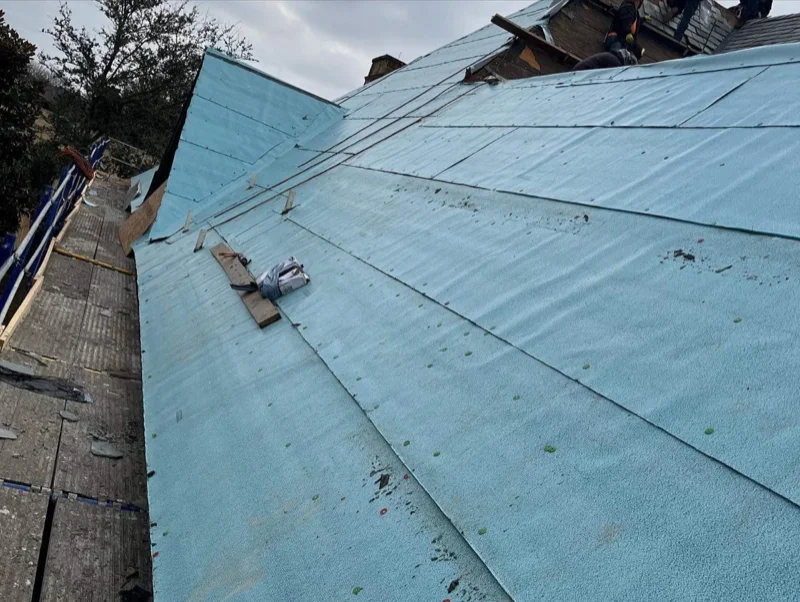
A Fortified sealed roof deck uses peel-and-stick membrane or taped seams over the plywood. When wind rips shingles off during a hurricane--and some always come off--the deck itself keeps rain out. A standard 15-pound felt underlayment can't do that. The difference between a damp attic and $40,000 of drywall and hardwood damage usually comes down to this one detail.
The other Fortified requirements--ring-shank nails at a 6-inch pattern, enhanced drip edge, metal flashing at valleys and transitions, locked-down starter strip--all add to the wind performance. But for Houston specifically, you're buying the deck seal.
Three Fortified Levels
- Fortified Roof - The baseline designation. Covers the sealed deck, fastening, flashing, and drip edge. This is what qualifies for the FHLB Dallas grant and what most Texas carriers credit for discounts.
- Fortified Silver - Adds attic ventilation, gable end bracing, and impact-resistant openings.
- Fortified Gold - Adds a continuous load path from roof to foundation. Strongest designation, highest cost, mostly relevant to new construction or major renovation.
For many existing Houston homes, the Roof designation is the practical starting point. It creates a third-party documentation package your carrier or member bank can review without rebuilding your gable walls.
Want the longer explainer? Read the complete Fortified Roofing guide.
FHLB Dallas Fortified Fund - The Primary Texas Grant
Texas has proposed, but not enacted, a state roof fortification program. The July 2026 proposal calls for a $400 million fund and grants up to $10,000, but there is no application or official eligibility list. What Texas homeowners may be able to verify today is the separate FHLB Dallas Fortified Fund--a Federal Home Loan Bank program delivered through participating member financial institutions across the five-state district.
Grant Amounts
- Up to $17,000 for existing home roof replacement
- Up to $7,500 for new construction
FHLB Dallas says funds and offering windows change, and member institutions submit applications. Treat the amount as a possible funding path to verify, not a homeowner entitlement.
2026 Application Windows
- Offering 1: Opens January 26, 2026
- Offering 2: Opens July 1, 2026
As of our June 23, 2026 review, FHLB Dallas listed a second 2026 offering scheduled for July 1, 2026. Confirm the current offering status directly with a participating member institution before timing the roof work.
Eligibility
- Household income at or below 120% of Area Median Income for your Houston MSA tract
- Primary residence (owner-occupied)
- Roof work must meet IBHS Fortified Roof standards and be inspected by a certified FORTIFIED evaluator
- Work must be documented to the IBHS FORTIFIED Roof standard and reviewed by the required program parties
Income thresholds depend on the current AMI table and household size. Your member institution should verify the current number for your tract and application date.
How To Actually Apply
You cannot apply directly to FHLB Dallas. The application flow is:
- Find a FHLB Dallas member bank--most Texas community banks and many credit unions qualify. FHLB Dallas publishes the member list.
- Ask the bank if they participate in the Fortified Fund specifically. Membership in FHLB Dallas does not guarantee they offer this specific program.
- Submit income documentation, deed, homeowners insurance declaration page, and a signed contractor estimate for Fortified-spec work.
- If approved, funding and disbursement follow the member institution and program rules after required FORTIFIED documentation is complete.
Reference: FHLB Dallas Fortified Fund program page.
Documents To Have Ready Before You Walk Into the Bank
The homeowners who get funded on day one have their paperwork stacked before the window opens. Here is the packet:
- Two most recent federal tax returns for every adult in the household
- Two most recent pay stubs for each wage earner
- Current homeowners insurance declaration page
- Copy of the recorded deed or property tax statement proving primary residence
- A signed written estimate from a Fortified-familiar contractor, broken out by line item, noting which Class 4 shingle will be installed
- For self-employed applicants: a year-to-date profit and loss statement
If your estimate does not clearly call out the sealed deck method, fastening specification, and FORTIFIED evaluator inspection, ask your contractor to rewrite it before you submit a packet. Member institutions and programs may request specific line-item documentation.
Class 4 + Fortified Carrier Review Caveats in Texas
Here is the part to verify with your carrier before choosing materials: Texas policies may offer credits for eligible impact-resistant roofing products or FORTIFIED documentation.
The Range
TDI says impact-resistant roof materials may be eligible for credits, but each insurer sets the amount, test criteria, labeling, and paperwork it accepts. Ask your agent for the exact discount and documentation requirements before you select a shingle.
For planning, you can model potential savings once your carrier gives you an exact percentage. Do not price the roof assuming a discount that your carrier has not confirmed.
The Catch: Texas Discounts Are Voluntary
This is the single most important thing to understand about Texas insurance. The discount, accepted test standard, labeling, and paperwork are carrier-specific. Not every carrier offers the same percentage, and some smaller or surplus-lines carriers may not offer a meaningful credit.
What to do: Before you sign, ask your current carrier what it needs: manufacturer label, UL 2218 documentation, FORTIFIED certificate, contractor invoice, or a carrier-specific form. Then compare quotes only after you know the paperwork is accepted.
Documentation You Must Have
- UL 2218 Class 4 certificate for the specific shingle installed (manufacturer provides this)
- IBHS Fortified designation letter from the third-party evaluator
- Contractor invoice showing materials and installation method
Texas Department of Insurance publishes the current list of qualifying impact-resistant products at tdi.texas.gov/company/roofing-discounts.html. Match what's on your proposal against that list before you sign anything.
Shingle Brands That Qualify in Texas
Common Class 4 shingles may appear on the TDI list, but the exact product model and label matter. Match the proposal to the current TDI list and your carrier's approved documentation before you sign.
TWIA and Coastal Harris County
TWIA--the Texas Windstorm Insurance Association--is Texas's insurer of last resort for windstorm coverage along the coast. It matters only for properties in the TWIA context, not for every Houston roof.
Who Is Actually In TWIA Territory
TWIA covers 14 designated coastal counties: Aransas, Brazoria, Calhoun, Cameron, Chambers, Galveston, Jefferson, Kenedy, Kleberg, Matagorda, Nueces, Refugio, San Patricio, Willacy, and a portion of Harris County. That last one is the one Houstonians trip over.
Harris County is split. Only the eastern portion of Harris County--generally the areas along Galveston Bay, Morgan's Point, Shoreacres, La Porte, and parts of Seabrook--falls inside the TWIA-designated catastrophe area. The city of Houston proper--downtown, Montrose, Heights, West University, Memorial, Bellaire, most of the Inner Loop--is not in TWIA territory. Those homeowners buy wind coverage through their standard homeowners policy.
If you live in Clear Lake, Seabrook, or other bay-adjacent neighborhoods, check your address against the TWIA/TDI coverage resources. If your property is not in the TWIA context, focus on standard carrier documentation instead.
If You Are TWIA-Eligible
TWIA says roof replacement or significant roof repair is a common improvement that may need windstorm certification. If you rely on TWIA wind and hail coverage, confirm certification timing before work begins and ask your agent which impact-resistant roofing documentation is required for any available credit.
One nuance: homeowners near the coast may carry both a TWIA windstorm policy and a separate homeowners policy for fire, liability, and theft. Provide documentation to each carrier, but let each carrier confirm whether a credit applies.
"Most of Houston proper sits outside TWIA. If your home is not in the TWIA context, focus first on your standard carrier's Class 4 and FORTIFIED documentation requirements."
-- Hunter Lapeyre, GAF Certified Contractor
Actual Cost Breakdown
Here's what you're actually paying for a Fortified Roof on a typical Houston 2,000 sq ft asphalt shingle roof in 2026.
| Line Item | Typical Range (2,000 sq ft) | What It Covers |
|---|---|---|
| Class 4 shingles & accessories | $3,400-$5,200 | UL 2218 impact-resistant shingles, ridge caps, starter strip |
| Sealed deck underlayment | $1,100-$1,900 | Peel-and-stick membrane or taped synthetic per IBHS spec |
| Enhanced flashing & drip edge | $450-$800 | Valleys, step flashing, metal drip edge on eaves and rakes |
| Labor & tear-off | $3,200-$5,500 | Remove existing roof, dispose, install Fortified spec |
| FORTIFIED evaluator inspection | $300-$500 | Third-party IBHS-certified evaluator |
| Harris County permit & dump fees | $250-$450 | Permit, disposal, inspection |
| Total installed | $9,000-$14,500 | Complete Fortified Roof designation |
Houston runs roughly a 5% premium over the national average on installed roofing--driven by labor costs, permit fees, and the reality that qualified Fortified crews are in short supply here compared to Louisiana or Alabama. A Fortified build adds $1,000-$3,000 over a standard Class 3 architectural reroof. That's the premium you're paying, before incentives, for the certificate.
Net Out-of-Pocket Scenarios
| Scenario | Typical Out-of-Pocket | Carrier Treatment to Verify |
|---|---|---|
| Under 120% AMI, FHLB member-institution path approved | Depends on award amount, project cost, and program rules | Use only carrier-confirmed discount amounts |
| Over 120% AMI, no grant | $9,000-$14,500 | Use only carrier-confirmed discount amounts |
| TWIA-eligible coastal Harris County | Full cost unless funding is approved through the proper channel | TWIA or carrier credits only if documentation qualifies |
For an income-qualified homeowner, the FHLB Dallas path can be meaningful, but the application must move through a participating member institution and funds can change by offering. Do not start from the assumption that the roof will be fully covered.
"Harvey proved what IBHS had modeled for years. The worst damage does not come from shingles blowing off. It comes from wind-driven rain getting past the deck after the shingles are gone. That sealed-deck requirement is the one FORTIFIED feature I would build into every Houston reroof whether the homeowner pursued the designation or not."
-- Hunter Lapeyre, Owner, Lapeyre Roofing
Installation Process
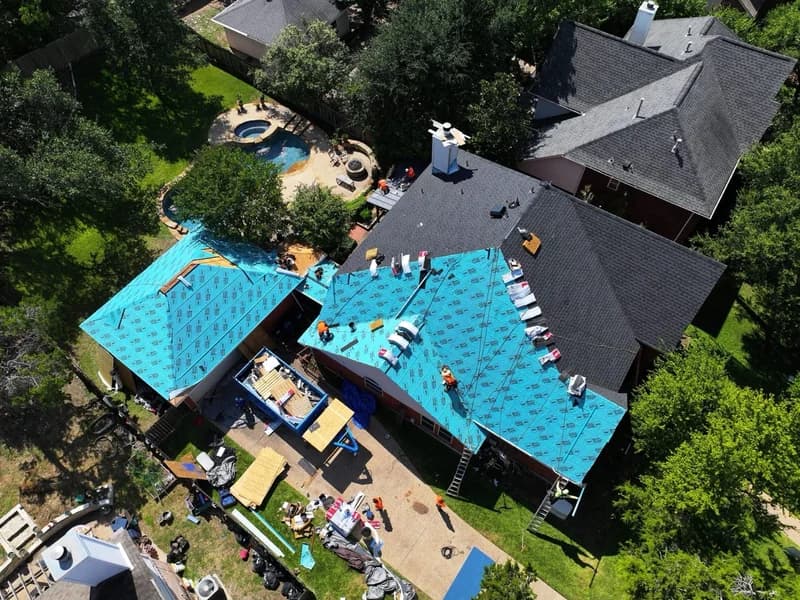
A Fortified Roof in Houston runs 3-5 working days for a typical 2,000 sq ft home. Longer if we hit rot under the old deck or the weather moves in. Here's the sequence.
- Day 1 - Tear-off and deck inspection. Old shingles, underlayment, and failed flashing come off. We inspect every plywood sheet. Anything that's soft, delaminated, or water-damaged gets replaced at $85-$150 per sheet. This is the step where budgets sometimes move--you don't know what's under a 20-year roof until it's off.
- Day 2 - Sealed deck installation. Self-adhering peel-and-stick membrane at eaves, valleys, and penetrations. The rest of the deck gets either full peel-and-stick or taped-seam synthetic--whichever method matches your approved Fortified submittal. Drip edge goes on first.
- Day 3 - Shingle install. Ring-shank nails, 6-nail pattern per Fortified spec. Starter strip locked down at every eave and rake. Architectural or Class 4 shingles over the sealed deck. Ridge vents cut and set.
- Day 4 - Flashing, trim, cleanup. Step flashing at chimneys and sidewalls, pipe boots, ridge caps. Magnetic sweep of the yard and driveway for nails.
- Day 5 - FORTIFIED evaluator inspection. Independent third-party evaluator photographs the work, reviews contractor documentation, and issues the designation letter. This is the document your insurance carrier and FHLB bank want.
Any contractor telling you they'll do a Fortified roof in one day is skipping the evaluator step. The third-party inspection is what makes it Fortified. No certificate, no carrier documentation path, no grant.
Retrofit vs Full Replacement
Occasionally a Houston homeowner asks if a 5-year-old roof can be "upgraded" to Fortified without tearing the whole thing off. The honest answer is almost always no.
IBHS requires the sealed deck and the fastening pattern to be verified, and there is no non-destructive way to confirm what's between the shingles and the plywood on an existing roof. If you want the designation, the discount, and the grant, you need a full tear-off and replacement to Fortified spec.
The exception is a brand-new roof (less than 12 months old) where the contractor kept detailed photo documentation of the deck, fastening, and flashing. In those cases, an IBHS evaluator can sometimes certify retroactively. If that's your situation, call and we'll walk you through the photo requirements.
Houston-Specific Mistakes We See Weekly
A few patterns show up again and again on Houston bids we review. Avoid these and you'll dodge most of the expensive surprises.
- Contractor claims "Fortified-equivalent" without the evaluator. Equivalent is not certified. No letter from an IBHS-certified evaluator means your carrier or member institution may not accept the documentation. Always ask for the evaluator path up front.
- Using a shingle that is not on the current TDI discount list. Last year's Class 4 product may have been dropped. Verify the exact model and manufacturer batch before you sign.
- Skipping attic ventilation review. Houston humidity destroys shingles from below. A new Fortified roof with starved intake ventilation can cook itself in 8 years. A proper install includes a soffit intake check and ridge vent sizing.
- Not confirming carrier paperwork. The insurance credit is not automatic. Provide the designation letter and product documentation to your carrier in writing and ask whether a credit applies.
- Assuming the member bank handles the evaluator. Confirm who schedules the evaluator and which documentation the member institution needs before work starts.
Learn More About Fortified Roofs →
Want a real number on your specific Houston home?
We'll measure the roof, pull the shingle spec against the TDI discount list, and prepare a Fortified proposal package you can review with your member institution and insurance carrier. Schedule a free Houston Fortified estimate →
Common questions
Frequently asked
A Fortified Roof in Houston typically costs $9,000-$14,500 for a 2,000 sq ft home in 2026, installed. That is roughly $1,000-$3,000 more than a standard Class 3 architectural reroof. The premium covers the sealed roof deck, ring-shank nailing, enhanced flashing, and the third-party FORTIFIED evaluator inspection. Houston prices run about 5% above the national average due to labor costs and permit fees.

Founder of Lapeyre Roofing, continuing a family legacy in Louisiana since 1699. Licensed in Louisiana, GAF Certified, and FORTIFIED Roofing specialist serving Texas and Louisiana.
Found this helpful? Choose Lapeyre Roofing as a source you want to see on Google.
Add Lapeyre Roofing as a preferred source on Google (opens a Google window)