Metal roof gauge describes a thickness category, but it does not identify the complete panel's suitability or performance. Compare the metal, actual product specification, profile, support, and attachment together.
Metal roof gauge describes a thickness category, but it does not identify the complete panel's suitability or performance. Compare the metal, actual product specification, profile, support, and attachment together.
Within the same metal and gauge convention, a smaller gauge number means thicker material: 24-gauge steel is thicker than 26-gauge steel, which is thicker than 29-gauge steel. McElroy explains this ordering. Do not carry that comparison across different metals without checking their actual published thicknesses.
Read the product data
The Metal Construction Association installation manual hosted by McElroy lists gauges and thickness information for roofing materials. Do not compare unlike metals using a gauge number alone or invent a thickness from a generic chart when the manufacturer publishes it.
Ask the supplier to identify the actual metal and panel. A quote saying 24 gauge metal leaves profile, finish, and assembly undecided. Those details affect the complete product you are purchasing.
Ask what an upgrade changes
If a heavier panel is offered, request its additional price and the project-specific reason. Ask whether the proposed product meets the required assembly specification at the actual support and attachment arrangement.
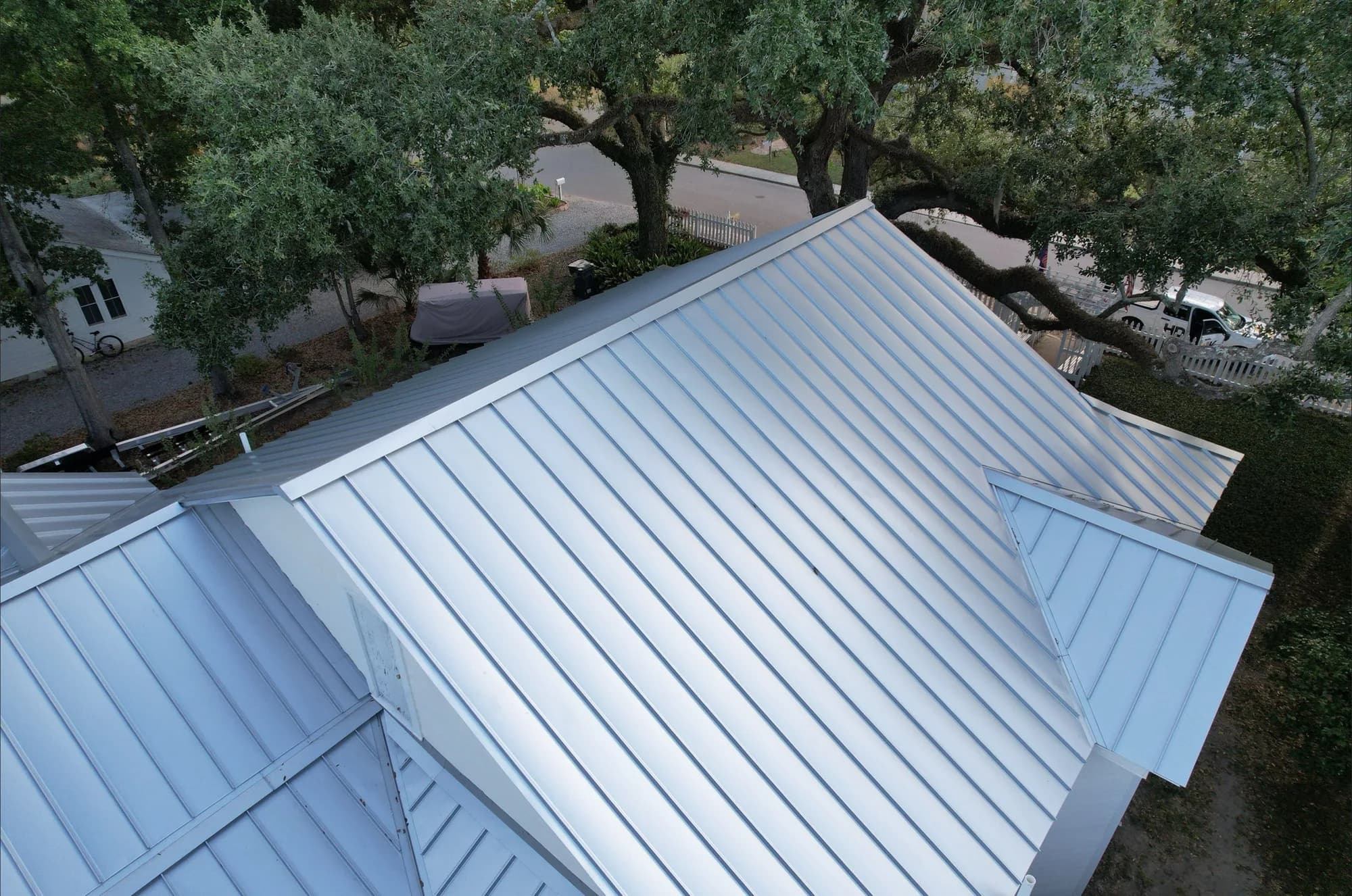
For example, two roofs using the same gauge can use different panel widths, seam designs, and coatings. Their specifications are not equivalent simply because the gauge matches.
Do not assume thickness eliminates visible waviness or guarantees resistance to every storm. Review appearance expectations and compare the complete options with the metal roofing team.
Published by
Editorial team
Our editorial team publishes homeowner guides with sources linked in the article. For a recommendation about your roof, request an inspection of the property.
Found this helpful? Choose Lapeyre Roofing as a source you want to see on Google.
Add Lapeyre Roofing as a preferred source on Google (opens a Google window)