Repair Guide
Slate Roof Repair vs. Replacement: Inspect Before Deciding
Compare slate condition, flashings, fasteners and repair access before replacing a historic roof. Use a documented inventory rather than a blanket percentage rule.
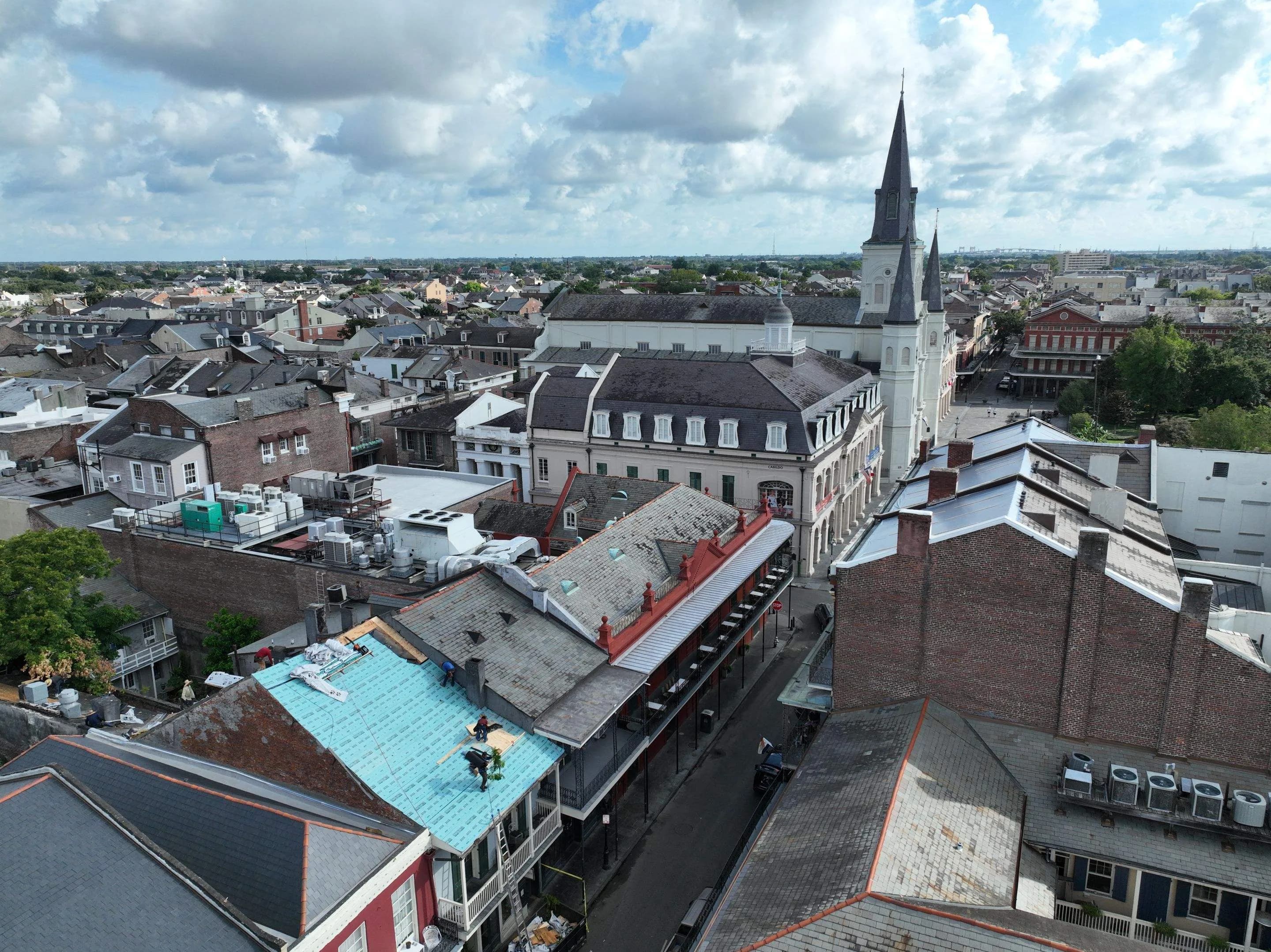
Quarried stone with a documented 75-200 year lifespan, installed and restored by the team behind multiple French Quarter slate roofs — including the historic Sylvain building, one of the oldest in New Orleans.
We partner with multiple lenders to offer financing for all credit levels. A soft credit pull checks your options without affecting your score.
Pay off your project within 18 months with zero interest.
Spread your project cost over up to 20 years for the lowest monthly payment.
Our multi-lender platform finds options where single-bank programs turn people away.
Subject to credit approval. Terms and conditions apply. Contact us for details.
Get answers to common questions about our slate roofing services.
It depends on the slate. Hard slate — Vermont and Virginia unfading varieties — routinely serves 150-200 years. Soft slate, like Pennsylvania soft-vein, lasts 50-125 years and fails by delaminating in layers. The flashings usually give out long before hard slate does, which is why we install 20oz copper in valleys, rated for 100+ years. Many New Orleans slate roofs installed in the 1800s are still in service today.
A slate quote depends on measured roof area, slate grade and size, source availability, access, and flashing details. Inspection also determines whether existing slate can be reused and whether structural work is needed. Compare natural and synthetic slate estimates using the same removal, underlayment, flashing, and repair scope, with engineering and any reinforcement priced separately.
Synthetic slate is a molded composite — usually polymer or rubber blends — made to mimic quarried stone. Good products carry Class 4 impact ratings, weigh about a quarter of natural slate, and are warrantied for around 50 years. It is a legitimate roof, but it is not stone: it will not last centuries, and up close the texture reads differently. We recommend it when structure or budget rules out natural slate but the look matters.
Repair, in most cases. A good rule: if fewer than about 20% of the slates have failed and the slate is a hard variety, repair and targeted flashing work will buy decades. Replace when soft slate is delaminating across whole slopes, when previous repairs relied on tar or face-nailing, or when the failure rate keeps accelerating. Inspect the flashings before pricing replacement. A repair estimate should identify the source of the leak and the slate handling needed to reach it.
Honestly: hard slate sheds most hail, but large hail — 2 inches and up — can crack individual slates. No roof is hail-proof. The good news is that slate fails visibly and repairs tile by tile, so a hailstorm typically means replacing dozens of slates, not the roof. Synthetic slate carries Class 4 impact ratings and takes hail better. After any major hailstorm, we document cracked slates slope by slope for insurance review.
Because the flashing dies first. Slate can last 150+ years, but a valley in thin galvanized steel fails in 25-40 — and replacing flashings under slate means carefully unweaving stone. That math is why we install 20oz copper in valleys and built-in gutters, following the standards in Joseph Jenkins' The Slate Roof Bible, with copper or stainless nails throughout. Matching flashing life to slate life is what makes a true century roof.
Natural slate weighs roughly 800-1,500 lbs per square, or 100 square feet, so a structural evaluation comes first. An engineer must assess the existing framing and specify any reinforcement. Price that work as a separate scope based on the design and site access. Synthetic slate, at about a quarter of the weight, may be an alternative if the structural assessment supports it.
Yes. We match thickness, color behavior (unfading versus weathering), texture, and exposure, sourcing from Vermont, Pennsylvania, and international quarries, plus salvage suppliers for discontinued slates. On historic roofs, a slightly weathered salvaged slate often blends better than a brand-new one. Matching matters for more than looks — mismatched thickness telegraphs through the coursing and can create water-shedding problems.
It depends on the district. Some commissions accept high-quality synthetic slate on secondary structures or low-visibility slopes; stricter districts — including much of the French Quarter's regulated area — generally require natural slate on contributing buildings. We work under historic guidelines regularly and can tell you what your district will approve before you spend money on samples. When in doubt, natural slate is always the approvable answer.
Our slate and tile crews are led by a master craftsman whose portfolio includes university landmarks like SMU and Tulane and hundreds of specialty slate and Ludowici roofs across the country. That crew restored the historic Sylvain building in the French Quarter — slate plus copper standing-seam on one of the oldest buildings in New Orleans — along with multiple other French Quarter slate roofs under Lapeyre contracts.
Find location-specific slate roofing information, pricing, and project details for your city.
Repair Guide
Compare slate condition, flashings, fasteners and repair access before replacing a historic roof. Use a documented inventory rather than a blanket percentage rule.
Homeowner Decisions
Compare St. Louis historic slate roof proposals by damaged area, flashing, matching material, access, and Cultural Resources review before replacing sound slate.
Materials
We install both synthetic and natural slate, so we have no axe to grind. Here is the honest comparison: cost, weight, lifespan, hail and wind ratings, and resale.
Contact us today for a free inspection and estimate for your slate roofing project.