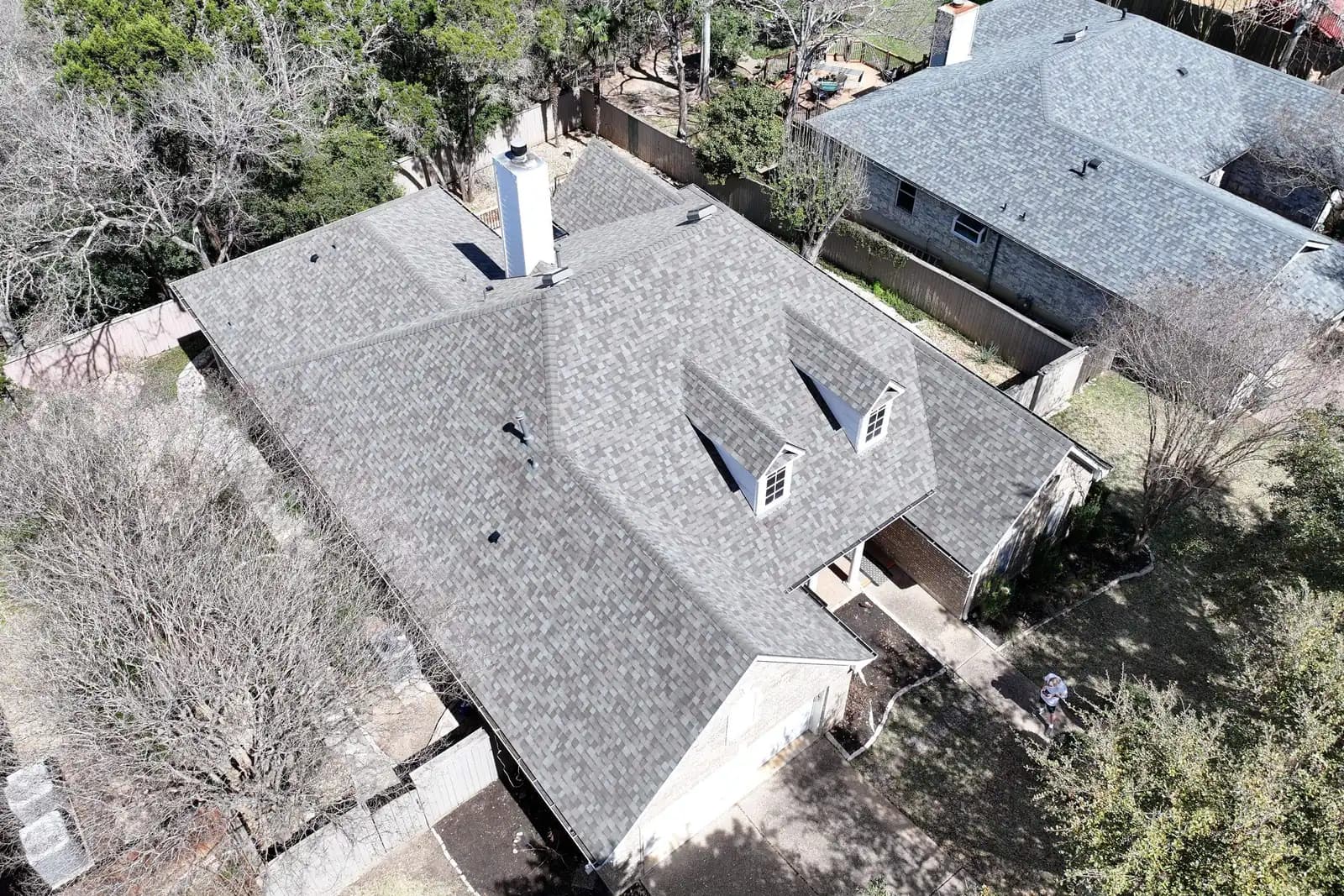
Roof Replacement in Austin: Straight Answers Before You Sign Anything
Clear roofing decisions for Austin homeowners
A single missing shingle isn't a replacement. Neither is one flashing leak over a bathroom vent. What pushes a roof past repair is spread. When we find the same failure in five places on four different slopes, patching just moves the leak.
Prefer to book online? Schedule your free Austin estimate
Schedule Your FREE
Roof Inspection & Estimate
Request a written estimate
Where is your property?
We serve Texas, Louisiana & Missouri
What do you need?
Almost done!
How can we reach you?
By submitting, you consent to follow-up messages. Reply STOP to opt out.
Sources we use
Current rules behind an Austin replacement scope
A replacement recommendation should be consistent with current city and state guidance and still be specific to the house in front of us.
City of Austin
Austin work exempt from building permits
Reviewed September 7, 2026. Check roof-cover exemptions, structural effects, and the Wildland-Urban Interface exception for the actual address.
Read the official guidance →Austin Fire
Wildland-Urban Interface Code
Provides the current map and zone-specific roof assembly, valley, eave, soffit, vent, and permitting guidance for covered projects.
Read the official guidance →Texas Department of Insurance
Products qualifying for impact-resistant roofing credits
Explains that each insurer sets accepted tests, labeling, paperwork, and any credit; TDI does not endorse a roofing material.
Read the official guidance →Texas Department of Insurance
Roofing and insurance: Know the law
Defines the boundary between a contractor’s construction documentation and a public adjuster’s role in policy and settlement matters.
Read the official guidance →Signs Your Roof Has Moved Past Repair
A single missing shingle isn't a replacement. Neither is one flashing leak over a bathroom vent. What pushes a roof past repair is spread. When we find the same failure in five places on four different slopes, patching just moves the leak. Bare mats showing through on wide areas of shingle, not just a strip near the ridge, with granules piling up in the gutters
- The report states why a targeted repair is or is not defensible
- The proposal separates required system components from optional upgrades
- Material selection considers hail, heat, roof geometry, budget, and carrier documentation
- WUI requirements are checked by property and scope instead of assumed for all Austin homes
- Carrier discounts or claim outcomes are never guaranteed
The decisions inside an Austin roof replacement
A roof is a system, not a shingle color
Not every leak means a new roof. We see this every single week. Someone spots a water stain on the ceiling after a storm, calls three companies, and two of them start measuring for a full tear-off before they've even climbed up there.
Hail and wind exposure
Impact: Storm exposure can differ by slope, and accessory damage does not automatically establish functional damage to the entire roof.
Our Solution: We document each slope and compare standard, impact-rated, and other system options without calling any roof hail-proof.
Heat and attic conditions
Impact: Surface temperature, ventilation, insulation, roof color, and deck conditions interact; one product claim cannot describe the whole house.
Our Solution: We inspect visible ventilation and deck conditions and explain which changes are included, optional, or outside the roofing scope.
WUI proximity zones
Impact: Austin Fire says WUI requirements depend on the property’s proximity zone and can affect the assembly, valleys, eaves, soffits, and vents.
Our Solution: We check the current WUI map and document applicable questions before finalizing materials and details.
Complex transitions
Impact: Skylights, chimneys, walls, low-slope sections, tile-to-metal transitions, and additions create more failure points than the field covering.
Our Solution: The proposal identifies those details explicitly instead of hiding them in a generic “complete roof” line item.
Scope questions by Austin property type
These are inspection prompts, not assumptions based on a ZIP code.
Older central-city homes
Prior additions, mixed decking, mature trees, and layered repair histories may be present.
The scope should identify deck replacement pricing, transition details, access, and visible material constraints before tear-off.
Hill-country and WUI properties
Steep or complex roofs and parcel-specific wildfire requirements can change materials and labor.
Confirm the current WUI zone and treat Class A as an assembly requirement, not merely a label on the exposed covering.
Production and newer homes
Simpler geometry may reduce labor, while original ventilation or flashing details may still need correction.
Separate necessary corrections from upgrades and check any active manufacturer or builder warranty before replacement.
Compare an Austin roof replacement quote
Almost nobody asks us about square footage first. They ask why one bid came in way under another. Usually it's not the shingles. It's what each contractor planned to do under them.
Architectural shingle system
Measured scope and written quote
The final number depends on measured roof area and the complete component scope. A home’s floor area is not enough to price the roof.
Impact-rated shingle option
Quoted as an upgrade
We show the incremental material and system cost. Ask your carrier what tests, labels, and paperwork it accepts before choosing based on a possible credit.
Standing-seam metal or specialty system
Property-specific
Panel profile, substrate, geometry, penetrations, trim, and transition details make a generic square-foot promise unreliable.
Factors Affecting Price
- 1Measured roof area and pitch
- 2Stories, access, and staging
- 3Tear-off and deck condition
- 4Flashing, ventilation, and drainage corrections
- 5WUI or permit-driven details
The proposal states allowances and unit prices for unknown deck conditions so a tear-off discovery is not a blank check.
From inspection to a replacement you can audit
Hail comes through Central Texas most springs, and the calls start the same afternoon. Someone heard it hit. They looked at the yard, saw shredded leaves and dents in the truck hood, and now they're staring up at a roof that looks fine from the driveway. That's normal. Shingle bruising doesn't show from the ground.
Condition and repairability report
We photograph the roof, identify system failures, and explain why a smaller repair is or is not responsible.
Property and code questions
We verify roof geometry, access, visible deck conditions, ventilation, drainage, permit needs, and the current Austin WUI map where relevant.
Good-better-best system options
The proposal separates the base compliant system from impact-rated, metal, ventilation, warranty, or aesthetic upgrades.
Preconstruction scope review
Materials, flashing details, exclusions, allowances, schedule, protection, payment, and warranty terms are reviewed in writing.
Installation documentation
We document tear-off findings, approved changes, critical details, cleanup, and the completed system for your records and any carrier paperwork.
How to compare Austin roofing systems
Austin roofs don't fail from one thing. They fail from heat, then hail, then heat again. Our summers push attic temps high enough to bake the oils out of asphalt shingles, and Central Texas sits in a hail corridor that gets active from March through June. So the material question isn't about what looks best on a sample board. It's about what holds up here.
Architectural asphalt shingles
Why for Austin
Broad availability and repairability make them a practical baseline for many homes.
Best For
Homeowners balancing initial cost, appearance, and future serviceability
Considerations
Impact class, warranty coverage, ventilation, and installation details vary by product and system.
Impact-rated shingles
Why for Austin
A tested product can provide more impact resistance than a standard counterpart.
Best For
Owners who value the material upgrade after confirming carrier criteria
Considerations
Impact-rated does not mean hail-proof, and an insurance credit is carrier-specific.
Standing-seam metal
Why for Austin
Long service life and distinct water-shedding details can fit some roof geometries well.
Best For
Long-horizon owners whose roof design and budget support a properly detailed metal system
Considerations
Panel profile, substrate, clips, oil canning, penetrations, sound, and repair access should be discussed.
Class A roof assembly
Why for Austin
Austin Fire requires a Class A assembly for covered WUI work.
Best For
Projects where the current WUI map and scope trigger the requirement
Considerations
The rating belongs to the tested combination of covering, deck, underlayment or insulation. It is not simply a label on the visible material.
A replacement proposal should survive hard questions
We want you to understand both the work and the limits of every claim made about it.
Repair is considered first
The report explains why repairing the existing roof is or is not a sound use of money.
Options are separated
Required components, prudent corrections, and elective upgrades are not blended into one unexplained number.
No insurance promises
We provide construction evidence and carrier-requested product documentation; the insurer decides policy coverage and credits.
Details are photographed
Tear-off findings and critical installation details become part of the project record.
What Drives Roof Replacement Costs Up or Down
Almost nobody asks us about square footage first. They ask why one bid came in way under another. Usually it's not the shingles. It's what each contractor planned to do under them.
Most roof replacement pricing gets built off the roof's measured area, then adjusted for how hard that roof is to work on and what has to be fixed once the old layer comes off. That's the whole model. Everything below either adds labor hours or adds material.
Pitch and height. A steep Austin roof needs more safety setup and slower work. Two stories cost more than one.
Decking condition. We can't see rotted or sagging decking until tear-off. Replacing sheets adds material and time.
Material choice. Asphalt, metal, concrete tile and clay tile all sit at different labor and weight levels. Tile and slate need a structure that can carry them.
Layers coming off. More old roofing means more tear-off labor and more disposal.
Penetrations and details. Skylights, chimneys, valleys, dead valleys and wall flashings are where the hours hide.
Access. Tight side yards and mature shade trees, common on older central Austin lots, slow down loading and cleanup.
Then there's timing. Hail season pushes a lot of Austin roofs into the same few months, and demand affects scheduling more than most people expect.
So how do you compare bids fairly? Ask every contractor the same four things. Is decking replacement included or billed separately? What's the plan for flashing and pipe boots, reuse or replace? Is underlayment specified by type? And is the permit, if the property needs one, in the number?
We put our scope in writing with photos so you can line it up against anyone else's. Nobody can give you a real price without measuring your roof and looking under it, a written project-specific estimate is the only honest answer here.
Recent Projects
An Austin replacement with added decking work
A published replacement case with signed additional decking, removal and vent scope. It illustrates concealed-condition decisions, not an average price or standard timeline.
Read the project detailsCompare your options before signing
Compare roof financing payments
Enter the actual financed amount, APR, and term to compare monthly payments and total repayment.
Read more about this roofing decision
Roof Replacement Cost in Austin: Scope and Estimate
Use measured roof area and transparent Austin planning rates to estimate replacement cost, then compare decking, permits, materials and payment terms.
Roof Repair vs. Replacement: Compare Evidence and Scope
Repair is worth evaluating when the cause is localized and a sound repair can connect to the retained roof. Replacement becomes more compelling when broader deterioration or assembly problems make that repair unsuitable. Neither age alone nor a fixed percentage of damage settles the decision.
Best Roofing Materials for Texas: Compare Actual Products
Choose a Texas roof by slope, hail evidence, heat performance, repairability and installation details rather than generic lifespan or savings claims.
Texas Roof Insurance Claims Guide
Learn how to document roof damage, review your policy, work with the carrier’s adjuster, and keep the contractor’s role clear under Texas law.
Compare the right next step
Austin roofing decision center
Start with the Austin market overview or go directly to the service that matches what you found.
FAQ
Frequently Asked Questions
How do I know if my roof needs a full replacement or just a repair?
You need a full replacement when damage shows up in more than one spot and affects the deck or underlayment, not just the shingles. Look for bare mats over wide areas, soft spots underfoot, or leaks returning in different places after repairs. A single missing shingle or one flashing leak is usually a repair. We photograph the roof and write out the scope so you can see exactly what's driving the decision, not just take our word for it.
Will Austin's heat and hail shorten my roof's life?
Yes, both play a role in Austin. Long stretches of high roof-deck temperature age asphalt shingles faster than the calendar suggests, so a roof can wear out sooner than expected. Repeated hail and high wind also cause nail heads to back out and shingles to lift across a slope, which we see often on Austin homes. That combination is why we recommend documenting your roof's condition each spring rather than guessing based on age alone.
What should I expect when your team comes out for an inspection?
You can expect us to climb up and photograph everything, from bare patches to soft spots to attic staining, then hand you a written scope alongside it. We chalk out test squares on each slope if hail is involved and record hit counts per square. You'll see exactly what we saw instead of a vague verbal summary. Sometimes that documentation points to repair, sometimes replacement, and sometimes just monitoring the roof through another storm season.
Is it worth waiting to replace a roof with only minor damage?
Sometimes, yes. If your roof has minor granule loss and no active leak, watching it through another Central Texas hail season with dated photos each spring can be smarter than replacing it early. Age alone isn't a verdict. A twelve-year-old roof in decent shape doesn't need replacing just because of the number on a document. What matters is whether the shingles are brittle or cracking, not how old they are.
How does hail damage get documented for an insurance claim?
We record it slope by slope with dated photos, chalked test squares, and close-ups of bruised or fractured shingles and exposed mat. We also photograph soft metal evidence like dented vents, flashing, and gutter aprons, plus any interior water damage. Documentation isn't the same as approval, though. Your carrier still decides on coverage based on age, deductible, and their own threshold, so ask them directly how they handle shingle matching and wind or hail deductibles.
What questions should I ask before agreeing to a full roof replacement?
Ask to see the photos and ask which slopes are affected. A real inspection scope holds up when you ask what the decking looks like underneath the shingles. If someone tells you the whole roof needs replacing without showing you why, that's a red flag. We build every estimate around photo documentation and a written scope so you can compare what we found against what you're being told elsewhere.
What makes a replacement estimate comparable?
Compare measured area, tear-off, deck allowances, underlayment, flashing, ventilation, accessories, permits, cleanup, warranties, exclusions, and change-order rules. The total price alone hides too much.
Want the complete picture?
Everything Texas and Louisiana homeowners need to know about roof replacement—costs, timelines, materials, and what to expect.
Read our Complete Roof Replacement GuideContact information
Thank you for considering us for roofing needs. We will get back to you during normal business hours.


Send us a message