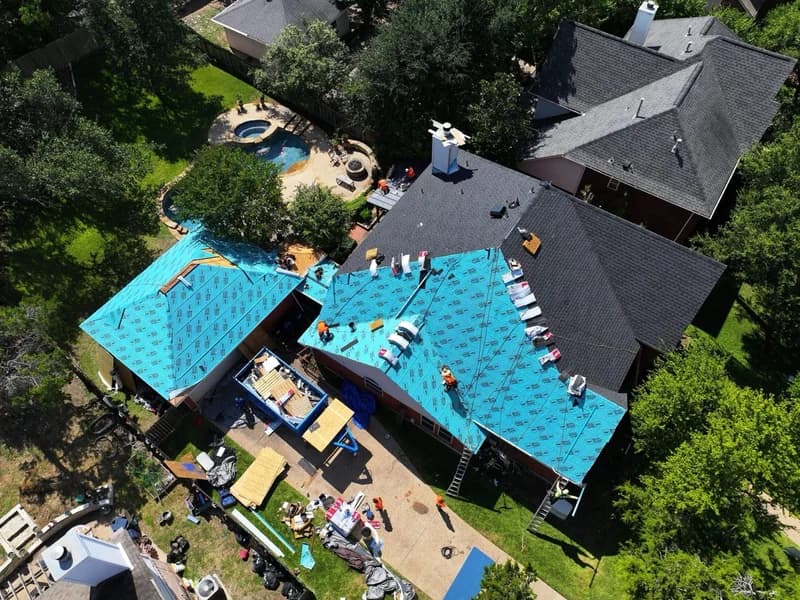
A membrane’s name does not define its coverage area. Have the installer specify the product and the roof details it will serve.
An ice and water barrier is a specialized membrane beneath the roof covering. It is not interchangeable with every field underlayment, and the name does not mean the whole roof automatically needs to be covered with it.
What the product is intended to do
Owens Corning's WeatherLock G literature describes a self-sealing, adhesive ice-and-water barrier. The selected product's current instructions establish compatible assemblies and installation conditions. Other products may have different requirements.
Ask the contractor to distinguish this membrane from the field underlayment in the estimate. “Waterproof paper” is too vague to establish which product will be installed or how it connects to nearby layers.
Make the coverage area explicit
Have the roof sketch identify the intended membrane locations and the reason for each. An edge detail, valley, penetration, low-slope section, and full-deck approach are different scopes. The installer should resolve the assembly rather than adding a universal extra roll without explanation.
For a hypothetical example, two estimates both list an ice-and-water barrier. One covers defined vulnerable details; the other specifies a broader system. Ask each contractor to state the actual area and design basis. You cannot compare quantities or price until the coverage is clear.
Also ask how substrate condition, weather, overlaps, penetrations, and connections will be checked against the product instructions. Progress photographs should show the intended locations before the covering conceals them. A roll label establishes the delivered product; it does not show where it was installed.
If a particular resilience standard is part of the contract, confirm the approved assembly and documentation with the evaluator. Membrane installation alone is not FORTIFIED designation. Review underlayment choices and designation documentation with the project team.
Common questions
Frequently asked
No. The product and coverage must suit the complete assembly, covering, and applicable requirements. Ask why the proposed locations are appropriate.
Published by
Editorial team
Our editorial team publishes homeowner guides with sources linked in the article. For a recommendation about your roof, request an inspection of the property.
Found this helpful? Choose Lapeyre Roofing as a source you want to see on Google.
Add Lapeyre Roofing as a preferred source on Google (opens a Google window)