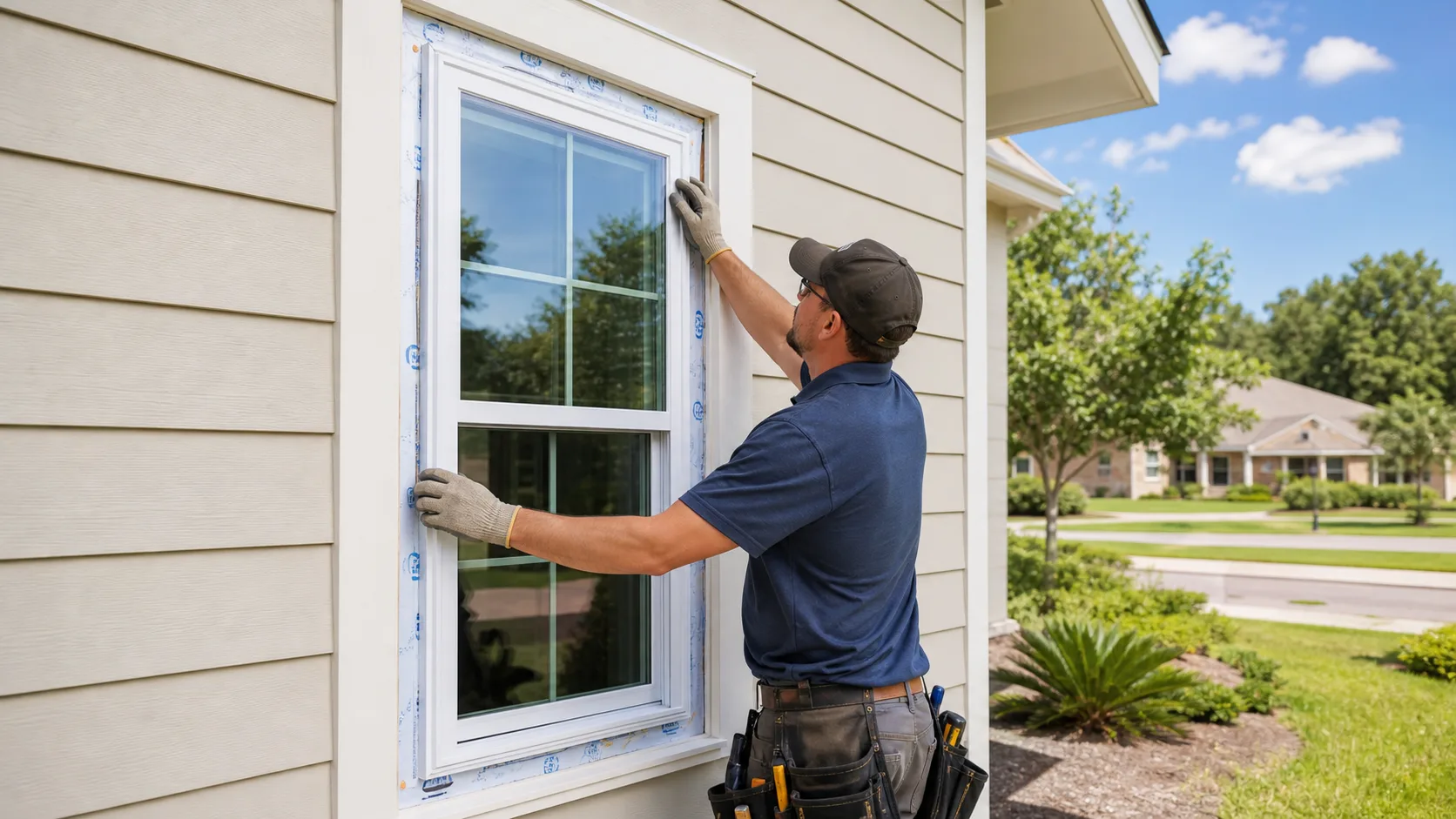
St. Louis Window Replacement
Energy Star v7.0 North-Central + Cold-Climate Glass Packages
St. Louis is in Energy Star's North-Central climate zone — Version 7.0 calls for U-factor at or below 0.25 and SHGC at or below 0.40. That SHGC range is permissive on purpose: in a heating-dominant climate, winter solar gain is a real heating subsidy worth preserving. We install vinyl and fiberglass-framed windows with moderate-solar low-E and warm-edge spacers, with triple-pane options where the cold-winter U-factor improvement is worth it.
Prefer to book online? Schedule your free St. Louis estimate
Schedule Your FREE
Roof Inspection & Estimate
Request a written estimate
Where is your property?
We serve Texas, Louisiana & Missouri
What do you need?
Almost done!
How can we reach you?
By submitting, you consent to follow-up messages. Reply STOP to opt out.
What windows do I need in St. Louis to qualify for Energy Star?
St. Louis is in Energy Star's North-Central climate zone. For Version 7.0 (effective October 2023), windows must have U-factor at or below 0.25 and SHGC at or below 0.40 to qualify for the Energy Star label. Both numbers come straight from the NFRC label. The SHGC range is intentionally permissive — in a heating-dominant climate, higher SHGC preserves winter solar gain that helps heat the home. Triple-pane assemblies deliver meaningful U-factor improvement and noticeably better cold-edge condensation resistance for north-facing rooms.
- St. Louis = Energy Star North-Central climate zone
- U-factor ≤ 0.25, SHGC ≤ 0.40 to qualify
- Moderate-solar low-E preserves winter solar gain
- Triple-pane improves cold-climate U-factor
- Warm-edge spacers reduce cold-edge condensation
How St. Louis Climate Drives Window Selection
Cold-Climate U-Factor + Hail + Freeze-Thaw, Not Hurricane
St. Louis is heating-dominant in winter and cooling-relevant in summer. Window failures here are condensation, freeze-thaw stress on weatherstripping, and hail impact. Hurricane and salt corrosion are not factors.
Cold-Edge Condensation
Impact: Older aluminum-spacer IGUs and lower-grade vinyl frames create cold-edge surfaces in winter, where interior humidity condenses and runs down the glass. Over years, this damages sashes, sills, and surrounding finish.
Our Solution: Warm-edge spacer construction verified on the IGU spec sheet. The NFRC condensation resistance (CR) rating is a useful proxy. Triple-pane assemblies further reduce cold-edge effects.
Freeze-Thaw on Weatherstripping and Seals
Impact: Multiple freeze-thaw cycles per year stress weatherstripping, corner seals, and sash balances. Worn weatherstripping shows up as cold drafts in winter.
Our Solution: Quality weatherstripping (typically silicone bulb or compression seal) and warranty-backed sash hardware. We verify weatherstripping quality on the product spec sheet, not just the marketing brochure.
Hail Impact on Glazing
Impact: St. Louis hail belt conditions can crack standard tempered glass and damage frames. Insurance documentation is the priority since impact-rated windows are not code-required in Missouri.
Our Solution: Laminated glass options provide hail resistance similar to coastal hurricane impact glass. We discuss the cost-benefit on a per-home basis. Hail damage to windows is consistently covered when the storm event is documented.
Ice Dam Water Intrusion at Window Heads
Impact: Where ice dams form at the eave, water can back up under shingles and find its way to window heads on the floor below. Failed head flashing lets water enter the wall above the window.
Our Solution: Drip cap above every head, sealed transition to WRB. Coordinate with roof scope to address ice dam formation at the source (attic insulation and ventilation).
Heating-Dominant Climate Energy Spec
Impact: St. Louis is heating-dominant. Lower U-factor matters more here than lower SHGC. The Energy Star North-Central spec reflects this with strict U-factor and permissive SHGC.
Our Solution: Moderate-solar low-E coatings preserve winter solar gain on south and east elevations. Triple-pane assemblies deliver meaningful U-factor improvement for cold-winter heating bills.
St. Louis Window Replacement Considerations by Area
Architecture and existing window vintage vary across the metro:
Central West End + Forest Park-Adjacent
Historic homes, often with original wood single-hung sashes. Architecturally significant.
Restoration vs replacement conversation. For homes outside historic protections, full replacement to v7.0 spec yields biggest comfort and energy impact. For protected homes, restoration coordination.
Webster Groves + Kirkwood
Older homes from various eras with original or first-replacement windows aging out, mature canopy.
Vinyl or fiberglass v7.0-spec replacements common. Triple-pane upgrade discussions for north-facing rooms with chronic cold-edge condensation.
St. Louis County Suburbs (Chesterfield, Ballwin, Wildwood)
Newer subdivisions with original builder-grade windows aging out. Often vinyl single-hung from 1990s-2010s.
Wholesale upgrade to v7.0 North-Central spec yields meaningful comfort and heating-bill savings on older builder-grade windows.
South County + Affton + Mehlville
Mix of post-war ranches and newer infill. Variable window vintage.
Standard v7.0 spec replacements. Triple-pane upgrade for chronic-condensation rooms.
St. Louis Window Replacement Cost Ranges
St. Louis window pricing depends on size, frame material, glass package (double vs triple), and Class 4 hail-rated upgrades. We work in installed-cost ranges per opening:
Vinyl, double-pane low-E argon, double-hung
Baseline tier per opening
Standard St. Louis replacement. Meets Energy Star North-Central spec.
Fiberglass, double-pane low-E argon
Mid-premium tier per opening
Better dimensional stability across freeze-thaw cycles.
Vinyl or fiberglass, triple-pane low-E krypton
Premium upgrade per opening
Meaningful U-factor improvement in cold-climate North-Central. Better cold-edge condensation resistance.
Hail-rated laminated glass
Significant add per opening
Some insurance carriers offer hail-rated discount.
Wood-clad premium (Andersen 400, Pella Reserve, Marvin Elevate)
Premium tier per opening
Reserved for historic homes.
Factors Affecting Price
- 1Frame material (vinyl < fiberglass < wood-clad)
- 2Glass package (double-pane vs triple-pane)
- 3Hail-rated laminated glass upgrade
- 4Opening size and configuration
- 5Trim and casing repair revealed at removal
Ranges represent typical St. Louis contractor pricing for residential replacement windows as of mid-2026.
Our St. Louis Window Replacement Process
St. Louis install priorities: NFRC label verification for North-Central spec, warm-edge spacer verification, freeze-thaw-rated sealant detail.
Measurement and Quote
Each opening measured. NFRC spec confirmed for v7.0 North-Central qualification (U ≤ 0.25, SHGC ≤ 0.40).
Order and Manufacturing Lead
Custom-sized windows ship from manufacturer in 4-8 weeks typical. Triple-pane assemblies and Class 4 hail-rated options can have longer lead times.
Existing Window Removal
Glazing taped to prevent shatter. Sash and frame components removed without damaging surrounding wall.
Rough Opening Prep
Old caulk and shims out. Sill checked for level and rot. Sheathing inspected for water damage from ice dam history.
Local Note: In St. Louis we often find evidence of ice-dam-related water intrusion at second-floor window heads. We address the source (attic insulation and ventilation) when this is found.
Pan Flashing at Sill
Self-adhered membrane or formed pan that turns up at the sides and slopes outward.
Window Set and Anchor
Window placed, shimmed plumb and square, anchored per manufacturer fastening pattern.
Freeze-Thaw-Rated Insulation and Air Seal
Low-expansion foam at perimeter (high-expansion can bow the frame). Manufacturer-approved elastomeric sealant where the spec calls for it.
Head Flashing and Trim
Drip cap above head, tied into WRB. Critical in ice-dam climate. Trim caulked top and sides, left open at bottom for any incidental water exit.
Punch-List, Walk, Documentation
Operation check on every sash. NFRC label left in place per Energy Star requirements. Photo documentation, manufacturer warranty registration.
Recommended Window Specs for St. Louis
Energy Star Version 7.0 North-Central, with cold-climate-tuned glass packages and warm-edge spacers:
Vinyl Double-Hung (Premium Line) with Triple-Pane
Why for St. Louis
Triple-pane assembly delivers meaningful U-factor improvement in cold-climate North-Central. Welded-corner premium vinyl provides good thermal performance at reasonable cost.
Best For
Most residential replacements where cold-winter heating bills matter and budget allows the triple-pane upgrade.
Considerations
Triple-pane is heavier and reduces visible transmittance slightly. Krypton fill in narrower cavities is common for triple-pane.
Fiberglass Double-Hung or Casement
Why for St. Louis
Coefficient of thermal expansion close to glass — better IGU seal longevity across St. Louis freeze-thaw cycles. Stiffer frame allows larger glass area without sagging.
Best For
Premium budget, larger custom-size openings, north-facing elevations with chronic cold-edge concern.
Considerations
Higher cost than vinyl. Painted finish can chalk over decades.
Double-Pane Moderate-Solar Low-E Argon
Why for St. Louis
Right glass package for St. Louis heating-dominant climate. Moderate-solar low-E lets more winter solar gain through while still cutting summer cooling load.
Best For
All elevations in St. Louis, particularly south and east where winter solar gain is heating subsidy. SHGC up to 0.40 acceptable for North-Central.
Considerations
Different low-E formulation than what we use in Texas and Louisiana (which need low-solar low-E).
Why Hire Lapeyre for St. Louis Windows
St. Louis windows need cold-climate-tuned glass packages, freeze-thaw-rated sealant detail, and ice-dam-aware head flashing. Coming from roofing, the integration with roof scope (especially for ice dam mitigation) matters.
NFRC Label Verification for North-Central
U-factor and SHGC confirmed before installation. North-Central numbers (U ≤ 0.25, SHGC ≤ 0.40) are non-negotiable for Energy Star qualification.
Warm-Edge Spacer Verification
Older aluminum-spacer IGUs create cold-edge condensation problems in St. Louis winters. We verify warm-edge construction on the IGU spec sheet.
Ice-Dam-Aware Head Flashing
Drip cap above every head, sealed WRB transition. Critical in St. Louis ice-dam climate where second-floor window heads see chronic backed-up-water exposure.
Climate-Specific Low-E Selection
Moderate-solar low-E for St. Louis heating-dominant climate, not the low-solar low-E we use in Texas and Louisiana.
Hail-Rated Upgrade Options
Laminated glass options for hail-priority homeowners. Some insurance carriers offer hail-rated discounts.
How We Approach Windows in St. Louis
St. Louis windows live in a different climate from our Texas and Louisiana markets, and the spec reflects that. Energy Star v7.0 North-Central calls for U-factor at or below 0.25 — meaningfully tighter than the South-Central 0.28 — and accepts SHGC up to 0.40 because winter solar gain is a real heating subsidy in this climate. We use moderate-solar low-E coatings here, which preserve winter solar gain while still cutting summer cooling load. That is the opposite of the low-solar low-E coatings we specify in Austin, Houston, and New Orleans. Triple-pane assemblies are worth discussing for cold-winter homes where U-factor improvement matters and where chronic cold-edge condensation has caused problems with older aluminum-spacer IGUs. The ice-dam connection matters: we have seen chronic water intrusion at second-floor window heads on older St. Louis homes that turns out to be ice damming forcing water under the shingles and down the wall to the window. The fix is usually upstream (attic insulation and ventilation) rather than the window itself, and we coordinate with roof scope when both are part of the project. Hail-rated laminated glass is an optional upgrade we discuss for homeowners with claim history; it is not code-required in Missouri.
FAQ
Frequently Asked Questions
What U-factor and SHGC do my St. Louis windows need?
St. Louis is in the Energy Star North-Central climate zone. For Version 7.0 (effective October 2023), windows must have U-factor at or below 0.25 and SHGC at or below 0.40 to qualify for the Energy Star label. Both numbers come straight from the NFRC label. The SHGC range is intentionally permissive — winter solar gain is a heating subsidy in this heating-dominant climate.
Is triple-pane worth it in St. Louis?
Often yes. Triple-pane delivers meaningful U-factor improvement in cold-climate North-Central applications, and the cold-edge condensation resistance is noticeably better than double-pane. The cost premium runs roughly 10-30% over a comparable double-pane. For homes with chronic-condensation north-facing rooms or homeowners prioritizing cold-winter comfort and heating bills, triple-pane is a defensible upgrade.
Why moderate-solar low-E and not low-solar low-E?
Low-emissivity coatings come in different formulations. Low-solar low-E is tuned for cooling-dominant climates — it blocks more solar heat gain (lower SHGC). Moderate-solar low-E lets more winter solar through and is better suited to heating-dominant climates. For St. Louis, moderate-solar preserves winter solar gain on south and east elevations while still cutting summer cooling load. That is the opposite of the low-solar low-E we use in Texas and Louisiana.
Do St. Louis windows need impact rating?
No, code does not require it in Missouri. Hail-rated laminated glass is an optional upgrade we discuss on a per-home basis, particularly for homeowners with repeated hail damage history. Ask your carrier whether it recognizes laminated glass documentation. Impact-rated assemblies are reserved for coastal hurricane zones (Houston, NOLA) where code mandates them.
Will replacing windows lower my St. Louis heating bill?
Yes — and the savings are typically larger in St. Louis than in our Texas markets because of the heating-dominant climate. Going from 1970s single-pane wood or aluminum to a v7.0 double-pane low-E argon window produces meaningful winter heating savings. Going from 15-year-old double-pane vinyl to current spec (especially triple-pane) produces smaller but still measurable savings.
What about cold-edge condensation?
Cold-edge condensation appears at the perimeter of the IGU where the spacer creates a thermal bridge. Older aluminum-spacer windows show this aggressively in St. Louis winters. Modern warm-edge spacer construction (foam, stainless steel hybrid, etc.) is now standard on quality windows. We verify warm-edge spacer construction on the IGU spec sheet before installation. The NFRC condensation resistance (CR) rating is a useful proxy.
What about ice dams and window damage?
Where ice dams form at the eave, water can back up under shingles and find its way to window heads on the floor below. Failed or missing head flashing lets that water enter the wall above the window, often visible as paint failure or staining inside. The fix is usually upstream — attic insulation and ventilation to prevent ice dam formation. We coordinate with roof scope when both are part of the project.
How long does St. Louis window replacement take?
For 15-20 windows on a typical St. Louis home, 2-4 working days from start to punch-list, assuming all product is on site. Manufacturer order lead is typically 4-8 weeks for custom-sized; triple-pane and laminated-glass options can run longer. Winter installs are possible with weather watching but we avoid sub-freezing temperatures for sealant work.
Are vinyl windows OK for St. Louis cold?
Premium-grade vinyl is fine. It maintains dimensional stability across freeze-thaw cycles, holds up to UV, and meets Energy Star North-Central spec. Lower-grade vinyl can show more dimensional movement and color fade. Fiberglass costs more but has better long-term dimensional stability and is the premium choice for very cold-winter applications.
Can hail damage to windows be claimed?
Yes — hail and wind-driven debris are typically named perils on Missouri homeowners policies. We document broken seals, cracked panes, damaged sashes, and missing glazing beads using the same approach we use for roof claims. Failed seals from impact (which fog weeks later) are particularly important to document early.
Contact information
Thank you for considering us for roofing needs. We will get back to you during normal business hours.


Send us a message