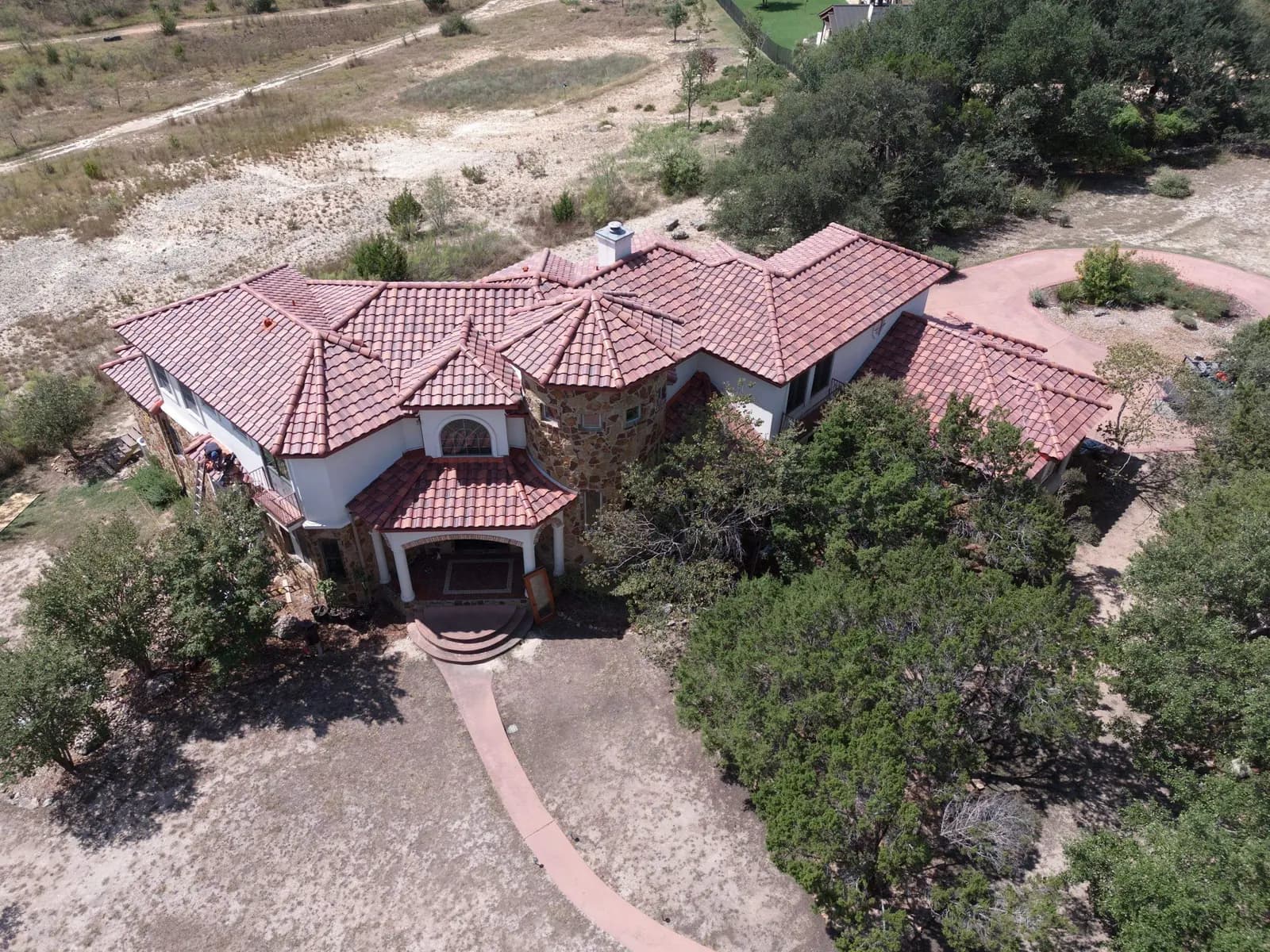
Concrete Tile Roofing in Austin, Texas
Repair, Underlayment Replacement, and Honest Answers for Austin's 90s Tile Neighborhoods
If you own a concrete tile roof in Circle C Ranch, Steiner Ranch, or Avery Ranch, your roof is probably 20 to 30 years old—and the question is rarely "do I need new tile." It is usually cracked tiles after a hailstorm, a leak from underlayment that quietly died beneath perfectly good tile, or a repair quote from a shingle company that does not stock your discontinued profile. Lapeyre Roofing works concrete tile properly: matched repairs, lift-and-relay underlayment replacement, and full replacement only when the math actually says so.
Prefer to book online? Schedule your free Austin estimate
Schedule Your FREE
Roof Inspection & Estimate
Request a written estimate
Where is your property?
We serve Texas, Louisiana & Missouri
What do you need?
Almost done!
How can we reach you?
By submitting, you consent to follow-up messages. Reply STOP to opt out.
Sources we use
Check the scope against current guidance
Official sources reviewed September 7, 2026, plus a planning tool for comparing the decisions in your estimate.
City of Austin
Austin work exempt from building permits
Reviewed September 7, 2026. Check roof-cover exemptions, structural effects, and the Wildland-Urban Interface exception for the actual address.
Read the official guidance →Tile Roofing Industry Alliance
Concrete and clay tile installation guidance
Reviewed September 7, 2026. System installation manuals and manufacturer-specific requirements for concrete and clay tile.
Read the official guidance →How much does a concrete tile roof cost in Austin, TX?
New concrete tile roofing in Austin costs $8 to $18 per square foot installed in 2026—roughly $24,000 to $54,000 for a 3,000 square foot roof. But most concrete tile owners do not need a new roof: individual tile repairs run $450 to $1,200, and a lift-and-relay (new underlayment beneath your existing tile) runs $7 to $12 per square foot—usually the right fix for 1990s-2000s tile roofs that leak under sound tile. Concrete tile lasts 50+ years; the underlayment beneath it lasts 20 to 30, which is why so many Austin tile roofs from the production boom are leaking now despite looking fine from the street.
- New concrete tile installation: $8-$18 per sq ft installed (2026)
- Individual tile repair: $450-$1,200 typical
- Lift-and-relay underlayment replacement: $7-$12 per sq ft
- Concrete tile lasts 50+ years; original underlayment fails at 20-30
- Cracked vs shattered tile matters for hail claims—and matching sun-faded tile is the hard part
Concrete Tile and the Austin Production Boom
Why Austin's Concrete Tile Roofs Are All Hitting Problems at Once
Concrete tile went onto thousands of Austin-area homes during the 1990s-2000s building boom. Those roofs are now 20-30 years old, and they share the same climate history—the same hailstorms, the same UV load, the same underlayment generation. The result is a predictable set of issues arriving neighborhood-wide:
Underlayment Death Under Healthy Tile
Impact: The original felt beneath 1990s-2000s concrete tile was typically a 20-30 year material installed under a 50+ year tile. Two decades of Austin attic heat later, it is brittle and torn—and the roof leaks even though the tile field looks perfect from the street.
Our Solution: Lift-and-relay: remove and stage your existing tile, install modern high-temperature underlayment and new flashings, re-lay the same tile. It reuses the roof's most expensive component and resets the waterproofing for decades at roughly half the cost of full replacement.
Hail: Cracked, Shattered, and the Insurance Line Between
Impact: Central Texas hail cracks and shatters concrete tile several springs out of ten. Insurers distinguish fresh impact damage—clean fractures and shattered tiles on storm-facing slopes—from the age cracking, efflorescence, and surface erosion that 25-year-old concrete tile shows naturally. Getting that distinction wrong sinks claims or invites trouble.
Our Solution: We document tile hail damage the way adjusters evaluate it: impact location and pattern, fracture freshness, slope orientation versus storm path. Legitimate damage gets claim-grade documentation; wear gets an honest maintenance conversation instead of a doomed claim.
Matching Sun-Faded and Discontinued Tile
Impact: Austin UV fades concrete tile's surface color over 20+ years, and many of the manufacturers and profiles installed during the boom no longer exist. A brand-new replacement tile in the "same" color reads as an obvious bright patch on a faded field.
Our Solution: We source boneyard and salvage stock in matching profiles, harvest weathered tile from hidden slopes for visible repairs, and place new stock where it will not be seen. Matching is the real craft in concrete tile repair, and it is why shingle companies quote replacements instead.
Weight on 1990s Tract Framing vs Custom Builds
Impact: Concrete tile runs roughly 800-1,100 lbs per square. Production builders in the 90s framed to the tile spec of the day—usually adequately, but with less margin than engineered custom homes. Sagging ridgelines and deflected rafters occasionally show up where framing was marginal or later modified.
Our Solution: On repairs and relays the load is unchanged and no structural work is needed. Where we see deflection, or when converting a shingle home to tile, we bring in a licensed structural engineer rather than guessing. Lightweight concrete tile lines exist for marginal structures.
Extreme UV, Thermal Cycling, and Surface Erosion
Impact: Austin's 60-80 degree daily swings and 300+ sunny days erode the pigmented surface of concrete tile over decades—fading color and exposing aggregate. This is cosmetic long before it is structural, but it complicates matching and gets misdiagnosed as "failing tile" by companies hunting replacements.
Our Solution: We tell you honestly which you have: cosmetic weathering (live with it, or coat it with correct breathable products if appearance matters) versus actual tile failure (spalling, delamination, widespread cracking) that changes the repair-versus-replace math.
Concrete Tile by Austin Neighborhood
Concrete tile concentrates in Austin's 1990s-2000s master-planned communities, with each area's construction era predicting what its roofs need now:
Circle C Ranch
Southwest Austin master-planned community, largely built 1990s-2000s, with a high concentration of concrete tile on production and semi-custom homes—now 20-30 years old and squarely in the southwest hail arc.
This is ground zero for underlayment aging under sound tile: leaks appearing on roofs that look fine. Hail claims here are common and legitimate—but so are denials when age cracking gets claimed as storm damage. Matching faded 90s profiles takes salvage sourcing.
Steiner Ranch
Hill-country community northwest of Lake Austin, built late 1990s-2010s, with concrete tile on exposed ridgeline homes taking full sun, wind, and hail with little tree cover.
Exposure accelerates everything: surface fade, ridge mortar cracking, wind-loosened rakes and hips. Storm-facing slopes take concentrated hail while sheltered slopes stay clean—which is exactly the case for targeted repair over full replacement, documented slope by slope.
Avery Ranch
Northwest Austin master-planned community built 2000s, with concrete tile mixed among shingle streets. Roofs here are slightly younger—approaching rather than past the underlayment window.
The smart move in Avery Ranch is inspection before failure: catching underlayment decline early keeps repairs localized. Hail on the northwest corridor is the other recurring need, and builder-era flashing shortcuts at chimneys and walls are common leak points.
Shady Hollow and Southwest Legacy Communities
Slightly older southwest neighborhoods, 1980s-1990s, where the earliest generation of Austin concrete tile is now 30-40 years old.
The oldest tile here is at the point where full evaluation matters: some roofs relay beautifully, others have enough tile-level deterioration (spalling, delamination) that replacement math wins. We assess tile condition honestly before recommending either path.
Lakeway and the Lake Travis Corridor
Custom and semi-custom homes with a mix of concrete and clay tile, larger roof areas, complex rooflines, and high-value interiors beneath aging membranes.
Bigger roofs raise the stakes on both leaks and relays—an underlayment failure over a $200K interior is not a wait-and-see item. Mixed tile types on the same street mean identification matters before ordering repair stock.
Concrete Tile Roofing Costs in Austin (2026)
Concrete tile is the affordable end of tile roofing, and repairs are far cheaper than most owners expect. Honest 2026 numbers for Austin:
Individual Tile Replacement
$450 - $1,200
Replacing cracked, shattered, or slipped concrete tiles with matched stock. Cost driven by access, tile count, and how hard your profile is to source.
Localized Underlayment / Flashing Repair
$1,000 - $3,000+
Lifting tile at the failure, replacing the membrane and flashing beneath, re-laying original tile. The correct fix for the classic leak-under-good-tile.
Ridge and Hip Re-Bedding
$1,200 - $4,500
Re-securing ridge and hip tiles loosened by decades of thermal cycling, in mortar or with modern mechanical fastening.
Full Lift-and-Relay (Underlayment Replacement)
$7 - $12 per sq ft
New high-temperature underlayment and flashings beneath your existing tile, broken tiles replaced from matched stock. The signature fix for Austin's 1990s-2000s tile roofs—roughly half the cost of full replacement.
New Concrete Tile Installation / Replacement
$8 - $18 per sq ft installed
Standard-weight concrete tile with proper underlayment and flashing package. Lightweight profiles and upgraded flashing metals adjust the range. Structural verification included where load changes.
Factors Affecting Price
- 1Tile profile availability (discontinued 90s profiles may require salvage sourcing and lead time)
- 2Sun-fade matching strategy (harvesting from hidden slopes adds labor but makes repairs invisible)
- 3How much tile must be lifted and staged (relay pricing is mostly careful labor)
- 4Flashing scope and metal choice (builder-era details usually need rebuilding, not reusing)
- 5Roof pitch, height, and complexity (hips, valleys, and dormers add staging time)
- 6Insurance involvement (hail claims add documentation scope and change payment mechanics)
Ranges reflect 2026 Austin material and labor costs. We provide free inspections and itemized written estimates—and when a $700 repair or a $9-per-foot relay serves you better than an $18-per-foot replacement, that is what we will quote.
How We Work Concrete Tile in Austin
Concrete tile work is careful, sequenced labor. Here is our process from first call to closed-out roof:
Identification and Inspection
First we confirm what is on your roof—concrete versus clay, profile, and manufacturer where determinable—because repair stock depends on it. Then we inspect slope by slope: cracked and slipped tiles, ridge and hip bedding, flashing condition, and underlayment condition at accessible points.
Local Note: In Circle C, Steiner Ranch, and Avery Ranch we already know the common builder profiles and their usual failure points, which shortens diagnosis considerably.
Separate Tile Problems From System Problems
A leak means one of three failures: broken tile, dead underlayment, or failed flashing—at three very different prices. We identify which before quoting. A cracked-tile repair on top of dead underlayment wastes your money, and we will not sell it.
Matching and Sourcing
We source replacement tile from current production, distributor boneyards, and salvage networks carrying discontinued boom-era profiles. For visible slopes on faded roofs, we harvest weathered tile from hidden planes and put new stock where it cannot be seen.
Local Note: Several major 90s tile manufacturers have merged or exited since your roof was built. Matching is a sourcing exercise, and we are upfront about lead times.
Repair Execution
Damaged tiles come out without collateral breakage; replacements install with correct clips, hangers, or fasteners. Underlayment repairs lift the minimum field necessary, rebuild the membrane and flashings, and re-lay original tile in original coursing.
Lift-and-Relay for Roofs That Need a New System, Not New Tile
Full relay: stage the tile, replace underlayment with high-temperature membrane, rebuild flashings, replace the broken percentage from matched stock, re-lay and re-fasten to current wind standards, and rebuild ridges and hips. Your 50-year tile gets a fresh 30-40 year waterproofing system beneath it.
Local Note: On typical 1990s Austin tile roofs we budget for 5-15 percent tile breakage and attrition during a relay—we are honest about that number up front, and sourcing covers it.
Full Replacement When the Math Says So
When tile-level deterioration (spalling, delamination, widespread cracking) makes a relay false economy, we say so and price replacement at $8-$18 per square foot with modern tile, underlayment, and flashings—including structural verification where the load profile changes.
Documentation, Warranty, and the Long Game
Before-and-after photos, itemized scope records, insurance-grade hail documentation when relevant, and a workmanship warranty. We keep your roof's file so the next repair call starts with knowledge instead of a cold inspection.
Materials That Make Concrete Tile Work in Central Texas
The tile is a commodity; the system decisions are where an Austin concrete tile roof succeeds or fails. What we use and why:
Matched Concrete Tile (Current, Boneyard, and Salvage)
Why for Austin
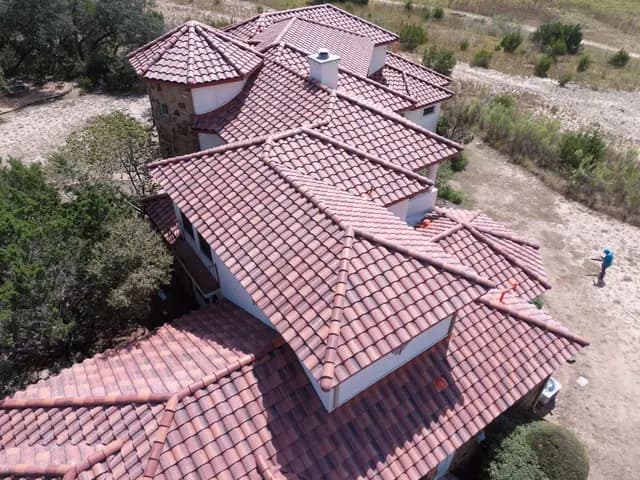
Thousands of Austin roofs carry discontinued boom-era profiles that new production does not match. Our sourcing spans current lines, distributor boneyards, and salvage networks so repairs disappear into the field instead of announcing themselves.
Best For
All repairs and the attrition allowance on relays
Considerations
Even a correct profile in a correct color reads bright against 25 years of sun fade—placement strategy (harvest visible, hide new) matters as much as sourcing.
High-Temperature Self-Adhering Underlayment
Why for Austin
The original felt under Austin's boom-era tile is the single most common failure we find. Modern high-temp membranes are engineered for decades of deck heat under tile—the upgrade that makes a relay worth doing.
Best For
Lift-and-relays, localized underlayment repairs, all new installations
Considerations
This is the actual waterproofing layer. Material cost differences are trivial against the labor of lifting tile—specify the good membrane.
Rebuilt Flashings in Heavy-Gauge Metal or Copper
Why for Austin
Builder-era tile flashings in Austin were usually light galvanized stock, and reusing them under a fresh membrane rebuilds the roof around its weakest part. Heavy-gauge painted metal is our baseline; copper where budget and lifespan goals justify it.
Best For
Valleys, chimney saddles, wall transitions, and penetrations during any relay or repair
Considerations
Tile flashing geometry must fit the profile's water channels—shingle-style details under tile are a recurring leak source we correct.
Mechanical Ridge and Hip Systems
Why for Austin
Mortar-bedded ridges from the 90s crack loose under Central Texas thermal cycling and end up in gutters. Mechanical ridge attachment fastens positively, ventilates the ridge, and does not crumble.
Best For
Ridge and hip work during repairs, re-beds, and relays
Considerations
Ridge ventilation added during a relay meaningfully cools the deck and attic—a free efficiency win while the ridge is open.
Class 3-4 Impact-Rated and Lightweight Concrete Tile
Why for Austin
For replacements in Austin's hail corridors, impact-rated concrete tile lines add real protection and can matter on insurance. Lightweight lines (under 600 lbs per square) solve marginal-framing situations without abandoning tile.
Best For
Full replacements, hail-corridor homes, structures where standard-weight tile is marginal
Considerations
Impact ratings reduce breakage; they do not make tile hail-proof. Tile's honest advantage is repairability—individual tiles replace cleanly when hail wins.
Why Austin Tile Owners Call Lapeyre
Most companies quoting concrete tile in Austin are shingle companies improvising. Our case, honestly stated:
A Genuine Specialty-Roofing Crew
Our slate and tile crews are led by a master craftsman whose portfolio includes university landmarks like SMU and Tulane and hundreds of specialty slate and Ludowici roofs across the country. Tile handling, matching, and tile-correct flashing are this crew's daily work, not an occasional adventure.
Craftsmanship Proven on Harder Roofs Than Yours
Lapeyre restored the slate and copper roof of the Sylvain building in the French Quarter—one of the oldest buildings in New Orleans—plus a portfolio of additional French Quarter slate roofs. That is steep, historic, zero-margin work, and it is the standard we bring to a Circle C relay.
Repair and Relay Before Replacement
Concrete tile's economics favor keeping your tile: repairs in the hundreds, relays at roughly half of replacement. We quote the cheapest option that genuinely fixes the failure—and show you the reasoning.
Matching That Makes Repairs Invisible
Salvage sourcing for discontinued profiles, harvest-and-hide placement for sun-faded fields. A repair you can spot from the curb is a repair done wrong.
Hail Claims Handled Straight
We document real impact damage in adjuster-grade detail and decline to dress up age cracking as storm damage. That reputation is why our legitimate claims get approved.
A Permanent Austin Address
Office at 215 Brazos Street, (512) 877-3087. Tile roofs need a contractor who is still here for the five-tile repair in 2031—not a storm-season phone number.
Separate concrete tile condition from the condition of the roof assembly
Begin with the tile profile, manufacturer if identifiable, attachment, and the location of any leaks. A surface that appears intact does not answer whether underlayment or transition details remain serviceable. Conversely, a few damaged tiles do not prove that the whole system needs replacement. Ask for a written diagnosis and compare localized repair with lifting a section to correct the concealed problem.
Concrete tile replacement requires more than matching color. Confirm dimensions, profile, interlock, exposure, and accessory availability before buying replacement pieces. Where an entire roof is being considered, compare the installed system: structure and deck suitability, underlayment, battens where specified, attachment, valleys, penetrations, edges, and transitions. The Tile Roofing Industry Alliance publishes system installation guidance and advises checking the selected manufacturer's additional requirements. Ask which current details govern the quoted product and property.
In Austin, the address and proposed work determine the approval path. Check City jurisdiction and Wildland-Urban Interface status before assuming the roof-cover exemption applies; structural effects require attention as well. Keep a material change separate from necessary repairs in the estimate. The material selector can organize the reasons for keeping tile or considering an alternative, but it cannot approve roof loading or substitute for a project specification.
Compare your options before signing
Compare roofing material priorities
Organize budget, maintenance, and material tradeoffs before a property-specific specification.
Read more about this roofing decision
Concrete Tile Roofing Texas: Cost
Concrete tile roofing costs $10-$18/sq ft installed and lasts 40-75 years. Compare concrete vs clay tile, see maintenance costs, and learn if tile is right for your Texas home.
Why Austin Roofs Fail Early
Austin roofs face a unique triple threat: extreme thermal cycling, intense UV radiation, and acidic debris from Live Oak trees. Understanding the science helps you choose materials that actually last.
Clay Tile Roof Cost 2026: Real Prices
Clay tile roofing costs $16-$50+ per sq ft installed. Compare Spanish tile, terracotta, and Ludowici prices, 75-100+ year lifespans, and real repair costs.
Slate Roofing Cost 2026: Real Prices
Slate roofing costs $20-$40+ per sq ft installed. Compare natural slate vs synthetic slate prices, lifespans of 100+ years, and repair costs for your home.
FAQ
Frequently Asked Questions
Can a similar-looking concrete tile be used for a repair?
Only after its physical fit and system compatibility are checked. A different interlock or exposure can create a poor repair even when the color looks close. Ask for sample verification before installation.
Should I replace concrete tile just because the underlayment needs work?
Not automatically. Ask whether serviceable tiles can be lifted and relaid, what breakage is expected, which replacement pieces are available, and how that scope compares with a complete new assembly.
How much does concrete tile roof repair cost in Austin?
Individual concrete tile replacement runs $450 to $1,200 in Austin in 2026, depending on access, tile count, and how hard your profile is to source. Localized underlayment or flashing repairs beneath the tile run $1,000 to $3,000+. Ridge and hip re-bedding runs $1,200 to $4,500. Full lift-and-relay underlayment replacement—the fix most aging Austin tile roofs eventually need—runs $7 to $12 per square foot. Inspections and written estimates are free.
My concrete tile roof is 25 years old and leaking. Do I need a new roof?
Probably not a new tile roof. Concrete tile lasts 50+ years, but the original felt underlayment beneath 1990s-2000s tile lasts 20 to 30—so boom-era roofs in Circle C, Steiner Ranch, and Avery Ranch are now leaking under tile that is only halfway through its life. The usual right answer is a lift-and-relay: new high-temperature underlayment and flashings beneath your existing tile, at roughly half the cost of replacement. We confirm your tile is relay-worthy before recommending it.
Will insurance cover hail damage to my concrete tile roof?
If the damage is genuinely from hail, typically yes. The claim turns on distinguishing fresh impact fractures—clean breaks and shattered tiles concentrated on storm-facing slopes—from what 25-year-old concrete tile shows naturally: age cracks, surface erosion, and efflorescence, which are wear and not covered. We document impact patterns slope by slope in the format adjusters expect, support legitimate claims through the process, and tell you honestly when damage will not support a claim.
Can you match my faded or discontinued concrete tile?
Usually. Many boom-era manufacturers and profiles are gone, so we source from distributor boneyards and tile salvage networks that stock discontinued lines. For sun-faded roofs where even a correct new tile would read as a bright patch, we harvest weathered tile from hidden slopes for the visible repair and install new stock where it cannot be seen. When no acceptable match exists, we say so before work starts.
What is a lift-and-relay on a concrete tile roof?
A lift-and-relay removes your existing tile, replaces the failed underlayment and flashings beneath it with modern high-temperature materials, then reinstalls the same tile with broken pieces replaced from matched stock. At $7 to $12 per square foot it costs roughly half of full replacement because the tile—the most expensive component—is reused. Expect a 5-15 percent tile attrition allowance on a typical 90s roof; we budget and source for it up front.
Can my 1990s Austin home handle the weight of concrete tile?
If it already has concrete tile, yes—production builders framed to the tile spec, and repairs or relays do not change the load. The structural question arises when converting a shingle home to tile (concrete runs 800-1,100 lbs per square) or when a roof shows deflection, sagging ridgelines, or evidence of modified framing. In those cases we bring in a licensed structural engineer, and lightweight concrete tile lines under 600 lbs per square cover marginal structures.
How long does a concrete tile roof last in Austin?
The tile itself: 50+ years, often more. Austin's UV fades the surface color over decades and thermal cycling loosens ridge mortar, but neither ends the tile's structural life. The real lifespan driver is the underlayment—20 to 30 years for the felt used during the building boom, 30 to 40 for modern high-temperature membranes. Plan for one underlayment renewal at mid-life and a concrete tile roof outlasts two or three shingle roofs.
Concrete tile vs clay tile for an Austin home—what is the real difference?
Cost, weight, color behavior, and lifespan. Concrete runs $8-$18 per square foot installed versus $16-$50+ for clay. Concrete's surface pigment fades in Texas sun; clay's fired-through color essentially does not. Clay lasts 75-100+ years to concrete's 50+. Both need the same underlayment renewals and both are repairable tile-by-tile after hail. For most production-built Austin homes, concrete is the pragmatic choice; clay earns its premium on architecture and longevity.
Should I have my concrete tile roof coated or sealed?
Rarely. Fading and surface erosion on concrete tile are cosmetic, and most "tile sealing" pitches in Austin sell an appearance treatment as if it were waterproofing—it is not; the underlayment beneath the tile does that job. If restored color matters to you, correct breathable coatings exist and we can discuss them honestly. But if the money is protective, spend it on underlayment and flashing condition, which actually determine whether the roof leaks.
Who repairs concrete tile roofs in Austin?
Fewer companies than the quote volume suggests—many Austin roofers are shingle operations that either decline tile or quote full replacement because they lack matching stock and tile-handling skills. Lapeyre Roofing runs dedicated slate and tile crews led by a master craftsman with hundreds of specialty tile and slate roofs in his career portfolio, operating from 215 Brazos Street in Austin. We handle single-tile repairs, lift-and-relays, and full replacements. (512) 877-3087.
Contact information
Thank you for considering us for roofing needs. We will get back to you during normal business hours.


Send us a message