Siding storm damage is one of the most under-claimed line items on residential policies. Here is the documentation playbook that gets adjusters to scope what is actually damaged — adapted from years of roofing-claim work.
Siding storm damage is one of the most under-scoped line items on residential insurance claims. Adjusters routinely miss hidden hail bruising on vinyl, wind-creased fiber cement, back-side water intrusion, and color-matching issues. The playbook to get a fair scope is the same one we use for roof claims — applied vertically instead of horizontally.
This guide covers the documentation approach, what adjusters miss, and the supplement strategy that gets initial under-scoped estimates corrected.
Starting Point: Same Playbook as Roofs
If you have ever filed a roof storm-damage claim, the siding playbook is familiar:
- Document immediately — photos before any cleanup or temporary repairs
- Tarping for active leaks — keep receipts; tarping cost is reimbursable
- File the claim with the carrier — note storm date and damage type
- Get a contractor inspection before the adjuster arrives — written scope and photos
- Prepare carrier-ready documentation — photos, measurements, material notes, and scope details
- Review the initial estimate — line by line
- Supplement if items are missed — written supplement with photo support
- Approval and repairs — verify scope before work starts
For a deeper dive on the roof side of this same playbook, see our complete guide to roof insurance claims.
What Adjusters Routinely Miss on Siding
Hidden Hail Bruising on Vinyl
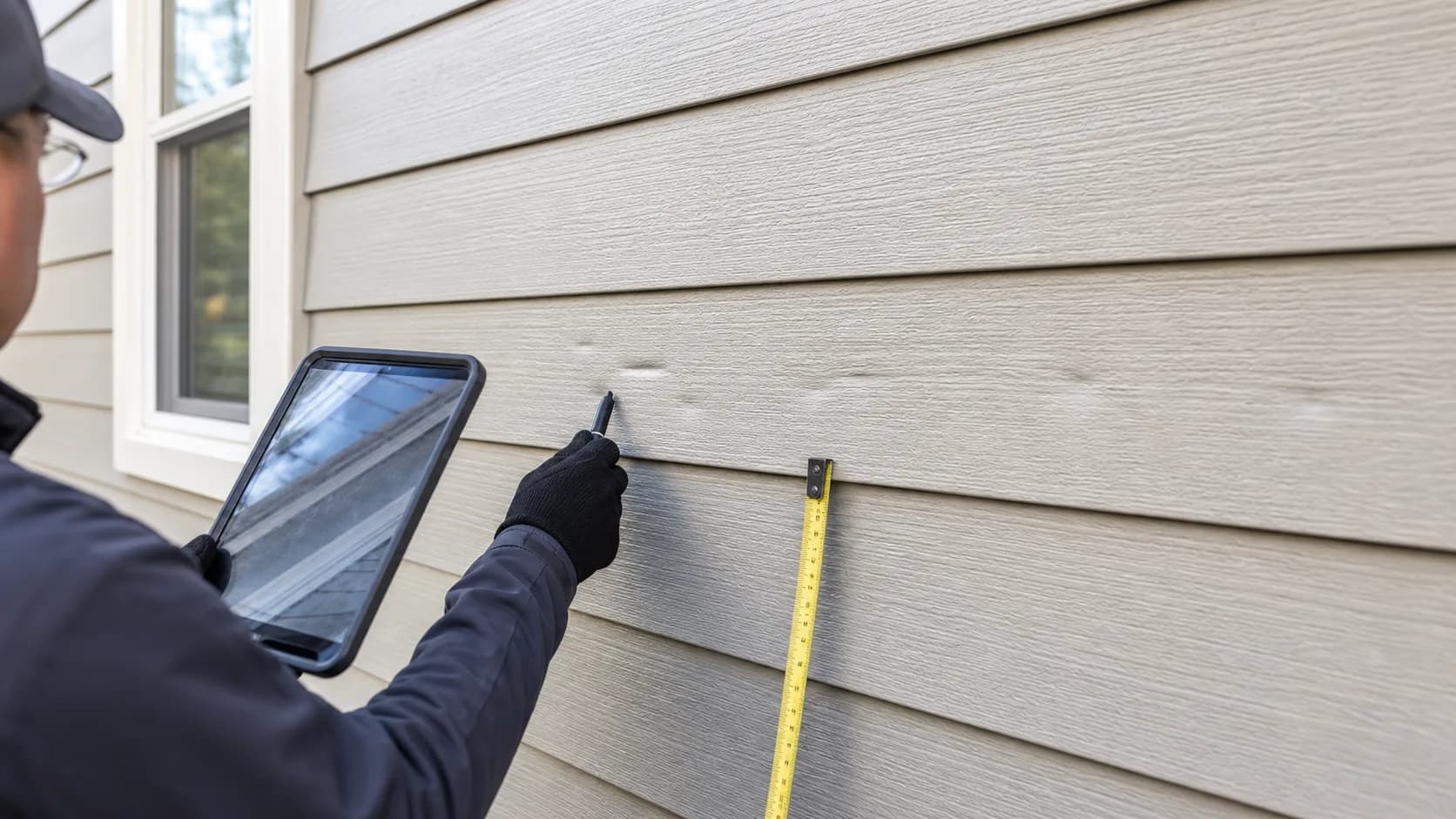
Hail can bruise vinyl panels without leaving a visible dent. The bruise shows up only at oblique angles or under flashlight inspection. Adjusters working from the ground frequently miss this entirely.
How to document: Walk every elevation with a flashlight at oblique angles. Mark bruised panels with chalk during inspection. Photograph the bruise with the flashlight angle. Counts toward the panel-replacement scope, not just spot repair.
Wind-Creased Fiber Cement
Hurricane and severe-thunderstorm wind can crease fiber cement panels along their length. The crease may not be visible until the next freeze-thaw cycle drives water into the substrate and the visible damage appears weeks later.
How to document: Run a hand along each panel's face after a wind event. Hairline cracks become visible at oblique angles. Document early before secondary damage develops.
Back-Side Water Intrusion
Wind-driven rain at fastener penetrations can saturate the back of panels and the WRB. Damage is invisible from the front until panels are pulled.
How to document: Pull a representative panel where back-side intrusion is suspected. Photograph the WRB and substrate. If sheathing damage is found, that adds to the scope significantly.
Soft-Metal Hits Confirming the Storm Event
Dents on vents, flashings, gutters, downspouts, AC condenser fins, and outdoor lighting all help establish the storm impact. They also create water-path issues when metal is deformed.
How to document: Photograph collateral damage on every elevation. Include in the scope when the metal damage is functional rather than purely cosmetic.
Window Components and Trim
Window head flashings, drip caps, sills, and surrounding trim are part of the wall system. Storm damage to these components frequently gets lumped into the siding claim and missed.
How to document: Walk window-by-window. Check head flashing for dent damage. Check drip caps for separation. Trim damage and flashing damage are part of the storm scope.
Documentation That Holds Up
The documentation that gets carriers to scope correctly:
- High-resolution photos at multiple angles per damaged area
- Slope-by-slope inventory — every elevation walked, every damage area logged
- Panel-by-panel for vinyl — vinyl cracks are panel-specific, requiring panel replacement scope
- Storm-event date documented (NWS storm reports, NOAA SPC database, local news coverage)
- Wind-speed verification for hurricane and severe-thunderstorm claims (NWS reports for the address)
- Pre-loss material spec documented from any preserved manufacturer marking, NFRC label remnants, or material samples
- Written scope that matches what insurance carriers expect to see (line-item breakdowns by elevation)
Color Matching as a Covered Issue
One of the most overlooked aspects of siding claims: color matching. UV fade is uneven across years of weather exposure. A new panel rarely matches siding that has been in service for 5+ years. Most homeowners policies include "matching" coverage that requires the carrier to fund full-elevation replacement when partial replacement leaves visibly mismatched panels.
How to argue matching:
- Document existing fade pattern with photos from multiple angles and lighting conditions
- Reference the policy "matching" language directly
- For ColorPlus or ExpertFinish factory-finished products, cite the factory color discontinuation if the original color is no longer available
- For vinyl, cite UV fade unevenness — premium grades show this less than standard but it always exists after 5+ years
Matching is one of the most-claimed and most-undercoded items on siding storm claims. The full-elevation replacement scope is often two to four times the cost of spot panel replacement.
RCV vs ACV: What to Verify
Two cost-recovery models matter:
- Replacement Cost Value (RCV) — pays the full cost to replace damaged property at current prices, minus depreciation initially. Recoverable depreciation pays out after replacement is complete.
- Actual Cash Value (ACV) — pays the depreciated value only. Original cost minus age-based depreciation.
Most modern homeowners policies are RCV by default. Some legacy policies are ACV-only. Verify your policy before the claim. RCV with recoverable depreciation produces meaningfully better outcomes on storm-damage claims for older siding.
Supplement Strategy
The initial adjuster estimate often misses items. The supplement process formally requests additional scope:
- Compare the initial estimate to the documented damage line by line
- Identify missing line items (panels, trim, color match, soft metal, sheathing)
- Write a supplement letter with photo support and line-item pricing
- Submit to the carrier with a defined response window
- Follow up if the response is delayed
- Escalate to a public adjuster or Department of Insurance complaint if necessary
Most supplements get approved when they are well-documented. The strategy is the same one that works for roof claims — siding just adds the matching argument and panel-by-panel detail to the documentation.
Red Flags to Avoid
- Storm-chasing contractors who appear after a storm with door-to-door pressure tactics
- Contractors offering to "waive your deductible" — illegal in most states; a sign of insurance fraud
- Verbal-only damage assessments — get written scopes
- Contractors who skip the WRB and flashing inspection — they will miss back-side damage
- Initial adjuster estimates with no panel-replacement detail — incomplete scopes that need supplements
- Missing pre-loss material spec verification — the carrier needs to know what was there before the storm to write the right replacement scope
Frequently Asked Questions
Common questions
Frequently asked
When the cause is a covered peril (wind, hail, wind-driven debris, falling tree), most policies cover the damage. The challenge is documentation — adjusters routinely under-scope the actual damage. Hidden vinyl bruising, wind-creased fiber cement, color-match issues, and back-side water intrusion are commonly missed. Documenting slope-by-slope and panel-by-panel and supplementing when initial estimates miss damage is the difference between a claim that covers actual scope and one that under-scopes.

Founder of Lapeyre Roofing, continuing a family legacy in Louisiana since 1699. Licensed in Louisiana, GAF Certified, and FORTIFIED Roofing specialist serving Texas and Louisiana.